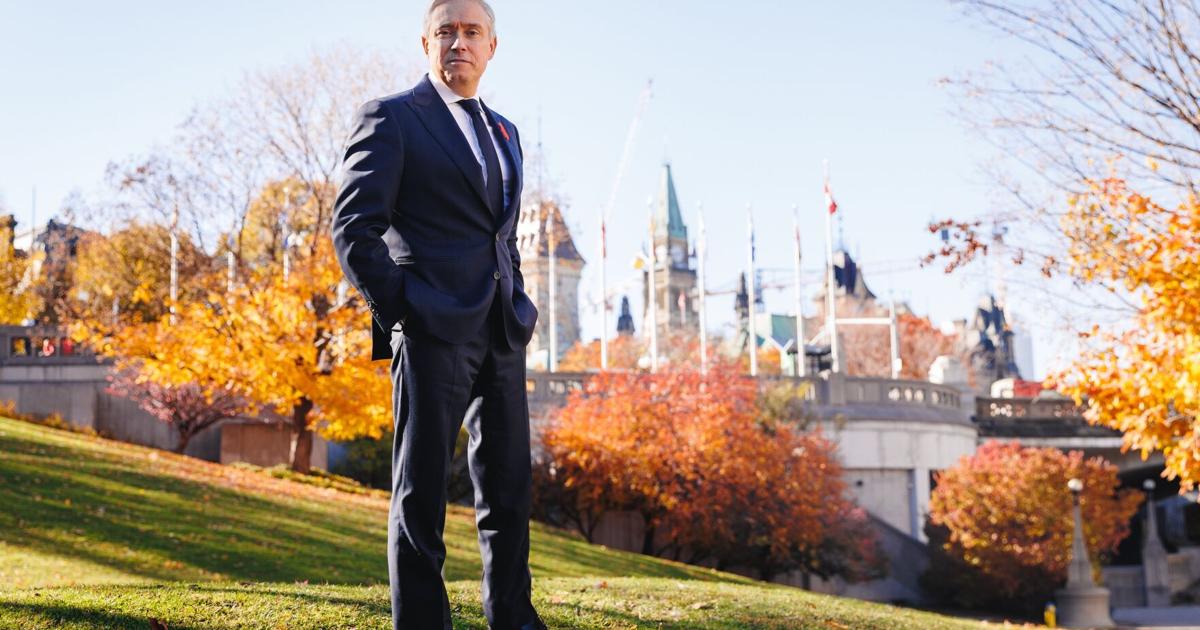
Mark Carney's quiet revolution rests on investment and affordability
asserted
revolution → rest → investment
Can the Liberal government master its economic strategy?
asserted
government → master → strategy
"Maitre chez nous" — "master in our own house" — was a rallying cry of Jean Lesage's Quiet Revolution, a period of rapid modernization and reform in Quebec in the 1960s.
asserted
nous → rally → 1960s
Mark Carney first tried it out a year and a half ago in the shadow of Donald Trump's America and a newly anglicized version — "masters of our destiny" — adorns the Carney government's second budget.
asserted
version → try → budget
"The moment in front of us is serious," Finance Minister François Philippe-Champagne said in presenting the budget on Thursday.
asserted
Champagne → say → Thursday
"The moment demands an ambitious plan to be masters of our destiny; to be maîtres chez nous."
asserted
moment → demand → destiny
Carney has never claimed to be a revolutionary.
asserted
Carney → claim → ?
Champagne's suggestion earlier this week that this week's budget was about "changing Canada's growth model" is perhaps as close as the Carney government will come to declaring a rousing overthrow of the old order.
asserted
government → change → order
But perhaps the Carney government's second budget can be said to be another step in the prime minister's own version of a quiet revolution.
asserted
budget → say → revolution
7 takeaways from the Carney government's 2nd budget
Canada's new budget proposes $5B for culture.
asserted
budget → propose → culture
Here's where it would go
Budget offers $50B jolt to help Canada double its electricity grid
The primary front in the revolution remains that "growth model."
asserted
front → go → revolution
The single largest line item in this budget is the "productivity mega-deduction," a previously announced measure that cuts the effective tax rate on new business investment.
asserted
that → announce → investment
Over the next five years it is expected to cost the federal treasury approximately $36 billion, a quarter of all new spending in the budget.
asserted
it → expect → budget
Paired with a new capital-gains exemption for entrepreneurs, the government hopes the "mega-deduction" will kickstart an "investment supercycle."
asserted
deduction → pair → supercycle
Nearly $9 billion is set aside for boosting the deployment of clean electricity — the backbone of Carney's climate agenda — and there is a commitment to work with provinces to provide further financing going forward.
asserted
billion → set → financing
Over $2 billion is set aside for transforming the forestry sector, and $1.7 billion for the development of critical minerals.
asserted
billion → set → minerals
The government will fully fund and construct the Mackenzie Valley Highway project in the Northwest Territories and support two hydro projects in the Yukon.
asserted
government → fund → Yukon
It is moving forward with plans to privatize some of the operations of Canada's biggest airports and it will begin inviting Canadians to invest in a new sovereign wealth fund.
asserted
it → move → fund
This is the continuation of an agenda that champions the ideas of investment and building things — a tonal and now fiscal shift away from the Trudeau era.
asserted
that → champion → era
However much this might amount to a revolution, it is also a long-term plan that may only start to be felt in the medium term.
uncertain
that → amount → term
In the meantime, the short term cries out for attention.
asserted
term → cry → attention
Wrestling with affordability
To the affordability concerns that may define this moment as much as the geopolitical upheaval, the Carney government's latest response includes enhancing both the groceries and essentials benefit (previously known as the GST benefit) and the workers benefit (an income-based tax credit), two policy changes that will particularly benefit low-income households.
uncertain
that → wrestle → households
Those two policies will cost $6.7 billion.
asserted
policies → cost → billion
A previously announced suspension of the federal gas tax is projected to cost another $2.9 billion.
asserted
suspension → announce → billion
The Carney government is setting a goal of eliminating homelessness over the next decade and is putting $11.2 billion over the next five years toward that goal.
asserted
government → set → goal
New funds are also being put toward affordable housing and using federal land to build more homes — a lack of new housing construction remains one of the government's most acute vulnerabilities.
asserted
lack → put → vulnerabilities
Though it might make fewer headlines, the budget also includes $26 billion over five years for housing, infrastructure and social supports in Indigenous communities.
uncertain
budget → make → communities
Looming over all such new expenditures are the ever-lingering questions about the sustainability of the federal government's balance sheet.
asserted
questions → loom → sheet
Fretting about the fiscal framework
Due to higher oil prices, the federal government managed to record a lower-than-projected deficit for the last fiscal year and it has also managed to avoid projecting higher deficits for the next four years than it had in the spring.
asserted
it → fret → spring
The debt-to-GDP ratio — the size of the federal debt when measured against the size of the Canadian economy — is now projected to settle in around 40 per cent, three points lower than what the Carney government predicted a year ago.
asserted
government → measure → what
In that sense, it might vaguely claim to have held its widely drawn line on the deficit.
uncertain
it → claim → deficit
But the federal government still shows a deficit of $53.4 billion in 2029.
asserted
government → show → 2029
And the cost of servicing the federal debt is now showing the sorts of big numbers — $78.4 billion in 2029 — that tend to attract attention.
asserted
that → service → attention
"This budget would be better titled, 'masters of increasing debt and interest payments,'" Michael Chong, the Conservative finance critic, charged after Champagne had concluded delivering the budget.
asserted
Champagne → title → budget
"The budget fails to establish a credible fiscal anchor to reduce the debt and balance the budget."
asserted
budget → fail → budget
The Carney government argues it has reduced the cost of government operations such that the borrowing it is doing will be put toward "capital" spending — building the sorts of things that should grow the economy.
asserted
that → argue → economy
(The parliamentary budget officer has quibbled with the government's methodology.)
asserted
officer → quibble → methodology
The cost of servicing the debt also doesn't look like a crisis when measured against the economy.
asserted
cost → service → economy
And it remains much lower than it was when Canada experienced a real fiscal crisis in the mid-1990s (when it peaked at 6.5 per cent).
asserted
it → remain → cent
In the long term, the federal government might face real fiscal questions, particularly as defence spending is projected to increase.
uncertain
spending → face → questions
…and 11 more, not listed.
 The Aporia