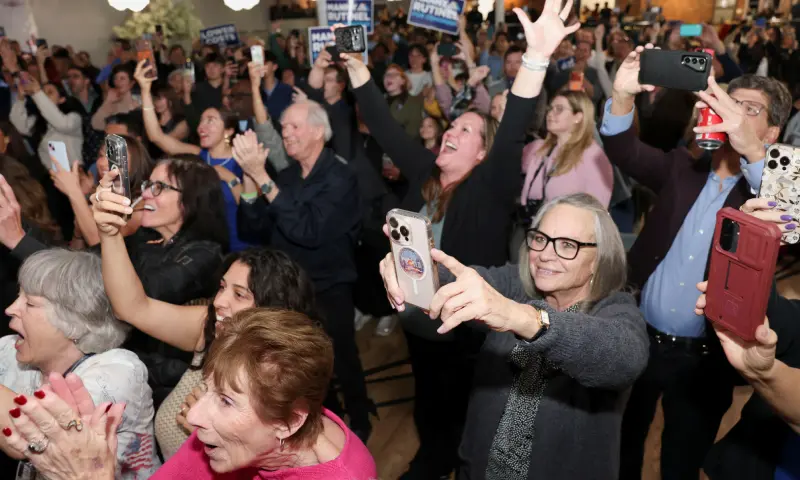
On November 4, the Democrats won the most decisive victory in the midterm elections since 1976, with The New York Times projections showing that the Democrats could win the national popular vote for the House of Representatives by almost 13%.
uncertain
Democrats → win → %
This spectacular shift in the mood of the American electorate within two years could have consequential implications in Washington, as President Donald Trump faces the grim reality of spending the rest of his term as a lame-duck President.
uncertain
Trump → have → President
A day before the polls opened, Mr. Trump released his own report card, claiming that he had kept all 127 campaign promises he had made before he was elected.
asserted
he → open → promises
Not only was he unable to convince the American electorate of his “achievements”, the midterm election results are also being interpreted as a repudiation of his policies.
Imposition of ‘America First’
Mr. Trump received a mandate to govern the U.S. for a second time in 2024 as a faltering Joe Biden Administration struggled to put the world’s largest economy back on track after the pandemic-induced crisis.
asserted
Administration → convince → crisis
Mr. Trump read this mandate as a vindication of the aggressive unilateral policies he had adopted in his first term, as he adopted the ‘America First’ trade policy, giving his administration sweeping powers to act against any country perceived to be pursuing unfair trade practices against the U.S.
asserted
he → read → U.S.
Mr. Trump used his trade policy to impose reciprocal tariffs on 157 countries in July 2025.
asserted
Trump → use → July
Several countries faced significantly higher tariffs and Indian exports faced punishing tariffs of 50% for importing Russian oil, even when it was negotiating a bilateral free trade agreement with the U.S.
Higher tariffs caused significant disruptions in the U.S. through elevated levels of inflation and slowing growth due to higher import bills.
A significant ruling by the U.S. Supreme Court that the reciprocal tariff was illegal spared the economy from an impending catastrophe.
asserted
tariff → face → catastrophe
But within days of this ruling, Mr. Trump launched his damaging war on Iran.
asserted
Trump → launch → Iran
The direct consequences of the war were felt in the supplies of oil and gas, and its indirect impact on the downstream industries and supply chains adversely affected the global economy.
asserted
impact → feel → economy
U.S. households bore the brunt of Mr. Trump’s Iran war, with costs increasing to $2,000 per household, absorbing about half the average American household’s income gain, according to one estimate.
uncertain
costs → bear → estimate
After remaining in denial about the impact his decision to attack Iran would have on his political future, Mr. Trump finally admitted, as the midterm election results were coming in, that the war had contributed to Republican losses in the midterms but insisted he would launch the military campaign again.
asserted
he → remain → campaign
The U.S. electorate has given the Democrats massive control over the U.S. Congress, hoping that they can prevent Mr. Trump from further damaging the country’s economy and polity.
asserted
they → give → economy
But questions have already arisen about whether they can do so, as he has threatened to use his veto against any decision that the Congress may take.
uncertain
Congress → arise → that
Democrats could now exercise their dominant presence in the Congress to control Mr. Trump primarily through the constitutional “power of the purse”.
uncertain
Democrats → exercise → purse
The U.S. Constitution states, “No Money shall be drawn from the Treasury, but in Consequence of Appropriations made by Law”, and the U.S. Supreme Court clarified that the rule of law directs “that no money can be paid out of the Treasury unless it has been appropriated by an act of Congress”.
asserted
it → state → Congress
Further, a “regular Statement and Account of the Receipts and Expenditures of all public Money shall be published from time to time”; in other words, the Congress must mandatorily perform “oversight” functions.
asserted
Congress → publish → functions
The ability of the Democratic Congress to perform its “oversight” functions would hold the key to ensuring that Mr. Trump and his administration are prevented from continuing to cause chaos and disorder, the adverse implications of which have been felt globally.
asserted
implications → perform → which
A major task before the Democrats would be to restrain President Trump’s penchant for across-the-board use of tariffs to address his concerns not just regarding the U.S. economy but those in the realm of geopolitics as well.
asserted
task → restrain → geopolitics
The Congress would have to use its constitutional powers to impose tariffs and regulate trade with foreign nations.
asserted
Congress → have → nations
Periodically, the Congress has “legislated authorities and procedures to signal to trading partners that trade agreements negotiated by the President will be implemented or voted upon”.
asserted
agreements → have → President
Commonly known as the Trade Promotion Authority (TPA), these laws virtually dictate the agreements the President can negotiate and the tariffs he can impose.
asserted
he → know → agreements
The last TPA was enacted in 2015 and it expired in 2021.
asserted
it → enact → 2021
One of the first tasks for the Democratic Congress would, therefore, be to enact a TPA to rein in Mr. Trump.
asserted
One → enact → Trump
What the shift means for India
What could be the likely implications of this seismic shift in Washington on India?
uncertain
implications → mean → India
One would expect that New Delhi would find it easier to engage with a weakened Trump administration, especially in its ongoing engagements to finalise the bilateral free trade agreement.
asserted
it → expect → agreement
The Indian government has insisted on a balanced agreement, but two unreasonable sets of demands from the U.S. have been constant sources of consternation.
asserted
sets → insist → consternation
One, the Trump Administration has pushed for opening India’s markets for major cereals and dairy products, and two, the country’s generic pharmaceutical companies have been threatened with higher tariffs unless they invest in the U.S.
asserted
they → push → U.S.
Indian stakeholders would hope the Government of India would be able to utilise the political change ushered in by the U.S. electorate to ensure a better deal for them.
asserted
Government → hope → them
 The Aporia