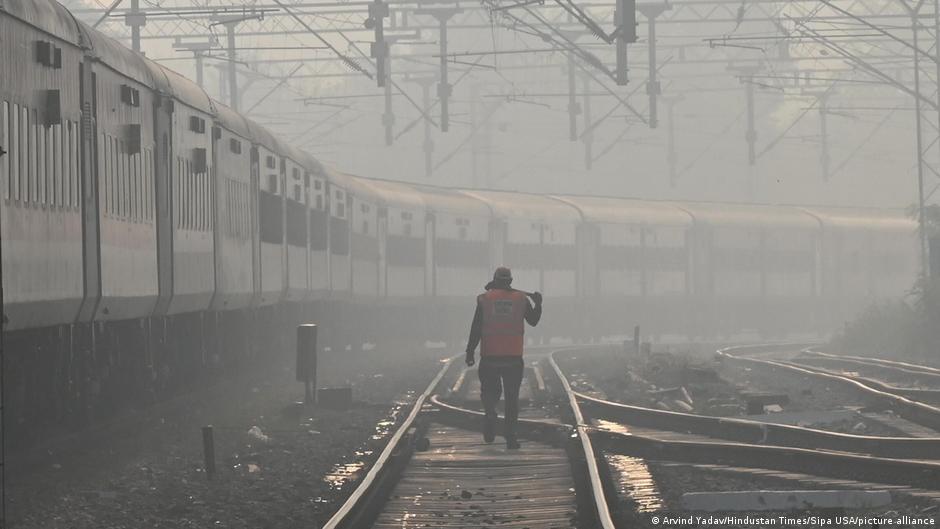
On a slightly chilly and distinctly smoggy morning in New Delhi, Khushboo Arora was looking for another air purifier for her mother, who has underlying health complications, before the city's air quality deteriorated further.
asserted
quality → look → complications
"Already, I am starting to get a recurring headache," she said.
asserted
she → start → headache
"These days when I wake up, I don't feel fresh.
asserted
I → wake → ?
As the day progresses, I feel a heaviness in my head, itching in my eye and a constantly parched throat.
asserted
I → progress → eye
Not too long ago, the unpacking of woolens announced the advent of winter in Delhi.
asserted
unpacking → announce → Delhi
Arora said she has already stopped doing yoga in the park and taking her morning walks.
asserted
she → say → walks
She has also filled her house with air-purifying plants and started spraying water mist inside the house to bring down the level of pollution.
asserted
She → fill → pollution
"My parents look at me like I have gone mad.
asserted
I → look → me
But I feel people are not realizing the gravity of the situation," she said.
asserted
she → feel → situation
A recurring crisis
Winters in Delhi increasingly follow a familiar pattern: Air quality deteriorates, residents struggle to breathe, emergency restrictions kick in and governments exchange blame.
asserted
governments → recur → blame
Then the season changes, only for the cycle to repeat the following year.
asserted
cycle → change → ?
On Thursday, Delhi's air fell into the "Very unhealthy" category, according to Swiss air quality monitor IQAir, with an average PM2.5 concentration of 157.9 micrograms per cubic meter of air.
uncertain
air → fall → air
The World Health Organization (WHO) recommends an annual safe limit of no more than 5 micrograms.
asserted
Organization → recommend → micrograms
Studies have shown that exposure to PM2.5 — air particles with a diameter smaller than 2.5 micrometers that can penetrate deep into the lungs and enter the bloodstream — is associated with an increased incidence of head and neck cancer (HNC), like oral, nasal and throat cancers.
asserted
that → show → cancers
But despite years of attempted interventions, India's capital continues to struggle with the same pollution crisis.
asserted
capital → attempt → crisis
What is causing the air pollution?
asserted
What → cause → pollution
Delhi is not dealing with an unknown problem.
asserted
Delhi → deal → problem
A 2026 assessment by an expert panel reviewed by the Delhi government identified the major winter contributors of PM2.5 as vehicular emissions, industrial activity, road and construction dust, biomass and waste burning, and pollution from neighboring regions.
asserted
assessment → review → regions
Sunil Dahiya, founder of the environmental group EnviroCatalysts, said Delhi is part of a larger airshed.
asserted
Delhi → say → airshed
On most winter days, more pollution comes into Delhi than is generated inside it, according to the environmentalist.
uncertain
pollution → come → environmentalist
"Analysis of the government's Decision Support System (DSS) data for winter 2025 found that around 65% of Delhi's PM2.5 came from outside the city and about 35% from sources within it," he told DW, adding that neighboring Noida and Gurugram, which comprise the National Capital Region (NCR), are some of the biggest contributors.
asserted
which → find → contributors
Coordinating action across the NCR, which spans Delhi and parts of three neighboring states, remains a major obstacle.
asserted
which → coordinate → states
"This is a shared problem, and no single city can solve it alone," Dahiya said.
asserted
Dahiya → share → it
Why aren't anti-pollution policies working?
asserted
policies → work → ?
To understand why existing policies have not delivered sustained improvements, Dahiya highlighted the gap between scientific recommendations and state action.
asserted
Dahiya → understand → recommendations
"Scientists have said for over a decade that we need airshed-wide, year-round, source-specific action.
asserted
we → say → action
What we mostly get is seasonal and reactive," he said.
asserted
he → get → What
According to the environmentalist, emergency restrictions kick in only after pollution has reached dangerous levels.
uncertain
pollution → accord → levels
Short-term measures such as water sprinklers and smog towers provide little relief, while bigger structural changes are slow to materialize.
asserted
changes → provide → relief
These include stricter enforcement of industrial emissions, cleaner fuels, expanded public transport, vehicle electrification and viable alternatives to crop burning for farmers.
asserted
These → include → farmers
Implementation, regional coordination and political will are," said Dahiya.
asserted
Dahiya → say → ?
"Until targets are tied to emission reductions at each source, and someone is held accountable for meeting them, we will keep having the same conversation every November."
asserted
we → tie → conversation
Bhavreen Kandhari, co-founder of Warrior Moms, agrees that official responses focus on reacting rather than preventing.
asserted
responses → agree → Moms
"They allow pollution to occur and then try to clean it up — producing nice photo opportunities of water sprinklers and smog guns, or talking about cloud seeding," Kandhari told DW.
asserted
Kandhari → allow → DW
"Creating pollution only to clean it up later is a waste of public funds, time, and health."
asserted
Creating → create → funds
Kandhari also added that incinerating waste instead of proper waste management has only exacerbated the situation.
asserted
incinerating → add → situation
Another obstacle to a lasting solution has been the political blame game that starts as soon as the air quality worsens.
asserted
quality → last → solution
On Thursday, Delhi Environment Minister Manjinder Singh Sirsa said stubble-burning in the neighboring state of Punjab is contributing to the capital's rising pollution, according to public broadcaster All India Radio.
uncertain
burning → say → Radio
He insisted that in Delhi, construction, vehicle and industrial sources were controlled.
asserted
sources → insist → Delhi
Dahiya agreed that seasonal crop-burning fires in neighboring states of Punjab and Haryana "is an episodic but sharp contributor" which "can tip 'very poor' air into 'severe'" for a few weeks.
asserted
which → agree → weeks
…and 18 more, not listed.
 The Aporia