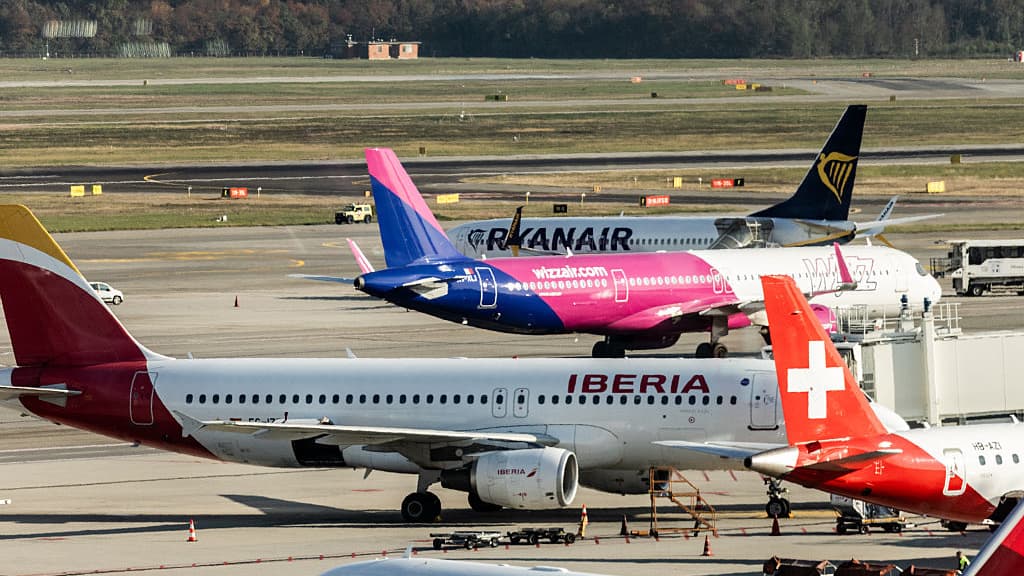
A wave of bomb threats this week targeted dozens of flights across Europe before expanding to include newsrooms, leaving authorities scrambling to find those responsible.
asserted
wave → target → those
The bomb threats—all ultimately identified as hoaxes—came through almost daily via anonymous calls and emails beginning Nov. 2.
asserted
all → identify → Nov.
On Monday, a Wizz Air flight traveling from London to Bulgaria was diverted after a bomb threat was received mid-flight, making an emergency landing in Budapest.
asserted
threat → travel → Budapest
At least seven passenger flights were targeted the following day, which led to emergency landings, searches, and diversions.
asserted
which → target → landings
More than two dozen additional flights were targeted Thursday, and threats continued into Friday.
asserted
threats → target → Friday
Affected flights connected countries including Italy, Ireland, Spain, Bulgaria, Romania, Poland, Finland, Austria, Denmark, Belgium, Portugal, France, Greece, Serbia, Czechia, and the United Kingdom.
asserted
flights → connect → Italy
Authorities, including the U.K. Transport Secretary, have since described them as “hoaxes,” as no attacks were carried out and each affected flight was landed safely.
asserted
flight → include → hoaxes
But the hoaxes were not harmless; they affected thousands of people’s flight plans, struck fear into potential travelers, and impacted the carefully structured aviation ecosystem.
asserted
they → affect → ecosystem
The malicious efforts expanded Friday when a warning was sent by email to several European broadcasters claiming that bombs had been planted in their buildings, forcing evacuations at outlets like Sky News, Bulgaria’s Nova TV, and Irish public broadcaster RTÉ.
“What happened this week is just a small part of what awaits Europe in the near future,” the message sent to broadcasters said, according to Reuters.
uncertain
message → expand → Reuters
European Union Transport Commissioner Apostolos Tzitzikostas strongly condemned the threats on X on Friday, saying that he has activated EU-level aviation security information-sharing mechanisms.
asserted
he → condemn → mechanisms
He added that it was “too early” to draw conclusions on whether the hoaxes were linked.
asserted
hoaxes → add → conclusions
Ireland’s government, meanwhile, said Friday that “it seems likely that this is a co-ordinated campaign of disruption.”
asserted
this → say → disruption
Experts tell TIME that the threats themselves might be the point—launching a fear campaign meant to disrupt systems and put millions of people on edge.
uncertain
threats → tell → edge
Elisabeth Braw, a senior fellow at the Atlantic Council, which is a nonpartisan think tank for global affairs based in D.C., says that these kinds of threats fall into what she calls “gray zone conflicts,” meaning that they’re “in the gray zone between war and peace.”
asserted
they → base → war
For example, Italian Prime Minister Giorgia Meloni told an Italian news station on Friday that “what’s being attacked is civilian infrastructure,” rather than military or weapons infrastructure.
asserted
attacked → tell → Friday
This puts European nations in a tight spot, Braw says, especially if the actor is another nation.
asserted
actor → put → spot
“If you attack another country's military, that country's military will strike back.
asserted
military → attack → military
That is the nature of war,” she explains.
asserted
she → explain → war
“Whereas if you target civilian infrastructure, what is that country going to do?
asserted
country → target → what
It’s not going to respond with military means, simply because then you would have war.”
asserted
you → go → war
Bomb threats against airliners are not new, Braw says, but their scale and frequency this week stand out.
asserted
scale → say → airliners
“What is concerning this time is it's such a significant number, and the fact that these have come in such close succession, and it comes against the background of all these other attacks and really geopolitically motivated crimes targeting European countries,” Braw adds, referencing another destabilization operation that recently hit Europe.
asserted
that → concern → Europe
Cyberattacks targeted refrigeration systems at grocery stores in at least nine countries across Europe and at blood banks in France, following similar attacks on French supermarkets in mid-October.
asserted
Cyberattacks → target → October
Two pro-Russian hacktivist groups claimed responsibility for the cyberattack campaign on supermarkets Wednesday, though their involvement remains unconfirmed.
Kremlin Spokesperson Dmitry Peskov distanced the Russian government from the cyberattacks on Thursday, calling any allegations “absurd” and “unfounded.”
Robert Jordan, a program director at the Royal United Services Institute, tells TIME that it might be “tempting” to ascribe the threats to hostile states like Russia.
uncertain
it → claim → Russia
“Certainly there are well-founded instances of Russian and Iranian groups recruiting people online using secure communications applications to conduct similar activity,” he says.
asserted
he → be → activity
At the same time, he continues, there is no way yet to discount that this is an individual or non-state-affiliated group exploiting safety standards in the region to “cause chaos.”
asserted
this → continue → chaos
Before the parties responsible can be ascertained, or their motives investigated, security personnel must identify where these threats are originating from, he says.
asserted
he → ascertain → where
Until they do, disruptions to airports are likely to continue, Jordan says.
asserted
Jordan → do → airports
Even suspected hoaxes demand serious consideration, Braw adds, given the potentially devastating consequences of a real attack.
asserted
Braw → suspect → attack
“You have to take every threat seriously in the sector, but especially in aviation, where the consequences would be so utterly devastating if an incident were successful, and so that's why we have seen all these airliners making emergency landings,” she says.
asserted
she → have → landings
“All of that causes disruption and it causes anxiety among passengers, and it also causes significant financial costs and losses for the airlines.
asserted
it → cause → airlines
French prosecutors are investigating whether foreign powers are connected to the bomb threats, Agence France-Presse (AFP) reported Saturday.
asserted
Presse → investigate → threats
The purpose of the investigation is to find “the authors of the emails who disseminated this false information ... and to determine any potential links they may have to foreign powers,” the Paris prosecutor’s office is quoted as saying.
uncertain
office → find → powers
Some of the emails were signed "fighters of the Male State," which matches the name of a radical misogynist group in Russia, though there has been no confirmed link, according to AFP.
uncertain
which → sign → AFP
The group's founder, Vladislav Pozdniakov, denied any involvement, saying on social media Friday that the "movement does not exist since 2021.
asserted
movement → deny → 2021
"
“Identifying who is doing this will rapidly be escalating up the priority ladder for law enforcement and security services across Europe,” Jordan says.
asserted
Jordan → identify → Europe
“In the meantime, it is likely that airlines and airports will be meeting to determine how much extra screening scrutiny the system can bear.”
asserted
system → meet → scrutiny
Even after learning who made the bomb threats, European nations might not be any closer to knowing how to respond to similar hybrid attacks in the future, Braw says.
uncertain
Braw → learn → future
“As a law-abiding democracy, you can't say, ‘Well, if they threaten our airlines, we will threaten them.’
asserted
we → abide → them
That’s not how democracies operate,” Braw says.
asserted
Braw → ’ → ?
…and 2 more, not listed.
 The Aporia