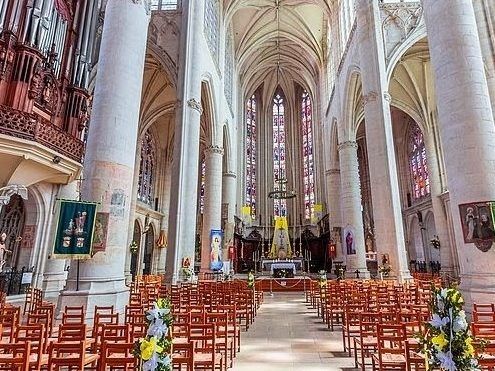
Photo via Daily Mail

Sacred bones of saint who inspired Santa Claus destroyed in church raid just before Christmas

Read the original at Daily Mail ↗
Cite

Liberatore, S. (2026, November 9). Sacred bones of saint who inspired Santa Claus destroyed in church raid just before Christmas. Daily Mail. https://www.dailymail.com/sciencetech/article-16278343/saint-nicholas-relics-destroyed-france.html?ns_mchannel=rss&ns_campaign=1490&ito=1490

Dated from the outlet's own feed. Check the original for its byline.

Daily Mail · collected 2026-11-09 · by Stacy Liberatore

Quick Summary

A reliquary containing bone fragments believed to be Saint Nicolas's was stolen from Saint Nicolas de Port church in France on November 2. The thief broke into the display case, burned, and crushed the relic before police identified and arrested him. This act is considered a significant attack on religious heritage, coming just weeks before the Feast of Saint Nicolas, which celebrates the saint’s legacy of charity and generosity.
Written by AI on 2026-11-10, from this article's own text only (the story summary below draws on all the coverage).
See how they differ ↓

AI analysis

Story summary

French police arrested a suspect who stole and destroyed bone fragments attributed to St. Nicholas, the historical figure who inspired Santa Claus, from the Basilica of Saint-Nicolas-de-Port in Lorraine on October 28, 2026. The theft was reported by parish priests at Dombasle-sur-Meurthe police station on November 2. According to reports, the suspect admitted to smashing and burning the remains out of a desire to destroy what he perceived as idol worship. This act occurred just weeks before the Feast of Saint Nicholas on December 6, deeply impacting local heritage and faith communities. The relic held significant historical value beyond its religious importance, touching upon the devotion of generations of pilgrims.

Written for “Saint Nicholas Bones Theft Destruction” on 2026-11-14, grounded in this article and the 2 other(s) covering the same event.

How they differ

3 outlets covered “Saint Nicholas Bones Theft Destruction”.

What each outlet says

One AI summary per outlet of its latest article on this story, written from that article alone and checked against it. Open the article for the outlet's own words.

Daily MailThis outlet9 Nov

A reliquary containing bone fragments believed to be Saint Nicolas's was stolen from Saint Nicolas de Port church in France on November 2. The thief broke into the display case, burned, and crushed the relic before police identified and arrested him. This act is considered a significant attack on religious heritage, coming just weeks before the Feast of Saint Nicolas, which celebrates the saint’s legacy of charity…

Sacred bones of saint who inspired Santa Claus destroyed in church raid just before Christmas (this article)
Daily Caller9 Nov

French police have arrested a suspect who allegedly stole and destroyed the bones of Saint Nicholas from the Basilica of Saint-Nicolas-de-Port in Dombasle-sur-Meurthe, Lorraine, on October 28. The suspect reportedly smashed the protective case containing the relics, burned, and crushed the remains, driven by what he called a "desire to destroy." Appearing before the Judicial Court of Nancy, the suspect underwent a…

Police Capture Thief Who Stole, Then Destroyed Bones Belonging To Saint Nicholas From Iconic Church →
Toronto Sun9 Nov

Fragments of bone believed to be from St. Nicholas were stolen from Saint Nicolas de Port church in France on November 2 and subsequently burned and crushed by the perpetrator who was later arrested. The suspect admitted destroying the relic due to a belief that devotion to saints' remains is idolatrous, an act which deeply affected the parish’s priests as it represents an attack on their faith and history. This…

Sacred bones of Santa saint stolen, destroyed →

Compared with similar articles

This article reads unscored and hedges 10% of its claims. Each row says how that neighbour differs.
Toronto Sun
Leans right Hedges 4 of 18 claims Outlet record 96/100
The Daily Caller
Hedges 11 of 21 claims Outlet record 92/100

Story

Saint Nicholas Bones Theft Destruction
Crime & Law · 3 article(s) covering the same event. See how they differ ↑
How this article was measured signals, leaning charts, publisher record, byline, topics and claims

Signals How these are calculated →

Claims extracted
29
sentences that state something as happening or true
Uncertain
10%
3 of 29 hedged ("reportedly", "may", "according to")
Leaning
not political
takes no side on a contested political question
Publisher signals
70/100
Daily Mail's corrections and hedging, across everything collected from it. Not a measure of accuracy.
Outlets on this story
3
Crime & Law
Same framing elsewhere
1
articles that frame the event the way this one does
Analyzed 2026-11-10 · how these are computed

How this is being covered How these are calculated →

Article leaning vs. publisher reliability
Source leaning vs. consistency

Publisher

Daily Mail · 11014 article(s) · 24 correction(s) detected
Running correction rate · 24 correction(s)

Who wrote this

Stacy Liberatore
10 article(s) here · 0 carrying a prediction
'It is a developing situation, and there will be knock-on impacts for travellers,' the Australian Travel Industry Association (ATIA) said on Saturday.
Inmates were told that until Outlook is restored, their bond would need to be posted in person at the jail.
The latest readings suggest the coming year could bring threats to both the natural world and the systems people depend on.
Now, a researcher has identified wording in an ancient text that he argues may preserve a first-century written account of Jesus' resurrection.
An official government agency is reviewing a complaint about how the Seattle Police Department handled new forensic findings Barnes said he could not personally assess the original investigation.
They found a metallic object approximately 11 feet in diameter that authorities believe may be space debris.
The tech giant's update fixes a security flaw that could let hackers make an iPhone or iPad run malicious code through a specially crafted file.
Another X user replied: 'I couldn't believe my eyes.
Also by Stacy Liberatore
Nothing else under this byline is closely related to this article, so these are simply their most recent.
All 10 articles by Stacy Liberatore →

Topics

Christian France Lorraine Lorraine Parish the Feast of Saint Nicolas

Subjects

France GPE · 5× Lorraine GPE · 3× Saint Nicolas PERSON · 3× Lorraine Parish GPE · 2× Santa Claus PERSON · 2× Belgium GPE · 1× Christian NORP · 1× Italy GPE · 1× St Nicolas PERSON · 1× the Association Connaissance et Renaissance de la Basilique ORG · 1×

Narrative

Osman Eravsar, then head of the provincial cultural heritage preservation board in Antalya, told Demirören News Agency at the time: ‘The first church was submerged with the rise of the Mediterranean Sea, and some centuries later, a new church was built above. ‘Now we have reached the remains of the first church and the floor on which Saint Nicolas stepped,’ he noted.
framing: assertive · carried by 1 article(s) · first seen 2026-11-10

Claims (29 extracted, 3 hedged)

Bone fragments attributed to Saint Nicolas were stolen from a church in France, then allegedly burned and crushed. uncertain
fragments → attribute → France
Priests at Saint Nicolas de Port, one of France's few sanctuaries to hold a relic of the saint, reported the theft of a reliquary containing a fragment of the saint's body on November 2. asserted
Priests → hold → November
Police later arrested the suspect, who reportedly admitted acting spontaneously out of a ‘desire to destroy’ the relic because he viewed devotion to the bones as a form of idol worship. uncertain
he → arrest → worship
Saint Nicolas, the inspiration behind Santa Claus, lived between 270 and 343 AD and is famous for inheriting money, giving it to the poor, and, in particular, for the story of how he gave three girls bags of gold to save them from a life of prostitution. asserted
he → live → prostitution
Priests with the Saint Nicolas in Lorraine Parish said: 'The police investigation made it possible to identify and arrest the perpetrator. asserted
it → say → perpetrator
He admitted having broken the display case, then burned and crushed the relic. asserted
He → admit → relic
'Beyond the heritage value of this object, what touches us today is, above all, a profound attack on our history, our faith and the devotion of generations of pilgrims.' asserted
touches → touch → pilgrims
The church desecration comes just weeks before the Feast of Saint Nicolas, which marks the anniversary of his death. asserted
which → come → death
The incident is also the latest in a string of high-profile thefts, vandalism and arson attacks targeting Christian heritage sites across France. asserted
incident → target → France
St Nicolas, who lived between 270 and 343 AD, is most famous for inheriting money that he gave away to the poor and specifically the story about how he gifted three girls with bags of gold to save them from a life of prostitution Priests at Saint Nicolas de Port, one of France's few sanctuaries to hold a relic of the saint, reported the theft of a reliquary containing a fragment of the saint's body on November 2 The basilica’s main relic remains in its treasury, housed in an arm-shaped reliquary, according to a November 7 statement from the Association Connaissance et Renaissance de la Basilique, a group dedicated to preserving the building. uncertain
relic → live → building
The fragment that was destroyed had been installed beneath a statue of Saint Nicolas in the patronal chapel in the early 2000s, the association said. asserted
association → destroy → 2000s
The basilica is preparing for its annual torchlight procession on December 5, the evening before the Feast of Saint Nicolas. asserted
basilica → prepare → Nicolas
Celebrated across Lorraine, Belgium and northern Europe, the December 6 festival gives the destruction added significance for communities that honor the saint. asserted
that → celebrate → saint
That connection began with a journey from southern Italy, where Italian sailors had taken Saint Nicolas’ skeleton in 1087 after removing it from Myra, in what is now Turkey. asserted
what → begin → Myra
In 1098, a knight named Aubert de Varangéville carried a bone fragment from Bari to Lorraine. asserted
knight → name → Lorraine
Tradition identifies it as a finger bone from the saint’s right hand, known as the dextre bénissante, or ‘blessing right hand. asserted
Tradition → identify → bénissante
Pilgrims flocked to the town after the relic arrived, establishing it as an important destination in medieval Europe. asserted
relic → flock → Europe
Among those who came to pray was Joan of Arc, who visited in 1429 before traveling to Chinon to meet the Dauphin. asserted
who → come → Dauphin
Priests with the Saint Nicolas in Lorraine Parish said: 'The police investigation made it possible to identify and arrest the perpetrator. asserted
it → say → perpetrator
He admitted having broken the display case, then burned and crushed the relic' asserted
He → admit → relic
St Nicolas is the inspiration behind the story of Santa Claus The saint’s importance to Lorraine grew further after Duke René II defeated Charles the Bold at the Battle of Nancy in 1477. asserted
II → grow → 1477
The duke named Saint Nicolas the region’s patron saint and commissioned the elaborate Gothic basilica to accommodate his relics. asserted
duke → name → relics
The basilica endured the Thirty Years’ War, the French Revolution and both world wars. asserted
basilica → endure → War
During the revolution, its gold reliquaries were melted down and the building was temporarily converted into a ‘Temple of Reason.’ asserted
building → melt → Reason
The history of its sacred relics stretches back to modern-day Turkey, where Saint Nicolas is traditionally believed to have been buried after he died in 343 AD. asserted
he → stretch → AD
In 2022, researchers announced that excavations beneath St Nicolas Church in Demre had revealed what they believed was the location of his original tomb. asserted
they → announce → tomb
The Byzantine church (pictured) built over the ancient foundation was a place of worship for Orthodox Christians between the 5th and 12th centuries The discoveries included flooring from an earlier church beneath the surviving Byzantine building, offering a glimpse of the sanctuary associated with the saint’s lifetime. asserted
discoveries → picture → lifetime
Osman Eravsar, then head of the provincial cultural heritage preservation board in Antalya, told Demirören News Agency at the time: ‘The first church was submerged with the rise of the Mediterranean Sea, and some centuries later, a new church was built above. ‘Now we have reached the remains of the first church and the floor on which Saint Nicolas stepped,’ he noted. asserted
he → tell → which
‘The tiling of the floor of the first church, on which Saint Nicolas walked, has been unearthed.’ asserted
Nicolas → walk → which
Give feedback · no sign-in needed

No sign-in needed for now. Your note is sent without a name, so it cannot be answered.

History Support