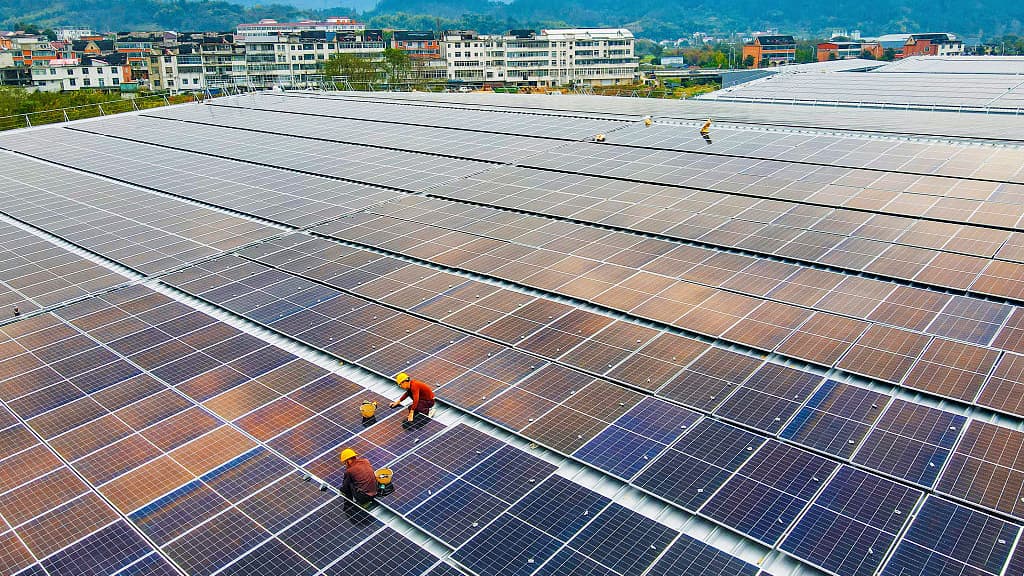
Photo via ABC News (AU)

Renewables and Iran war help drive fall in global fossil fuel emissions

Read the original at ABC News (AU) ↗
Cite

Stephens, R., & Morris, N. (2026, November 10). Renewables and Iran war help drive fall in global fossil fuel emissions. ABC News (AU). https://www.abc.net.au/news/2026-11-10/fossil-fuel-emissions-to-fall-in-2026-due-to-iran-war/107329262

Dated from the outlet's own feed. Check the original for its byline.

ABC News (AU) · collected 2026-11-10 · by Romy Stephens, Nathan Morris

Quick Summary

The Global Carbon Project’s latest report indicates that fossil fuel emissions are projected to decrease by 0.4% in 2026 compared to 2025 levels, primarily due to a reduction in oil emissions linked to the Iran war. However, lead researcher Pierre Friedlingstein warns that this drop is not sustainable without significant acceleration in renewable energy capacity and electrification efforts. Total global carbon emissions are expected to rise from 42.8 billion tonnes in the previous year to 43.3 billion tonnes in 2026, with South-East Asia's El Niño-linked peat fires contributing to this increase.
Written by AI on 2026-11-10, from this article's own text only (the story summary below draws on all the coverage).

AI analysis

Story summary

Global fossil fuel emissions are projected to decrease by 0.4% in 2026, according to new research from the Global Carbon Project. This decline is primarily driven by the Iran war, which has disrupted oil supplies through the Strait of Hormuz, leading to a significant drop in oil consumption and higher prices. Additionally, the adoption of renewable energy sources like solar and wind power also contributed to this reduction.

The study found that China's emissions are expected to fall by 0.9%, while the U.S. will see a 1.3% decrease mainly due to reduced coal use following high natural gas prices in 2025. However, experts caution that these reductions may be temporary and not indicative of a long-term shift away from fossil fuels.

Despite this slight decline, the world remains on track to reach 1.5 degrees Celsius of warming within four years unless more significant steps are taken to address climate change. The report emphasizes that current growth in clean energy deployment is insufficient for sustainable emissions reduction.

Written for “Fossil Fuel Emissions Fall Due to Iran War” on 2026-11-10, grounded in this article and the 3 other(s) covering the same event.
Why this leaning score
The model judged this article politically coded and scored it -0.45, but all 2 of its quote(s) are attributed speech - words the article quotes from someone, not the article's own narration, so the score is not published.
Written under an earlier scoring contract, which gave a paragraph rather than checkable quotes. Re-analysing this article replaces it.
Leaning score withheld for article 140374: attributed speech only · logged 2026-11-10

Story

Fossil Fuel Emissions Fall Due to Iran War
Environment · 4 article(s) covering the same event. Compare every outlet's account →

Compared with similar articles

This article reads unscored and hedges 14% of its claims. Each row says how that neighbour differs.
The Straits Times
Hedges 1 of 20 claims Outlet record 66/100
TIME
Hedges 4 of 24 claims Outlet record 59/100
The Hindu
Leans left Hedges 2 of 29 claims Outlet record 78/100
Semafor
Hedges 0 of 4 claims Outlet record 68/100
“Article A covers the opening of COP31 summit in Türkiye on November 9, while Article B discusses global carbon budget trends influenced by renewables and the Iran war on November 10.”
ABC News (AU)
Leans left Hedges 1 of 19 claims Outlet record 67/100
“The articles discuss related topics (renewable energy growth and efforts to reduce fossil fuel emissions) but describe different events: one discusses a global carbon budget report, while the other covers COP31 summit discussions.”
How this article was measured signals, leaning charts, publisher record, byline, topics and claims

Signals How these are calculated →

Claims extracted
42
sentences that state something as happening or true
Uncertain
14%
6 of 42 hedged ("reportedly", "may", "according to")
Leaning
withheld
no quote in the article backed the model's score
Publisher signals
67/100
ABC News (AU)'s corrections and hedging, across everything collected from it. Not a measure of accuracy.
Outlets on this story
4
Environment
Same framing elsewhere
1
articles that frame the event the way this one does
Analyzed 2026-11-10 · how these are computed

How this is being covered How these are calculated →

Article leaning vs. publisher reliability
Source leaning vs. consistency

Publisher

ABC News (AU) · 5225 article(s) · 11 correction(s) detected
Running correction rate · 11 correction(s)

Who wrote this

Romy Stephens
6 article(s) here · 1 carrying a prediction
In short: The 2026 edition of the global carbon budget shows fossil fuel emissions are set to drop, but the world is on track to reach 1.5 degrees Celsius of warming within four years.
In short: A major review into Australia's biggest renewable energy project has found it could cost up to $25 billion, which is about 12 times the original price.
There are concerns that unusually hot temperatures, combined with an increase in baseline warming due to climate change, could increase the risk of "flash droughts" this summer.
Climate diplomacy at the heart of security strategy Prime Minister Anthony Albanese will join global leaders at the pre-COP event which will feature preparatory talks ahead of next month's United Nations COP31 climate summit.
Lifting a ban on plug-in solar and batteries would unlock access to the technology for millions of apartment dwellers and renters for the first time. What's next?
Decades of research has deepened our understanding of how Pacific Ocean temperatures shape global weather, leaving countries better prepared than ever for potential impacts. But questions remain over how El Niño, and its cooler counterpart La Niña, will behave in a warming world. Fires linked to El Niño have blanketed Indonesia and Malaysia. 1983 El Niño record looms large In autumn 1982, weather conditions across eastern Australia shifted dramatically and rainfall effectively ceased.
2026-09-05 · assertive framing · Why this El Niño is different from all the others
Also by Romy Stephens
Nothing else under this byline is closely related to this article, so these are simply their most recent.
All 6 articles by Romy Stephens →
Nathan Morris
5 article(s) here · 1 carrying a prediction
In short: The 2026 edition of the global carbon budget shows fossil fuel emissions are set to drop, but the world is on track to reach 1.5 degrees Celsius of warming within four years.
" Batteries getting bigger, able to run longer It was March 2017 when then-prime minister Malcolm Turnbull announced Snowy 2.0, during a heated national debate around climate and energy policy that would eventually factor in to his political downfall.
2026-10-30 · assertive framing · Snowy 2.0 still has a place in a world of batteries
Published ahead of the world's COP 31 climate conference in Turkiye, this year's Lancet Countdown report noted significant progress had been made on key climate goals that could reduce heating by 2100 from up to 3.5 degrees Celsius to 2.6C. It found the growth of energy from renewable sources had "vastly exceeded expectations", but that global action on climate change was "grossly insufficient", and that this had already led to significant harm to human health.
To make matters worse, several high transmission lines were also running below capacity due to maintenance, meaning huge amounts of mostly renewable energy and storage capacity could not be delivered to Sydney just when it needed it most.
" Long road to meet climate goals While 2026 may well become a turning point for passenger EVs, reaching Australia's climate targets will require a revolution in the national fleet.
Also by Nathan Morris
Nothing else under this byline is closely related to this article, so these are simply their most recent.

Topics

El Niño Iran the Global Carbon Budget Office the Global Carbon Project the University of Exeter

Subjects

Iran GPE · 4× CSIRO ORG · 2× IEA ORG · 2× the International Energy Agency ORG · 2× Global Carbon Project ORG · 1× Pierre Friedlingstein PERSON · 1× the Global Carbon Budget Office ORG · 1× the Global Carbon Project ORG · 1× the United Nations ORG · 1× the University of Exeter ORG · 1×

Narrative

The 1970s oil shocks sparked by conflict in the Middle East produced vast changes in how the global energy system worked, and drove innovations in fuel efficiency. And this time renewables and electric vehicles offer market-ready alternatives, with the cost of installed solar and batteries falling by 90 per cent since 2010.
framing: assertive · carried by 1 article(s) · first seen 2026-11-10
In short: The 2026 edition of the global carbon budget shows fossil fuel emissions are set to drop, but the world is on track to reach 1.5 degrees Celsius of warming within four years.
2026-11-10 · ABC News (AU)
Renewables and Iran war help drive fall in global fossil fuel emissions · assertive framing

Claims (42 extracted, 6 hedged)

In short: The 2026 edition of the global carbon budget shows fossil fuel emissions are set to drop, but the world is on track to reach 1.5 degrees Celsius of warming within four years. asserted
world → show → years
Renewable energy uptake and the war in Iran are driving the decline, but there are doubts it will last. asserted
it → drive → decline
Energy experts say accelerated electrification efforts could lead to a lasting shift in emissions. uncertain
efforts → say → emissions
Increasing renewable energy capacity and the Iran war have spurred a drop in oil, gas and coal emissions, but experts say a geopolitical shock could make the reduction short-lived. uncertain
reduction → increase → emissions
Research released by the Global Carbon Project projects emissions from the burning of fossil fuels to decrease by 0.4 per cent compared to 2025. asserted
emissions → release → 2025
Oil emissions, down 2 per cent, are the main driver of the drop, likely due to prolonged disruptions in the Strait of Hormuz. asserted
emissions → prolong → Hormuz
The world's need for energy is growing and clean sources, mainly solar and wind power, are increasingly meeting that additional need. asserted
sources → grow → need
But lead researcher and director of the Global Carbon Budget Office at the University of Exeter, Pierre Friedlingstein, said clean energy was not growing fast enough to for a durable drop. asserted
energy → say → drop
"A decline in fossil CO2 emissions is encouraging, but a reduction driven partly by geopolitical shocks is not a sustainable climate solution," he said. asserted
he → drive → shocks
"While renewables and electric vehicles are increasingly offsetting growth in energy demand, further acceleration is needed if global emissions are to peak and enter a sustained decline." Total carbon emissions are set to rise from 42.8 billion tonnes last year to 43.3 billion tonnes in 2026. asserted
emissions → offset → 2026
El Niño-linked peat fires and forest degradation in South-East Asia are driving the increase. asserted
fires → link → increase
The amount of carbon that can be emitted before warming reaches 1.5 degrees Celsius above pre-industrial levels is now 150 billion tonnes, which will be reached within four years at the current rate. asserted
which → emit → rate
This year the United Nations found the world was on track to reach 2C warming by about 2050 and move towards 2.6C warming by the end of the century. asserted
world → find → century
"The point the report is trying to make is that we need to change these policies and be a little more aggressive in the way we look at the transition to net zero," CSIRO chief research scientist and Global Carbon Project executive director Pep Canadell said. asserted
Canadell → try → net
Some experts say Donald Trump's decision to start a war with Iran did more than briefly interrupt the world’s oil flow — it created a tipping point for accelerated global electrification efforts. asserted
it → say → efforts
The 1970s oil shocks sparked by conflict in the Middle East produced vast changes in how the global energy system worked, and drove innovations in fuel efficiency. And this time renewables and electric vehicles offer market-ready alternatives, with the cost of installed solar and batteries falling by 90 per cent since 2010. asserted
cost → spark → 2010
Solar and wind together are now the largest sources of growth in global electricity generation, overtaking coal and gas to meet over half of new electricity demand, according to a dedicated report on electrification by the International Energy Agency (IEA). uncertain
Solar → overtake → Agency
According to Gabrielle Kuiper, an energy researcher affiliated with CSIRO, consumer-level electrification of transport is well underway. uncertain
electrification → accord → transport
"I think the momentum is unstoppable," she said. " asserted
she → think → ?
We've reached the tipping point, particularly on EVs." asserted
We → reach → EVs
A report released by the International Energy Agency (IEA) last week found the shift to renewables is most pronounced in emerging economies, where the continued high oil price caused by the Iran conflict has accelerated uptake. asserted
price → release → uptake
The report forecasts global renewable capacity to grow by almost 4,800 gigawatts (GW) in the 2026-2031 period, 57 per cent more than in the previous six years. asserted
capacity → forecast → years
Growth in emerging and developing economies outside China is expected to match that in advanced economies for the first time, the report said " asserted
report → emerge → time
Off-grid solar PV capacity is expected to increase by 2.5 times to around 80 GW by 2031, led by Pakistan, sub-Saharan Africa and Southeast Asia. asserted
capacity → expect → Pakistan
But as the UN's annual climate summit, COP 31, gets underway, growth in renewables still lags the pledge at COP28, where nearly 200 countries agreed to triple renewable capacity by 2030. asserted
countries → get → 2030
"Current policies, market developments and cost trends boost cumulative renewable energy capacity to around 9, 710 GW by 2030, a 2.6-fold increase from 2022, in line with last year's forecast," the IEA said. asserted
IEA → boost → forecast
India records a rise asserted
India → record → rise
The annual global carbon budget update found China's emissions are set to fall by 0.9 per cent in 2026 due to a plunge in oil emissions, and growth in electricity generation from renewable energy. asserted
emissions → find → energy
While the world's largest emitter produces 32 per cent of global emissions, it was found to be the most active in deploying clean technologies and increasing carbon sinks, which are systems that absorb more carbon from the atmosphere than they release, through reforestation. asserted
they → produce → reforestation
Emissions across the United States are projected to decrease by 1.3 per cent, mainly due to dropping coal emissions, which spiked last year. asserted
which → project → emissions
India's emissions are expected to increase by 4.4 per cent, higher than its annual average growth of 3.5 per cent over the past decade. asserted
emissions → expect → decade
The European Union's emissions are expected to drop by 1.5 per cent, Japan's are expected to drop by 1 per cent, while emissions for the rest of the world are set to go down by 0.7 per cent. asserted
emissions → expect → cent
"This year, for the first time, we saw 40 countries which, over the last 10 years, had emissions declining from fossil fuels; at the same time, they had an economy that has been growing," Dr Canadell said. asserted
Canadell → see → economy
"That is double the amount of countries as the previous decade, so certainly things are happening." asserted
things → happen → decade
Emissions in aviation and shipping are projected to decrease by 1 per cent, partly due to reduced flights across the Middle East, while total emissions have grown at a slower pace over the past decade. asserted
emissions → project → decade
El Niño could make things worse Oceans and vegetation remove about half of all carbon dioxide emissions from human activities from the atmosphere. But as El Niño exacerbates drought and bushfire conditions in many regions, plants absorb less carbon dioxide via photosynthesis when they are stressed by low rainfall and higher temperatures. uncertain
they → make → rainfall
Bushfires also release large amounts of CO2 back into the atmosphere. asserted
Bushfires → release → atmosphere
Dr Canadell said the Amazon's absorption rate declined by 66 per cent during the El Niño of 2023/24, which has since returned to normal. asserted
which → say → normal
But he warned that a drop of that scale could repeat towards the end of the year. uncertain
drop → warn → year
"We'll see the full force of El Niño in the sinks, particularly in the tropics, in the Amazon specifically, early next year," Dr Canadell said. " asserted
Canadell → see → Amazon
…and 2 more, not listed.

Give feedback · no sign-in needed

No sign-in needed for now. Your note is sent without a name, so it cannot be answered.

History Support