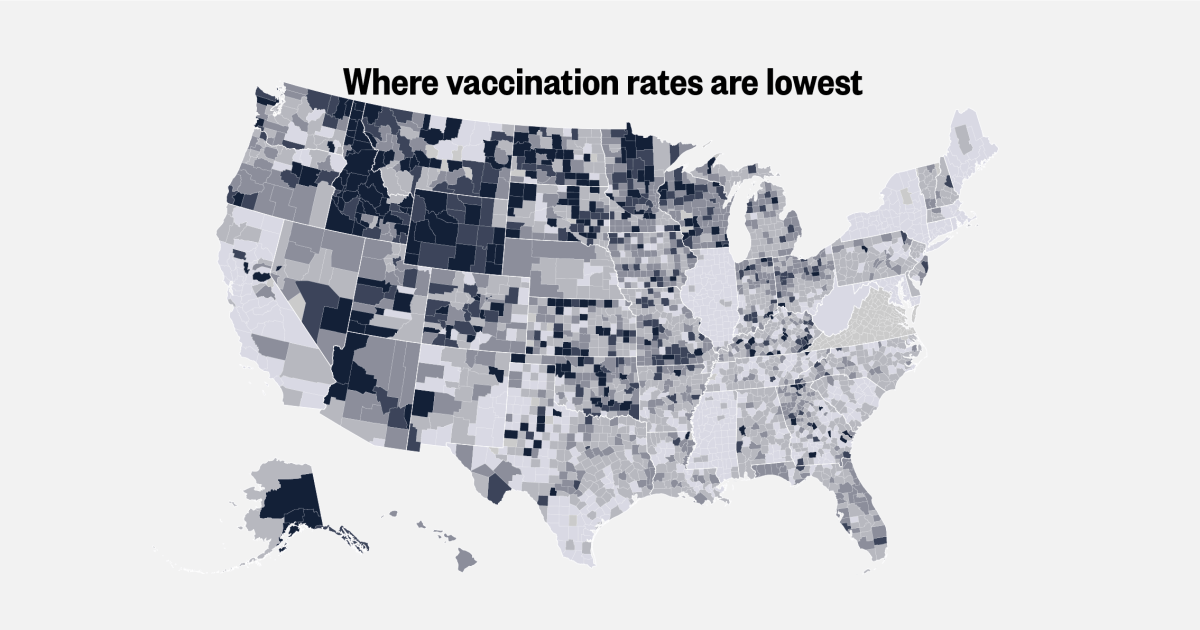
Editor’s note: This 2026 NBC News data investigation is an update of The Vaccine Divide, which was originally published in September 2025.
asserted
which → publish → September
The new data was collected from June to October 2026.
asserted
data → collect → October
For “The Vaccine Divide,” NBC News gathered massive amounts of data from state governments and archives of public records.
asserted
News → gather → records
With the help of infectious disease researchers at Stanford University, NBC News filed scores of requests for documents, including materials obtained under the Freedom of Information Act, and wrestled different types of data into a standardized format to map and compare rates across thousands of counties.
asserted
News → file → counties
Methodology
How NBC News collected the data
NBC News built a database of childhood vaccination and exemption information using data provided by state governments, primarily health agencies.
asserted
News → collect → governments
The data combines public information available for some states and data provided directly to NBC News.
asserted
data → combine → News
The data covers kindergartner vaccinations for each academic year.
asserted
data → cover → year
After collection, the data was collated, and exemption rates were calculated in order to be analyzed.
asserted
rates → collate → collection
The analysis focuses on four facets of the data:
- Medical exemptions: Exemptions granted when students have a medical condition that would make vaccination potentially harmful.
- Nonmedical exemptions: Exemptions for students who opt out of required vaccinations due to personal beliefs or religious convictions.
- MMR (measles-mumps-rubella) vaccinations: For states in which data is subdivided by number of doses, MMR vaccination is counted by the second dose.
asserted
vaccination → focus → dose
Some states track measles, mumps and rubella immunization separately; in these states, measles was used to represent MMR rates.
asserted
measles → track → rates
- Up-to-date vaccinations: Students are considered “up to date” with their vaccinations if they have received the full vaccination series required for enrollment in their school.
asserted
they → consider → school
How the data was processed
asserted
data → process → ?
With a hodgepodge of formats, jurisdictions and collection practices across states, the task required extensive work to ensure that possible inconsistencies in the data were managed.
asserted
inconsistencies → require → data
- Certain states, such as Ohio and New York, required further calculations to aggregate the state-supplied data.
asserted
states → require → data
- Other states required hand input of hundreds of rows of tabular data.
asserted
states → require → data
- All data was checked for accuracy.
asserted
data → check → accuracy
Analyzing the data
This analysis of childhood MMR vaccination rates focused on states that provided MMR figures for the 2025-2026 school year.
asserted
that → analyze → year
Accompanying this analysis were several variant analyses, which confirmed that the results were robust.
asserted
results → accompany → analysis
The variant analyses all yielded similar results, mostly within 1 percentage point.
asserted
analyses → yield → point
We also examined the scale of MMR vaccination rate decline across counties, with almost 4 in 10 counties declining by over 5 percentage points since 2019 and approximately 1 in 8 declining by that amount since 2024.
asserted
8 → examine → 2024
Fewer than 2% of counties declined by 0.1 percentage points or less since 2019.
asserted
% → decline → 2019
Many states collect and report their data differently.
asserted
states → collect → data
Some use health districts instead of counties.
asserted
Some → use → counties
Some states provided over a decade of data; others provided only two years’ worth.
asserted
others → provide → worth
Some states redacted certain data due to privacy concerns.
asserted
states → redact → concerns
- Not all states have recent data.
asserted
states → have → data
Florida did not provide data on kindergarten exemptions after the 2021-2022 school year.
asserted
Florida → provide → year
Montana stopped collecting vaccine and exemption data after 2019, first due to Covid and thereafter due to the passage of a state bill (HB 334) in 2021 that struck down the mandate for the state to collect data on immunizations.
asserted
state → stop → immunizations
- Certain states (such as Arizona and Minnesota) do not collect an overall “up-to-date” figure representing the percentage of kindergarteners who are compliant with all required vaccines.
asserted
who → collect → vaccines
Others (such as Florida, New Hampshire and South Carolina) provided only “up-to-date” numbers.
asserted
Others → provide → numbers
- In other states — Mississippi, New Hampshire and South Carolina — data was provided only for years K-12, rather than specifically kindergarteners.
asserted
data → provide → years
West Virginia also falls into this category for its exemption data.
asserted
Virginia → fall → data
Some states — Illinois and New York — do not collect data at grade level, so data is for elementary schools as a whole (up to K-8 for Illinois, and New York was based on headcounts, where elementary schools were defined as having less than 3% enrollment above grades K-6), rather than kindergarteners specifically.
asserted
schools → collect → grades
Hawaii also fell into this category (up to pre-K-5), as its school-level data was more consistent than its kindergarten-specific data.
asserted
data → fall → data
- Other states did not provide data on a county level.
asserted
states → provide → level
Alaska and Nebraska provided data for other jurisdictions.
asserted
Alaska → provide → jurisdictions
Delaware and Rhode Island were unable to provide data at the county level, state-level figures were used instead.
asserted
figures → provide → level
Indiana was unable to provide county-level exemption data.
asserted
Indiana → provide → data
West Virginia was unable to provide county-level immunization data, but was able to provide exemption data per county, starting in January 2025.
asserted
Virginia → provide → January
- Some states (such as Michigan) collect data by calendar year, rather than school year.
asserted
states → collect → year
…and 3 more, not listed.
 The Aporia