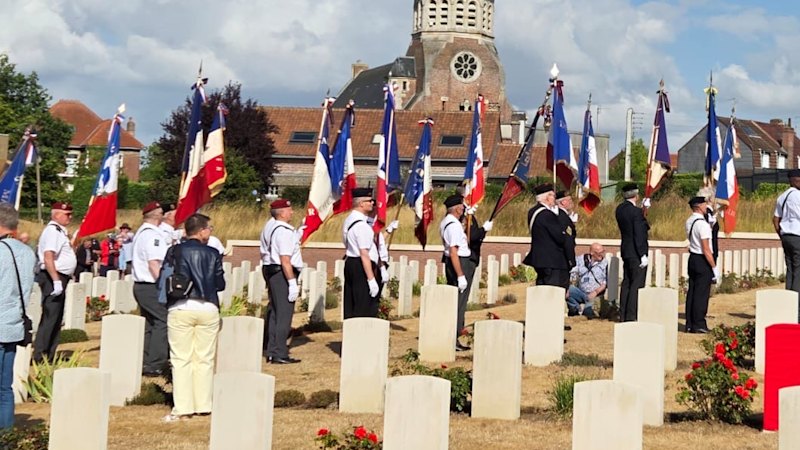
On a summer’s afternoon at Pheasant Wood Military Cemetery in northern France, I am suddenly taken aback to find life imitating art among the serried ranks of identical white headstones.
asserted
life → take → headstones
In 1976, Scottish-Australian folk singer Eric Bogle wrote and recorded the ballad No Man’s Land, about an imagined visit to the graveside of a young soldier killed in France in 1916.
asserted
Bogle → write → 1916
In Bogle’s soliloquy, the sun shines down on the green fields of France while the warm wind blows gently and red poppies dance.
asserted
poppies → shin → France
In Pheasant Wood, I find myself standing by the grave of Australian infantryman Lance-Corporal William Andrew Craigie, who died at the Battle of Fromelles on July 19, 1916, and whose inscription reads simply:
The sun’s shining down/On green fields of France
Warm wind blows gently/The red poppies dance.
asserted
poppies → find → France
I’m startled into tears that Bogle’s words have become a part of our dialogue with the dead: they’re no longer simply poetry, they’re history.
asserted
they → become → dead
And history has been written, revised and rewritten in this place.
asserted
history → write → place
Between 1914 and 1918, more than 530,000 British and Commonwealth servicepeople lost their lives in France.
asserted
servicepeople → lose → France
Whatever else they did in their lives they remain military personnel in death, like NSW-born labourer Craigie.
asserted
they → do → Craigie
After the war, their remains were collected from their burial sites and reinterred in about 1200 graveyards created and maintained by the newly constituted Commonwealth War Graves Commission (CWGC).
asserted
remains → collect → Commission
Those who could not be identified are remembered on grand and grim monuments still weighted with impossible sadness.
uncertain
who → identify → sadness
Pheasant Wood is a martial anomaly: a First World War cemetery that did not open until in 2010.
asserted
that → open → 2010
It’s the newest CWGC cemetery, the first for five decades.
asserted
It → ’ → decades
As such, this historic farmer’s field on the edge of the village of Fromelles – and this Portland stone marker with its quatrain plucked from a song – invites reflection on the very nature and practice of commemoration, and what it is that we remember on days such as Remembrance Day.
asserted
we → pluck → Day
Because the story of these burial grounds is heart-tearing, and redolent with the values of age that has passed.
asserted
that → tear → age
Indeed, I’m almost surprised that the folk singer’s lyrics were allowed on the headstone, as strict regulations have governed the wording on CWGC monuments since the end of the First World War – rules that are supposed to ensure there are no contentious statements on military headstones.
asserted
that → ’m → headstones
In 1921, the father of a British soldier was forbidden to mark his boy’s grave with the words “a noble son sacrificed for capitalism”.
asserted
father → forbid → capitalism
And in 1922, the CWGC refused to allow a British couple’s son to lie under the legend “his loving parents curse the Hun”.
asserted
parents → refuse → Hun
When asked for an alternative proposal, the family suggested a verse that began: “With every breath we draw, we curse the German more.”
uncertain
we → ask → German
This too was rejected.
asserted
This → reject → ?
The CWGC cemeteries were planned to reflect an equality of sacrifice among officers and “men”, meaning each stone would bear only a serviceperson’s regiment, name, rank and number, age and date of death, and an approved religious symbol such as a Christian cross or a Star of David.
asserted
stone → plan → David
An entire inscription might cost almost £1 for Australian parents who would never be able to travel across the world to see it – and they were still not permitted to be the final arbiters of the wording.
uncertain
they → cost → wording
Even today, when an inscription proposed for the tombstone of a freshly identified Australian soldier is considered “unusual or contentious in some way”, the wording has to be submitted for approval to the CWGC’s Policy and Commemorations Group in the UK, says a spokesperson for the Department of Veterans’ Affairs (DVA).
asserted
spokesperson → propose → Affairs
In addition, “To maintain historical integrity, inscriptions are expected to reflect language that could reasonably have been used at the time of the casualty’s death.
uncertain
that → maintain → death
For example, references to modern expressions, later events, or the passage of time are not permitted.
asserted
references → permit → time
What then are we to make of a eulogy, culled from a song written 50 years ago, but 60 years after a soldier’s death, whose verses go on to suggest that the killing and dying in the First World War was “all done in vain” and that military cemeteries bear witness to “man’s blind indifference to his fellow man”?
asserted
cemeteries → make → man
I’m here with a battlefield-tour group led by the irrepressible Lambis Englezos, a Greek-Australian retired art teacher whose efforts and energy largely led to the discovery of the burial site of missing casualties of the Battle of Fromelles, a bloodbath that historian Ross McMullin has called “the worst 24 hours in Australian history”.
asserted
McMullin → ’m → history
On July 19-20, 1916, British and Australian infantry launched a diversionary assault on German positions east of the village of Fromelles, to draw enemy troops away from the Somme.
asserted
infantry → launch → Somme
But the Germans realised that the attack was a feint, and the foot soldiers who charged their machine-guns were cut down like buckwheat.
asserted
who → realise → buckwheat
About 2000 Australians were killed, of whom more than 1330 could not be found.
uncertain
1330 → kill → whom
The remains of some were misidentified and confused with the body parts of other men.
asserted
remains → misidentifie → men
Many others are remembered on the wall of the nearby V.C. Corner Australian Cemetery and Memorial, where their names look down upon the graves of 410 casualties whose identities were only “known unto God”.
asserted
identities → remember → God
“They had to be buried somewhere,” says Englezos.
asserted
Englezos → have → ?
“It’s just logic.”
asserted
It → ’ → ?
In the face of perceived establishment indifference, Englezos and others spent years searching British and German records before they finally discovered the pits used by the German Army to bury 250 Commonwealth soldiers who had been killed on the German side of No Man’s Land.
asserted
who → perceive → Land
Englezos believes we have a national duty to recover and honour our war dead.
asserted
we → believe → dead
His son Anthony fought in Afghanistan.
asserted
son → fight → Afghanistan
“We saw him swear his oath of allegiance at his induction, before he went off to train,” says Englezos.
asserted
Englezos → see → induction
“And soon after, I was in V.C. Corner Cemetery when I took a phone call from my Australian soldier son – and there are 410 Australian soldiers buried in that cemetery: no headstones, not recognisable.
asserted
I → take → cemetery
The irony and the symbolism was not lost on me.
asserted
irony → lose → me
“I’m not the hard bastard I look,” says Englezos, who does not look like a hard bastard.
asserted
who → ’m → bastard
…and 70 more, not listed.
 The Aporia