The day that we now recognize as Veterans Day began at the end of World War I, when the armistice that turned into a lasting peace took effect on the eleventh hour of the eleventh day of the eleventh month.
asserted
that → recognize → month
In 1954, after veterans of World War II and the Korean War had joined the ranks of returning military personnel, Congress changed the name of the U.S. commemoration from “Armistice Day” to “Veterans Day.”
asserted
Congress → join → Day
President Dwight D. Eisenhower, himself a veteran who had served as the supreme commander of the Allied Expeditionary Force in Europe and who had become a five-star general of the Army before his political career
asserted
who → serve → career
, later issued a proclamation asking Americans to observe Veterans Day: “[L]et us solemnly remember the sacrifices of all those who fought so valiantly, on the seas, in the air, and on foreign shores, to preserve our heritage of freedom, and let us reconsecrate ourselves to the task of promoting an enduring peace so that their efforts shall not have been in vain.”
asserted
efforts → issue → vain
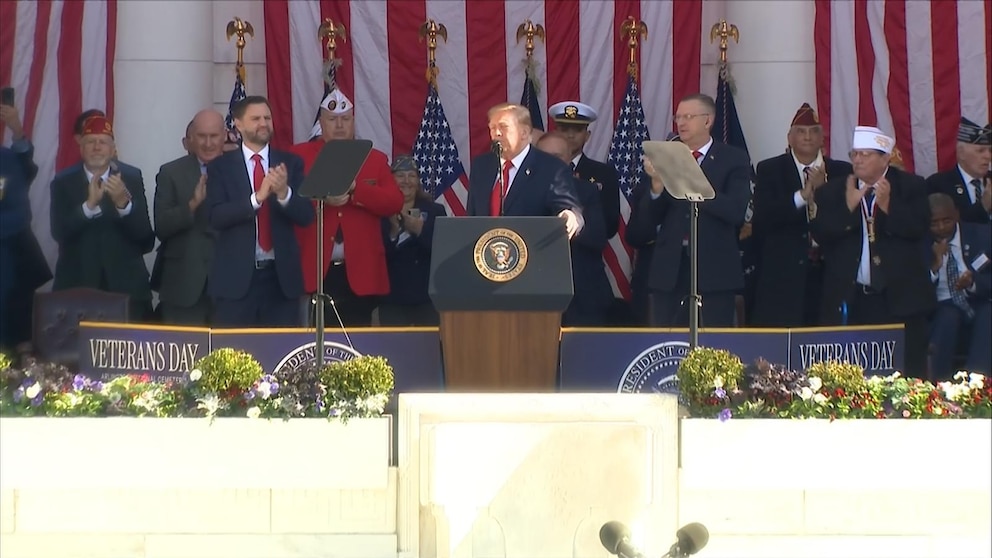
In our day it has become a tradition for political leaders to honor veterans on this day, and today was no exception.
asserted
today → become → day
Trump delivered a Veterans Day speech at Arlington National Cemetery, although he broke with the tradition of nonpartisan speeches and ended his speech with a defense of his war on Iran and a celebration of the attack on Venezuela that has given the U.S. control of its oil fields.
asserted
that → deliver → fields
“We’re taking out billions and billions of dollars of oil and all sorts of other things.
asserted
We → take → things
Be hundreds of billions very soon,” Trump said.
asserted
Trump → say → billions
“Nobody’s ever seen anything like it, and we paid for the cost of the war many, many times over already.”
asserted
we → see → war
“To the victor belong the spoils, they used to say,” he continued.
asserted
he → belong → victor
“But you can say it again with us under this leadership.”
asserted
you → say → leadership
Also unusual was the president using the solemn day of remembrance to raise money.
asserted
president → use → money
J.D. Wolf of MeidasNews reported that Trump used a holiday greeting to supporters to warn that his second term is “moving fast, and we still have major mountains to climb to finish the job.
asserted
we → report → job
After the unfortunate results of the recent Midterm Elections, The MAGA movement took a blow, but I will not falter….
asserted
I → take → blow
We don’t have the luxury of slowing down.
asserted
We → have → luxury
On this Veterans Day, the spirit of American courage and determination is burning bright in this movement, and we must protect it!”
asserted
we → burn → it
He announced a “Presidential Fundraising Blitz” to “send a powerful message that the American people will never surrender our liberty…the same liberty our veterans risked everything to protect.”
asserted
veterans → announce → everything
“YOU’RE THE ONLY REASON WE SAVED AMERICA,” the message concludes.
asserted
message → you’re → AMERICA
“NOW I AM ASKING YOU TO CONSIDER MAKING A SMALL SUSTAINING CONTRIBUTION, SO WE CAN COMPLETE THE MAGA AGENDA!”
asserted
WE → ask → AGENDA
After the ceremony at the Arlington National Cemetery, Defense Secretary Pete Hegseth and his wife, accompanied by his chief of staff Ricky Buria, deputy chief of staff Patrick Weaver and senior adviser and deputy assistant Tami Radabaugh, stopped for pictures by the Tomb of the Unknown Soldier.
asserted
Hegseth → accompany → Soldier
One of the nation’s most sacred monuments, the tomb is guarded constantly by a Tomb Guard from the U.S. Army’s 3rd Infantry Regiment, known as “The Old Guard,” and visitors are supposed to remain silent at the tomb.
asserted
visitors → guard → tomb
The group was chatting and laughing, and as Haley Britzky, David Brooks, and Natasha Bertrand of CNN reported, when their laughter floated back to the Tomb Guard, he stopped his carefully choreographed patrol to turn to the offenders and call out: “All visitors will maintain an atmosphere of silence and respect at all times.”
asserted
visitors → chat → times
Different ways of honoring veterans were highlighted today, as Trump suggested that the 250-foot triumphal arch he wants to build between the Lincoln Memorial and Arlington National Cemetery is for veterans, although Vietnam veterans are among those suing over its construction.
uncertain
veterans → honor → construction
“Soon we’re going to dedicate a magnificent triumphal arch to our veterans, and that’s in honor of our great veterans and our great militaries,” he said.
asserted
he → go → veterans
“They’ve been waiting for it for 200 years.”
asserted
They → wait → years
But in New York City, Mayor Zohran Mamdani had a different prescription for honoring veterans.
asserted
Mamdani → have → veterans
“This Veterans Day, let us renew our commitment to those who served by confronting the injustices too many veterans still face, from homelessness and isolation to the threat of deportation,” he posted.
asserted
he → let → deportation
“Our responsibility to those who served does not end when they come home.”
asserted
they → serve → those
Eric Umansky of ProPublica hammered this point home today, chronicling the dramatic cuts to the VA, or U.S. Department of Veterans Affairs, the Cabinet-level government agency that provides lifelong healthcare, benefits, and memorial services for veterans and eligible family members.
asserted
that → hammer → veterans
Umansky explains that the VA serves 9 million veterans, providing healthcare that is “essentially socialized medicine,” with doctors, nurses, and staff all employed by the federal government.
asserted
doctors → explain → government
Umansky also notes that despite occasional scandals and chronic short-staffing, the VA has better outcomes than private care.
asserted
VA → note → care
But the right wing has worked for decades to get rid of VA healthcare and push veterans toward private sector doctors and hospitals, claiming that such private care is more efficient than government-run healthcare.
asserted
care → work → healthcare
With data reporting by Joel Jacobs and illustrations by Hokyoung Kim, Umansky’s piece lays out how under Trump and Secretary of Veterans Affairs Doug Collins, the administration initially considered sweeping cuts to the VA but, after massive pushback, appear to have settled on making work conditions so bad people would leave on their own.
asserted
people → lay → own
Citing national security, they canceled union contracts, ordered remote staffers back to work in buildings that couldn’t accommodate them, required employees to report what they had accomplished each week, and offered incentives to retire or quit.
asserted
they → cite → incentives
Under President Joe Biden, the agency had been hiring personnel; in the first six months under Trump’s second administration, the VA lost 3,800 doctors, nurses, and “mission critical” staff and eliminated hiring for positions that were open.
asserted
that → hire → positions
In September 2025, Collins imposed new caps on staffing levels as part of his plan to cut 30,000 employees, and numbers of employees have continued to drop.
asserted
numbers → impose → employees
Umansky chronicled the downward spiral of a VA medical center as it and its affiliated facilities lost nearly 10% of their staff.
asserted
it → chronicle → staff
Umansky reports that according to the VA’s watchdog, 97% of VA hospitals report “severe shortages of doctors.”
uncertain
% → report → doctors
Veterans are being pushed into the Community Care system Trump supports, but those systems are overwhelmed and wait times can run into months.
asserted
times → push → months
Under Trump the VA has increasingly acted like an insurer, Umansky writes, simply paying private doctors to care for veterans as part of their normal practice.
asserted
Umansky → act → practice
…and 34 more, not listed.
 The Aporia