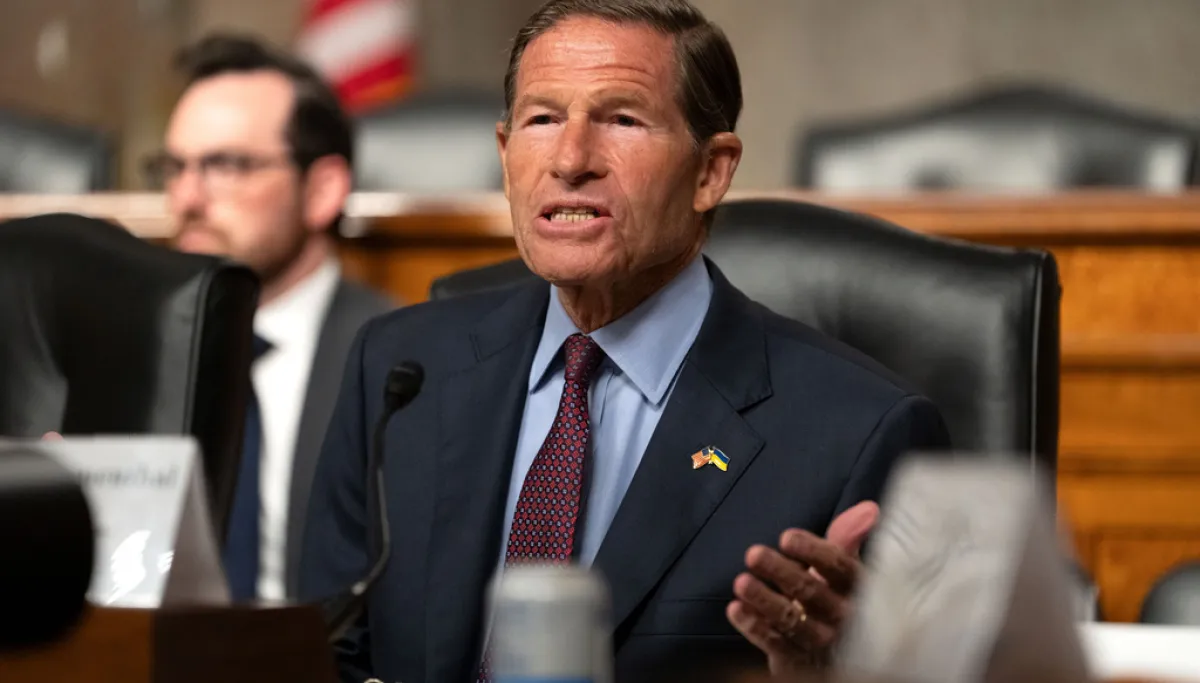
Senator Richard Blumenthal (D-CT) won’t officially have control of the Senate’s Permanent Subcommittee on Investigations until January, but once his party clinched the majority in the upper chamber, he began his crusade to expose every private donor helping to fund the new White House ballroom.
asserted
he → have → ballroom
Blumenthal, who became a household name when he was caught fudging the details of his stateside military service to make it sound as though he’d deployed to Vietnam, claimed that the ballroom donor list warranted public scrutiny — and a thorough investigation — because he believed the donors were only remaining anonymous to hide “pay-for-play” arrangements with President Donald Trump’s administration.
asserted
donors → become → administration
“I have previously written to dozens of companies and individuals who have given millions to the ballroom,” Blumenthal wrote to Salesforce CEO Marc Benioff in late October.
asserted
Blumenthal → write → October
“Many have apparently attempted to keep their contributions secret, and have deep financial, business, or other personal interests before the Trump administration.”
“The aggressive fundraising push by the president’s advisers suggests possible conflicts of interest and even corruption, and raises questions that Americans deserve to have answered.
uncertain
Americans → attempt → that
Particularly, what promises may have been made in exchange for substantial donations and why donors chose to remain anonymous
uncertain
donors → make → donations
,” Blumenthal continued, making no allowance for the possibility that they’d chosen to remain anonymous in an apparently fruitless effort to avoid the intrusive investigation that was almost guaranteed if Democrats returned to power.
asserted
Democrats → continue → power
The Department of Justice is already working to slow Blumenthal’s efforts, however, arguing that he’s essentially using the power of the Senate to harass and threaten anyone associated with President Trump.
Houston-based U.S. Attorney Aaron Reitz fired off a warning letter to Blumenthal, saying that his current course of action would be a violation of the donors’ rights to free association under the First Amendment — and countered with demands of his own.
“It is … extraordinary for an elected official to intimidate citizens for engaging in philanthropic practices that will benefit our nation for generations.
asserted
that → work → generations
The American people are entitled to freely associate themselves without elected officials terrorizing them with aggressive, harassing government action,” Reitz wrote.
asserted
Reitz → entitle → action
“I therefore write to formally give you notice of your obligation to preserve all documents, communications, and other electronically stored information relevant to your intent to deprive citizens of their core constitutional rights in violation of 18 U.S.C. 241 and 242,” he continued.
asserted
he → write → U.S.C.
“You are obliged to preserve all potentially relevant evidence related to your efforts to suppress associational activities for philanthropic projects throughout the nation’s capital.
asserted
You → oblige → capital
Failure to do so may result in sanctions, adverse-inference instructions, or other penalties, and may carry significant legal consequences.
uncertain
Failure → result → consequences
This demand applies to you, your staff, employees, agents, consultants, campaign personnel, and any other person acting on your behalf or in concert with you.”
asserted
demand → apply → you
“After the election, @SenBlumenthal & his allies think they can intimidate Americans for their constitutionally protected associations w/ President Trump.
asserted
they → think → Trump
Congress is not a weapon to be wielded against the American people.
asserted
Congress → wield → people
I’m taking the first step to stop this abuse of power,” Reitz posted via X, sharing a copy of the letter.
asserted
Reitz → take → letter
After the election, @SenBlumenthal & his allies think they can intimidate Americans for their constitutionally protected associations w/ President Trump.
asserted
they → think → Trump
Congress is not a weapon to be wielded against the American people.
asserted
Congress → wield → people
I’m taking the first step to stop this abuse of power.
asserted
I → take → power
— U.S. Attorney Aaron Reitz (@USAttyReitz) November 11, 2026
Blumenthal fired back with a letter of his own, claiming that he would not “be intimidated” and accusing the Justice Department of taking “unlawful action” against him.
asserted
he → fire → him
Blumenthal is just one of many Democrats already moving to investigate their political opponents in the coming congress — despite the fact that most of them won after running on kitchen-table issues like gas prices and general affordability.
asserted
most → move → prices
 The Aporia