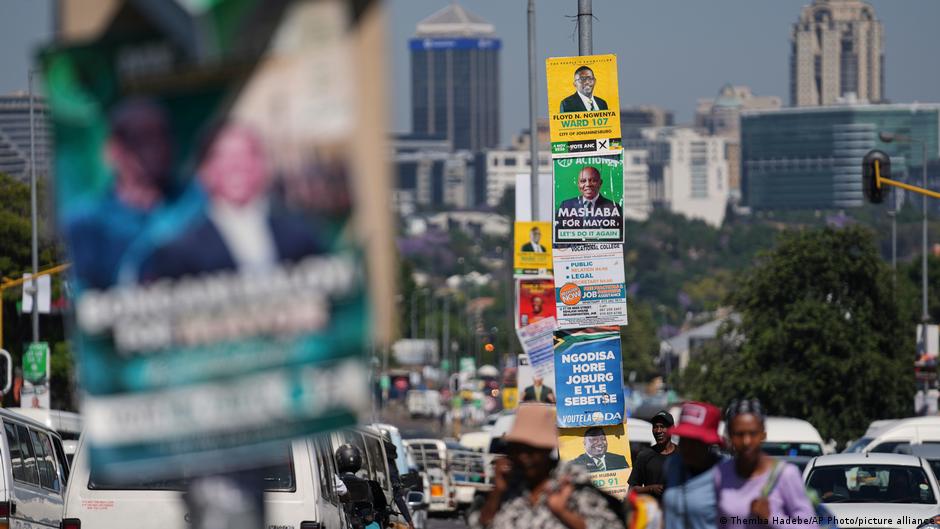
Photo via Deutsche Welle

After suffering its worst election result, what's next for the ANC — and for South Africa?

Read the original at Deutsche Welle ↗
Cite

Domena, A. T. (2026, November 13). After suffering its worst election result, what's next for the ANC — and for South Africa? Deutsche Welle. https://www.dw.com/en/after-suffering-its-worst-election-result-what-s-next-for-the-anc-and-for-south-africa/a-79929902?maca=en-rss-en-world-4025-rdf

Dated from the outlet's own feed. Check the original for its byline.

Deutsche Welle · collected 2026-11-13 · by Adwoa Tenkoramaa Domena

Quick Summary

This analysis explores the political implications following the African National Congress (ANC) securing under 31% of the vote in South Africa's local government elections, its worst electoral setback to date. The piece attributes this "catastrophic" decline to years of public frustration regarding skyrocketing unemployment, poor service delivery, and high-level corruption. Research and eyewitness accounts cited in the text suggest the result reflects a slow erosion of confidence rather than an overnight shift, forcing the ANC to confront leadership failures and prepare for complex coalition negotiations with its rivals.
Written by AI on 2026-11-13, from this article's own text only (the story summary below draws on all the coverage).
See how they differ ↓

AI analysis

Story summary

South Africans voted on November 8, 2026, in local government elections that saw the African National Congress (ANC) suffer its worst-ever result, securing only 31% of the national vote. This marks a significant decline for the party since it led South Africa out of apartheid in 1994 under Nelson Mandela. The Democratic Alliance (DA) and other opposition parties made substantial gains, with voter dissatisfaction stemming from issues like poor public services, crime, corruption, and economic challenges. These results could shift political power dynamics in key cities such as Johannesburg and set up a challenging period for the ANC as it prepares to choose its next leader.

Written for “ANC Suffers Worst-Ever Result” on 2026-11-13, grounded in this article and the 23 other(s) covering the same event.
Why this leaning score
This article does not take a side on a contested political question, so it has no leaning score. That is an answer rather than a gap: a match report or a rescue can be warmly or critically written without being left or right, and scoring it anyway is how approval of a subject gets recorded as a political position.
No political leaning scored for article 150407 · logged 2026-11-13

How they differ

9 outlets covered “ANC Suffers Worst-Ever Result”.

What each outlet says

One AI summary per outlet of its latest article on this story, written from that article alone and checked against it. Open the article for the outlet's own words.

Deutsche WelleThis outlet13 Nov

This analysis explores the political implications following the African National Congress (ANC) securing under 31% of the vote in South Africa's local government elections, its worst electoral setback to date. The piece attributes this "catastrophic" decline to years of public frustration regarding skyrocketing unemployment, poor service delivery, and high-level corruption. Research and eyewitness accounts cited in…

After suffering its worst election result, what's next for the ANC — and for South Africa? (this article)2 articles from Deutsche Welle on this story
The Straits Times9 Nov

South African voters rejected the ruling African National Congress (ANC) in local elections on November 4, with the party winning less than a third of votes—its worst result since leading South Africa out of apartheid. The election marked a shift towards coalition politics, weakening the ANC's dominance and strengthening rival parties like the Democratic Alliance (DA). Analysts suggest that this outcome reflects…

South African voters rebuff ANC, accelerating shift to coalition politics →5 articles from The Straits Times on this story
Al Jazeera9 Nov

South Africa’s African National Congress (ANC) suffered its worst performance in local elections on Wednesday, securing only 31% of votes compared to about 25% for the Democratic Alliance (DA). This marks a significant decline from its previous results: 46% in 2021 and 66% in 2006. The ANC lost control of key cities like Johannesburg and Pretoria, with President Cyril Ramaphosa calling on parties to approach…

What ‘catastrophic’ South Africa local election results mean for ANC →5 articles from Al Jazeera on this story
Semafor9 Nov

In recent local elections, South Africa’s ruling African National Congress (ANC) received its lowest vote share ever at 31%, narrowly beating the Democratic Alliance (DA), which gained ground significantly. The results highlight a continued decline for the ANC since it lost its national parliamentary majority in 2024 and signal a shift towards more coalition governance, particularly in major cities like…

South African voters punish ANC with worst-ever result →3 articles from Semafor on this story
The Hindu10 Nov

The African National Congress (ANC), which led South Africa's anti-apartheid struggle and has dominated national politics since Nelson Mandela’s presidency, suffered its worst electoral performance in local body polls, winning only 30.76% of the vote. The article attributes this decline to corruption allegations and internal divisions within the party, highlighting a significant loss of support for the ANC that…

The fall of the ANC: how Mandela’s party slid to its worst-ever result | Explained →3 articles from The Hindu on this story
BBC9 Nov

In South Africa's recent local elections, the ruling African National Congress (ANC) recorded its lowest voter support since the end of apartheid, winning only 31% of the overall vote compared to 46% in 2021. This decline has led to the ANC losing control of several cities and provinces, with significant gains made by opposition parties like the Democratic Alliance and former president Jacob Zuma's party. Political…

'Devastating message' as ANC records worst-ever result in South Africa election →2 articles from BBC on this story
Show 3 more outlets
The Guardian6 Nov

In South Africa’s local elections, the African National Congress (ANC) is projected to receive under a third of the national vote with over 80% of ballots counted, marking a significant decline from its previous performance. The ANC faces challenges in two populous provinces, Gauteng and KwaZulu-Natal, where it may lose its status as the largest party. Turnout increased to 54.5%, up from 46% five years ago, with the…

ANC faces bruising defeat in South African local elections with 80% of ballots counted →2 articles from The Guardian on this story
Toronto Star2 Nov

South Africans are set to vote in local government elections on Wednesday, which will determine control of major cities and assess the ruling African National Congress's (ANC) declining electoral strength. The election, focusing on issues such as municipal services and national concerns like illegal immigration and unemployment, comes after the ANC lost its parliamentary majority in 2024 and formed a unity…

South Africans to vote in key local elections seen as a tough test for ruling ANC →
ABC News (US)4 Nov

South Africans are voting in local elections that could further diminish the African National Congress (ANC)’s influence, particularly in major cities like Johannesburg. These elections will determine leadership for South Africa’s main city municipalities, district councils, and local councils. In Johannesburg, the ANC faces challenges from the Democratic Alliance (DA), which is using publicity stunts to highlight…

South Africans vote in local elections that could continue decline of ANC →

Where they agree and split

Framing

How the first headlines put it

Stated as fact2
The headlines (2)

South Africans to vote in key local elections seen as a tough test for ruling ANC Toronto Star · stated as fact

The ANC set to lose South African cities Semafor · stated as fact

Words to watch (1)

'Devastating message' as ANC records worst-ever result in South Africa election BBC

The full story: what happened, how it changed, and all 24 articles →

Compared with similar articles

This article reads unscored and hedges 0% of its claims. Each row says how that neighbour differs.
BBC News
Hedges 4 of 35 claims Outlet record 66/100

Story

ANC Suffers Worst-Ever Result
Politics · 24 article(s) covering the same event. Compare every outlet's account →
How this article was measured signals, leaning charts, publisher record, byline, topics and claims

Signals How these are calculated →

Claims extracted
24
sentences that state something as happening or true
Uncertain
0%
0 of 24 hedged ("reportedly", "may", "according to")
Leaning
not political
takes no side on a contested political question
Publisher signals
95/100
Deutsche Welle's corrections and hedging, across everything collected from it. Not a measure of accuracy.
Outlets on this story
24
Politics
Same framing elsewhere
1
articles that frame the event the way this one does
Analyzed 2026-11-13 · how these are computed

How this is being covered How these are calculated →

Article leaning vs. publisher reliability
Source leaning vs. consistency

Publisher

Deutsche Welle · 666 article(s) · 0 correction(s) detected
No corrections detected for this publisher. That may mean careful reporting, or simply that nothing has been checked.

Who wrote this

Adwoa Tenkoramaa Domena
1 article(s) here · 1 carrying a prediction
DW correspondent Dianne Hawker-Kalubi, who reported from various polling stations during the election, agrees with that observation, stressing that many of the voters she had spoken to expressed "a lot of frustration, a lot of concern about basic services not being delivered" for years. Mokhiri Phooko, a Cape Town resident, said that "people are losing hope" across the country after over three years of the political landscape being dominated by late President Nelson Mandela's party: "You promised us jobs, why [are] you not keeping up the end of your bargain right," she told Reuters, stressing that "(t)he unemployment rate went up drastically" in the past few years. A shifting role for the ANC The ANC itself meanwhile has acknowledged that things have to change: In a statement, the party announced that its National Executive Committee would convene a special meeting to deal with the "serious political responsibility to listen to the people, confront its shortcomings and provide leadership.
The only article under this byline in the corpus.

Topics

ANC African National Congress South Africa South Africa's the Society, Work and Politics Institute

Subjects

ANC ORG · 7× Essop ORG · 3× South Africa's GPE · 2× South African NORP · 2× African National Congress ORG · 1× SWOP ORG · 1× South Africa GPE · 1× Tasnim Essop PERSON · 1× the Society, Work and Politics Institute ORG · 1× the University of the Witwatersrand ORG · 1×

Narrative

DW correspondent Dianne Hawker-Kalubi, who reported from various polling stations during the election, agrees with that observation, stressing that many of the voters she had spoken to expressed "a lot of frustration, a lot of concern about basic services not being delivered" for years. Mokhiri Phooko, a Cape Town resident, said that "people are losing hope" across the country after over three years of the political landscape being dominated by late President Nelson Mandela's party: "You promised us jobs, why [are] you not keeping up the end of your bargain right," she told Reuters, stressing that "(t)he unemployment rate went up drastically" in the past few years. A shifting role for the ANC The ANC itself meanwhile has acknowledged that things have to change: In a statement, the party announced that its National Executive Committee would convene a special meeting to deal with the "serious political responsibility to listen to the people, confront its shortcomings and provide leadership.
framing: assertive · carried by 1 article(s) · first seen 2026-11-13
DW correspondent Dianne Hawker-Kalubi, who reported from various polling stations during the election, agrees with that observation, stressing that many of the voters she had spoken to expressed "a lot of frustration, a lot of concern about basic services not being delivered" for years. Mokhiri Phooko, a Cape Town resident, said that "people are losing hope" across the country after over three years of the political landscape being dominated by late President Nelson Mandela's party: "You promised us jobs, why [are] you not keeping up the end of your bargain right," she told Reuters, stressing that "(t)he unemployment rate went up drastically" in the past few years. A shifting role for the ANC The ANC itself meanwhile has acknowledged that things have to change: In a statement, the party announced that its National Executive Committee would convene a special meeting to deal with the "serious political responsibility to listen to the people, confront its shortcomings and provide leadership.

Claims (24 extracted, 0 hedged)

South Africa's governing African National Congress (ANC) party is forced to confront its worst electoral setback to date after securing under 31% of the vote in the country's significant local government elections; party leaders themselves have described the result as "catastrophic." asserted
leaders → govern → result
This outcome marks a steep decline for the party that had once led South Africa's liberation struggle; the party that had dominated the country's political landscape since the end of apartheid in 1994. asserted
that → mark → 1994
The result reflects growing public frustration about the ANC's lack of performance in key areas such as skyrocketing unemployment, poor service delivery, local governance failures and years of graft and corruption — sometimes at the highest levels of government. asserted
result → reflect → government
So what comes next for the ANC — and for South Africa? asserted
what → come → Africa
Voters express growing frustration and despair asserted
Voters → express → frustration
Tasnim Essop, a researcher at the Society, Work and Politics Institute (SWOP) at the University of the Witwatersrand in Johannesburg, says it is time for the party to undertake some serious introspection. asserted
party → say → introspection
She believes that the ANC has to confront a long list of difficult questions about governance, leadership and accountability. asserted
ANC → believe → governance
"You're talking about issues like water, electricity, housing, public services at the basic municipal level. asserted
You → talk → level
And ... research has shown that unemployment is also a big part of what drives people to vote in certain ways" she told DW. asserted
she → show → DW
Essop also highlights the fact that the outcome of the vote didn't happen overnight, and that it rather reflects a slow erosion of public confidence in the erstwhile ruling party over a long period. asserted
it → highlight → period
DW correspondent Dianne Hawker-Kalubi, who reported from various polling stations during the election, agrees with that observation, stressing that many of the voters she had spoken to expressed "a lot of frustration, a lot of concern about basic services not being delivered" for years. Mokhiri Phooko, a Cape Town resident, said that "people are losing hope" across the country after over three years of the political landscape being dominated by late President Nelson Mandela's party: "You promised us jobs, why [are] you not keeping up the end of your bargain right," she told Reuters, stressing that "(t)he unemployment rate went up drastically" in the past few years. A shifting role for the ANC The ANC itself meanwhile has acknowledged that things have to change: In a statement, the party announced that its National Executive Committee would convene a special meeting to deal with the "serious political responsibility to listen to the people, confront its shortcomings and provide leadership. asserted
Committee → report → leadership
Furthermore, the party also has to prepare a framework for upcoming coalition negotiations at the same time — many times involving some of its biggest rivals, as was the case after the 2024 general elections. asserted
case → have → elections
The election results therefore signal a broader shift in South African politics, with voter support increasingly spread across multiple parties rather than being concentrated behind a single dominant force. asserted
support → signal → force
While nationally, the ANC remained the country's largest party, opposition parties made significant gains; the Democratic Alliance (DA) managed to strengthen its position across several major urban centers. asserted
Alliance → remain → centers
Meanwhile the uMkhonto weSizwe (MK) party, launched by former President Jacob Zuma in late 2023, performed rather strongly in the KwaZulu-Natal provice despite entering the political arena so recently. asserted
party → launch → arena
At the local level, smaller civic organizations and community-based movements also recorded notable successes. asserted
organizations → base → successes
'Vote fluidity' enters South African politics Essop describes this trend as a growing sense of "vote fluidity," with voters increasingly willing to move their support between parties instead of remaining loyal to a single political organization. asserted
voters → enter → organization
Some observers have already linked this drift to the idea of South Africans are moving beyond liberation-era loyalties; however, Essop opines: "I would be cautious to say that liberation politics are dead and gone," as many political parties continue to draw ther legitimacy and support from the country's liberation history — even if they no longer operate under the ANC banner. asserted
they → link → banner
Essop argues that the political shift does not signify a wholesale rejection of that liberation narrative itself, but rather a growing demand for effective governance and leadership. asserted
shift → argue → governance
A critical test for the ANC For the ANC, the challenge now is rebuilding trust, with South African President Cyril Ramaphosa saying that the results are a challenge not just for his party but for all political parties to come together and perform better for citizens. asserted
parties → rebuild → citizens
In a statement, Ramaphosa said that "[t]hose who have been elected to councils now need to prove themselves worthy of the trust placed in them by the South African people." asserted
themselves → say → people
While the ANC still remains South Africa's largest political party, its latest setbacks at the polls underscore how much the country's political landscape is no longer what it was when apartheid ended. asserted
apartheid → remain → polls
The era of undisputed ANC loyalty and dominance appears to be over as voters are showing a greater willingness to support alternative parties and punish those they believe have fallen short. asserted
they → appear → those
Whether the ANC can reverse this decline will depend largely on how convincingly it can deliver not only improved public services, but effective change throughout. asserted
it → reverse → services
Give feedback · no sign-in needed

No sign-in needed for now. Your note is sent without a name, so it cannot be answered.

History Support
