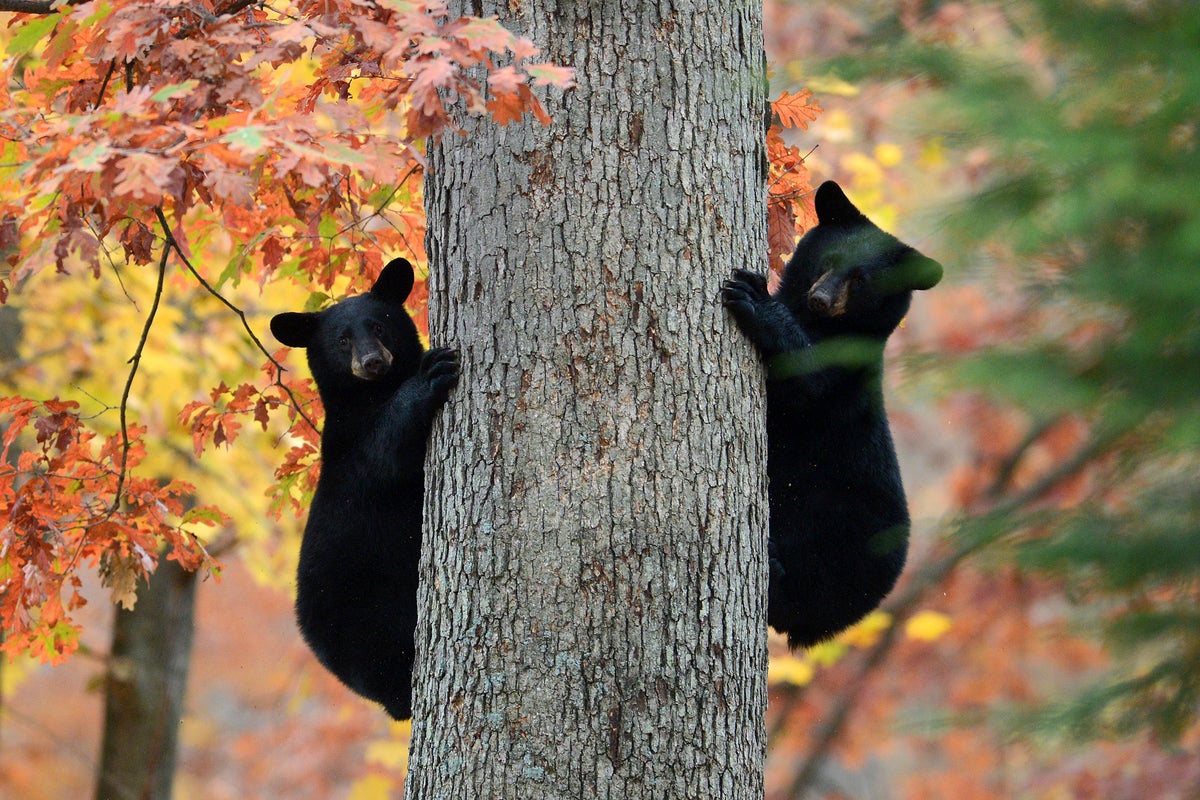
Brandan Smith stepped outside his house in rural Coshocton on a mild evening in mid July after hearing an unexpected sound outside.
asserted
Smith → step → sound
As his eyes adjusted to the darkness, he noticed a huge, imposing figure in his driveway, sifting through the rubbish containers and cardboard boxes he had set out for collection the next day.
asserted
he → adjust → collection
"I immediately turned around, went back inside the house and slammed the door," Smith recalled.
asserted
Smith → turn → door
"That image of something huge spooked me.
asserted
image → spook → me
And it just kind of dawned on me: It’s a bear."
asserted
It → dawn → ?
Convinced that nobody would believe him without proof, Smith retrieved his mobile phone, summoned his courage and went back outside to capture the animal on video.
asserted
Smith → convince → video
"Sure enough, the bear was still there, eating garbage," Smith said.
asserted
Smith → eat → garbage
"I’d just gotten done cleaning out the deep freezer, and it was into the old freezer-burned ice cream."
asserted
it → do → cream
According to Smith, the animal appeared entirely unfazed by his presence, despite him standing merely 25 feet away.
uncertain
him → accord → presence
Uncertain of how to react, Smith contacted the police.
asserted
Smith → react → police
He then observed the bear rummaging through his rubbish until a police car arrived half an hour later, driving the creature away with a powerful spotlight.
asserted
car → observe → spotlight
Having virtually vanished from the Ohio landscape in the mid-19th century, black bears may be staging a comeback.
uncertain
bears → vanish → comeback
Over 1,500 bear encounters have been submitted to the Ohio Department of Natural Resources (ODNR) since 2022.
asserted
encounters → submit → 2022
Although most sightings occur in rural areas near Ohio's borders with West Virginia and Pennsylvania, black bears have been reported across 69 of Ohio’s 88 counties, with a few straying into more populated localities, including near Pataskala in Licking County in the year 2025.
asserted
few → occur → year
Data from the Ohio Division of Wildlife’s 2026 Ohio Black Bear Monitoring Report shows that confirmed black bear encounters steadily grew throughout the 1990s and 2000s, levelled off in the 2010s, and then surged rapidly from 2022.
asserted
encounters → show → 2022
"On average, over the past 10 years the Division of Wildlife has received 239 black bear sighting reports per year," the report stated.
asserted
report → receive → year
"In 2023, 260 sightings were reported in 49 counties.
asserted
sightings → report → counties
In 2024 we received 370 sightings in 55 counties.
asserted
we → receive → counties
"
Based on local accounts, black bear sightings are probably under-reported.
asserted
sightings → base → accounts
Anyone who encounters a bear can report it to the division of wildlife using ODNR’s online Wildlife Reporting System or by telephoning 1-800-WILDLIFE (945-3543).
asserted
who → encounter → WILDLIFE
The ODNR advises people encountering bears not to approach them.
asserted
ODNR → advise → them
Should you see a black bear, remain calm and step away slowly.
asserted
you → see → bear
Do not run or climb trees, as this can trigger a bear’s chase instinct.
asserted
this → run → instinct
If a bear approaches, try to appear large by raising your arms, and clap or shout to scare it off.
asserted
bear → approach → it
in the early 1800s, the state’s newly arrived residents began aggressively felling forests to make way for farms and settlements.
asserted
residents → arrive → farms
They also trapped and killed bears that preyed on their crops and livestock.
asserted
that → trap → crops
The arrival of the timber, iron and coal-mining industries only accelerated the destruction of the woodlands where black bears resided.
asserted
bears → accelerate → woodlands
In 1803, forests covered about 95% of the state of Ohio.
asserted
forests → cover → Ohio
By 1900, only 10% of the state was wooded —but by then, the bears had been gone for half a century.
asserted
bears → go → century
Habitat loss and unregulated hunting had driven black bears from a region they had populated for millennia – the same fate faced by other large mammals in Ohio, including bison, elk, cougars and wolves.
asserted
they → drive → bison
Starting in the 1930s, occasional reports of black bear sightings began surfacing in Ohio, according to the ODNR Division of Wildlife.
uncertain
reports → start → Wildlife
Reports became more regular in the 1990s, and the division of wildlife began tracking black bear observations across the state in 1993.
asserted
division → become → 1993
The division soon collected enough evidence of bear activity that the state of Ohio changed the status of the species from “extirpated” to “endangered” in 1995.
asserted
state → collect → 1995
Bear sightings gradually increased over the following decades and appeared to level out in the 2010s.
asserted
sightings → increase → 2010s
Then, in the 2020s, the division of wildlife recorded a notable uptick in bear sightings.
asserted
division → record → sightings
Of the 4,793 bear sightings the division recorded since it began collecting data in 1993, nearly a third occurred between 2022 and 2025.
asserted
third → record → 2022
Brandan Smith wasn’t the only resident of east-central Ohio’s Coshocton County to see a bear in recent months.
asserted
Smith → see → months
A day or two after the police scared the bear from his property – and more than 10 miles east, near the Village of Fresno – Erica Gray was planting a pollinator garden beside her pond when she looked up and saw a “big, dark object.”
asserted
she → scar → object
A bear with a white marking on its chest was resting on the hillside near her mother’s cabin.
asserted
bear → rest → cabin
The bear eventually left but later returned to her mother’s bird feeder to lap up the grape jelly inside – a delicacy intended to attract Baltimore orioles, not bears.
asserted
bear → leave → orioles
…and 114 more, not listed.
 The Aporia