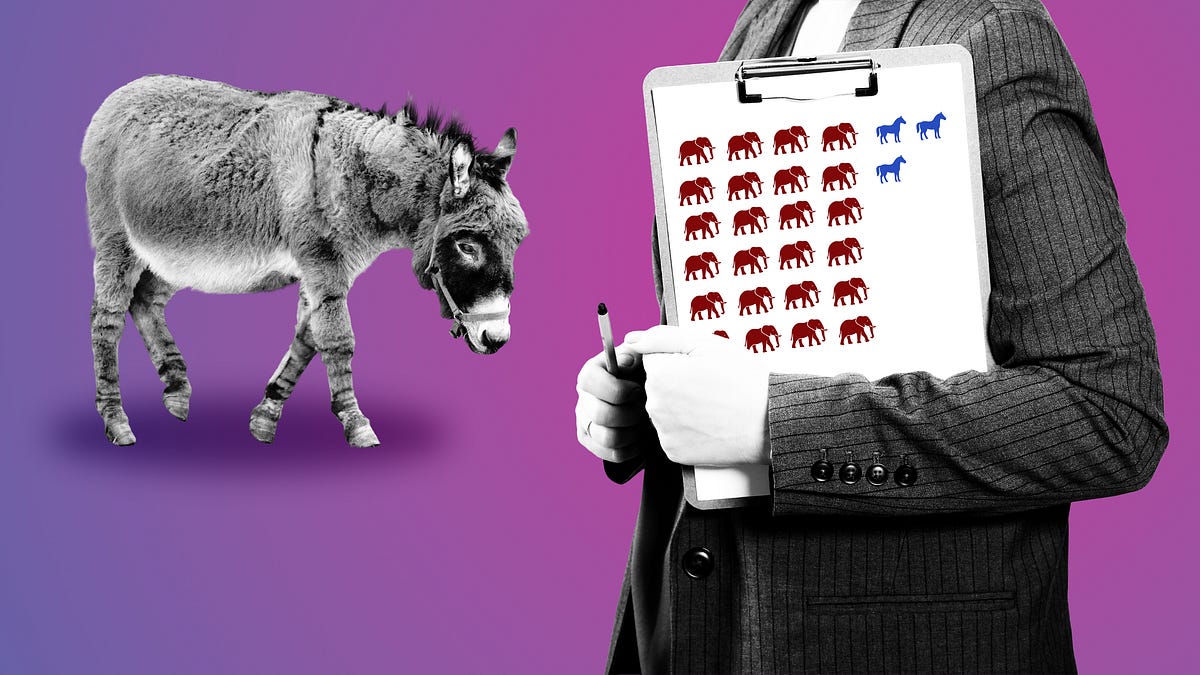
IN THE WAKE OF THE BLUE TSUNAMI that engulfed America last week, you’ve probably seen some pollsters claiming vindication for the industry.
asserted
pollsters → engulf → industry
After all, the polls said a blue wave would happen, and it did.
asserted
it → say → ?
The results were proof that, despite the numerous challenges faced by the industry, polling is fine, right?
asserted
polling → face → industry
I’m not an armchair critic.
asserted
I → ’m → ?
Take it from me: The polls did not have a great night.
asserted
polls → take → night
In fact, per data from Matt Grossmann, the director of the Institute for Public Policy and Social Research at Michigan State University, pollsters may have had one of their worst cycles of this century, with a polling miss exceeding the infamous misfires in 2016 and rivaling those of 2020.
uncertain
miss → have → 2020
The reason it’s not being talked about more is because, in 2026, the misfires went in the opposite direction.
asserted
misfires → talk → direction
The polls this cycle undershot Democrats in fourteen of the fifteen key Senate races—all but Nebraska—and often substantially.
asserted
polls → undershoot → Nebraska
In North Carolina, Texas, and Georgia, they underestimated the Democratic margin by more than 8 percentage points.
asserted
they → underestimate → points
The reason the polls missed was entirely predictable: Pollsters were busy fighting the last war.
asserted
Pollsters → miss → war
Terrified of underrepresenting Trump voters in yet another election, survey practitioners and polling agencies forced their surveys into Republican-leaning screens.
asserted
practitioners → underrepresente → screens
Because pollsters were forcing their polls into a number that looked plausible by making heavy-handed assumptions about the electorate, they failed to catch real and serious shifts in public opinion.
asserted
they → force → opinion
As a result, when Trump’s base abandoned him by defecting or refusing to vote, the pollsters were caught flat-footed.
asserted
pollsters → abandon → him
How did this happen?
asserted
this → happen → ?
LET ME BRIEFLY EXPLAIN how a poll is conducted.
asserted
poll → let → ?
A survey tries to represent the electorate as accurately as possible.
asserted
survey → try → electorate
But if you collect eighty responses from white voters and twenty from black voters in a state like Georgia, whose electorate is 30 percent black, your raw sample won’t accurately represent the electorate.
asserted
sample → collect → electorate
You increase the weight given to black responses proportionally and downweight the white ones so that your sample accurately matches the electorate.
asserted
sample → increase → electorate
Weighting can be used across a multitude of dimensions to correct for sample skews—today, it’s regularly used to balance a sample’s partisanship, where polls that collect, say, too many enthusiastic Democrats have to upweight the fewer Republican respondents they get.
asserted
they → use → respondents
Weighting was one of the critical advancements of the twentieth century in survey science, and it’s the sole reason polling is even remotely in the ballpark these days.
asserted
polling → ’ → ballpark
(Trust me, if you think polls are bad now, you’d faint at what they used to be like.)
asserted
they → trust → what
But it is also frequently used to cover up some really bad data by forcing everything through a narrow lens.
asserted
it → use → lens
Take, for instance, what pollsters call the recalled presidential vote, where you ask people whether they voted for the Republican or Democratic candidate in the last election.
asserted
they → take → election
Having done this, you then ensure that the sample has the “right” number of Republican voters and the “right” number of Democratic ones through weighting.
asserted
sample → do → weighting
The benefits of this are obvious: If you’re polling in a state like Ohio, where Republicans respond at far lower rates to polls and where polls have frequently overshot Democrats, then a simple way to stop undercounting Republicans is to make sure a certain number of them are always represented in your poll.
asserted
number → poll → poll
Weighting like this doesn’t fix everything, but it gets you closer to reality than you might otherwise be, especially when both parties turn out voters at similar rates and retain similar amounts of their bases.
uncertain
parties → fix → bases
But if these assumptions break—e.g., if one party turns out at a much higher rate than the other—then this approach gets dangerous very quickly.
asserted
approach → break → other
Because at that point you begin to represent an electorate that may no longer exist.
uncertain
that → begin → electorate
From what I can tell, this is a primary culprit for what happened in 2026.
asserted
what → tell → 2026
Several pollsters would release surveys that weighted the partisanship of the likely electorate to something resembling 2024 numbers.
asserted
that → release → numbers
In doing so, they failed to anticipate the turnout edge Democrats ultimately had, which led them to undercount Democrats by several points.
asserted
which → do → points
As it happened, Republicans were far less likely to show up than Democrats were in 2026.
asserted
Democrats → happen → 2026
This meant that a state that gave Trump 55 percent of the vote in 2024 was likely to have a 2026 electorate that would have given him 52 percent of the vote back in 2024.
asserted
that → mean → 2024
A poll that forced Trump’s recalled vote to precisely reflect 2024 levels via weighting would probably have overshot Republican support by several points.
asserted
that → force → points
The second problem with weighting by recalled presidential voting is that people are liars.
asserted
people → recall → voting
When a president is very unpopular, a nontrivial number of people lie about their vote choice and say they didn’t vote for that president in a past election.
asserted
they → lie → election
We have some serious evidence that this happened this time, both from our own research and from independent work done by State Navigate.
asserted
this → have → Navigate
These fibbers made many polls more likely to overrepresent Trump voters, since pollsters relying on self-reported recall would have to find or upweight extra Trump voters who did confess to voting for him to hit their targets.
asserted
who → make → targets
The last problem—and perhaps the most serious one—is that the polling industry has reputational troubles, and pollsters are well aware of it.
asserted
pollsters → have → it
In many ways, it is more acceptable to miss by overestimating Republicans than to miss by overestimating Democrats, because no pollster wants to repeat the fiascos of 2016 and 2020.
asserted
pollster → miss → 2016
…and 18 more, not listed.
 The Aporia