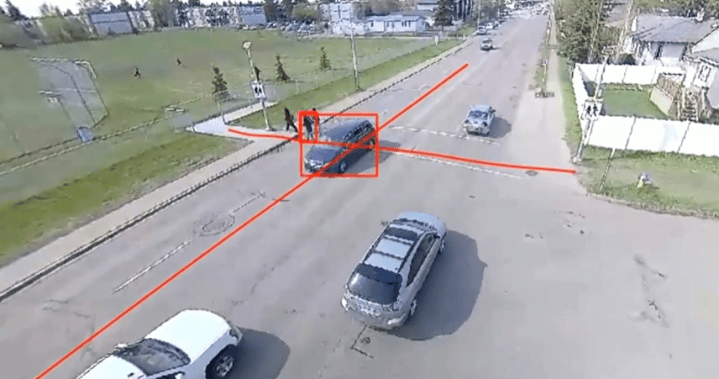
Dozens of near-misses between vehicles and pedestrians were recorded at school-area crosswalks in Edmonton and Calgary as part of a national study commissioned by the Alberta Motor Association and its federal counterpart.
asserted
Dozens → record → Association
Researchers used video and artificial intelligence analysis to track the movement of pedestrians and vehicles.
asserted
Researchers → use → pedestrians
The data released Thursday (scroll down to read the full study) came after 12 Alberta locations — six each in Edmonton and Calgary — were monitored and 72 near-misses recorded.
asserted
misses → release → Edmonton
Seventeen happened between 3 p.m. and 4 p.m., when students are leaving school — the highest number recorded during any single hour.
asserted
students → happen → hour
This was followed by 12 conflicts between 4 p.m. and 5 p.m., and another 12 between 8 a.m. and 9 a.m., during morning drop-off.
asserted
This → follow → off
The Alberta locations were among 30 school-area crosswalks monitored over five days in 11 Canadian cities: Vancouver, Edmonton, Calgary, Saskatoon, Regina, Winnipeg, Toronto, Ottawa, St. Catharines, Ont., Montreal and Halifax.
asserted
locations → monitor → cities
The average school zone crosswalk in the study served 377 pedestrians and 7,600 vehicles a day, and perhaps not surprisingly, higher-volume spots have more conflicts.
asserted
spots → serve → conflicts
Across Canada, the study recorded 660 near-misses, with an average of 4.5 per day.
asserted
study → record → day
One in every 84 pedestrians crossing the monitored locations nationwide experienced one.
asserted
One → cross → one
Near-misses were 2.6 times more likely when vehicles were exiting an intersection than when entering.
asserted
vehicles → exit → intersection
Nationally, the highest number recorded in any single hour was between 5 and 6 p.m., as many adults got off work, when the AMA said there were 94 near-misses.
asserted
AMA → record → work
Near-misses at crosswalks with traffic controls, such as flashing lights, were 20 times lower than at crossings without them.
asserted
misses → flash → them
Conversely, crosswalks without school zone signs or reduced speed zone signs had a 67 per cent higher conflict rate.
asserted
crosswalks → reduce → rate
The AMA calls the report the first study of its kind in North America.
asserted
AMA → call → America
“We use this data to help inform our partners, like municipalities, in creating safer road design and infrastructure,” said Hannah Hamilton, program manager of safe communities with AMA.
asserted
Hamilton → use → AMA
“We’re able to look at communities and help figure out what do they specifically need to have safer crossings around their school zone?”
asserted
they → ’re → zone
Hamilton said most of the incidents in Alberta involved vehicles driving straight.
asserted
most → say → vehicles
“Seventy per cent of near-misses happen with vehicles going straight through an intersection and about 20 per cent of conflicts happen when vehicles are turning through an intersection,” she told Global News.
asserted
she → happen → News
Drivers need to take particular care around children, Hamilton said, because their size can make them harder to see.
asserted
them → need → children
“Children are shorter and they’re less predictable with movement, so they can dart in and out of cars.
asserted
they → ’re → cars
“They may not stop and wait for you, so it’s your responsibility as a driver to pay extra attention — to look for them.”
uncertain
it → stop → them
Edmonton mom Katie Vargas, who has a baby and toddler, said she is careful when approaching a road with her kids.
asserted
she → have → kids
“We approach a crosswalk pretty cautiously, looking back and forth, making sure that the cars see us so they stop,” Vargas told Global News.
asserted
Vargas → approach → News
“Especially with her,” she said, motioning to her toddler.
asserted
she → say → toddler
“I don’t want her to run across the road.”
asserted
her → want → road
AMA is not identifying which crosswalks were monitored but said municipal staff in each city were consulted to select locations that reflected a range of road types, intersection layouts and traffic controls along established routes to nearby schools.
asserted
that → identify → schools
AMA officials say improving safety around school crossings requires action on several fronts.
asserted
improving → say → fronts
“It involves driver attention, it involves pedestrian awareness, it involves school zones being retrofitted to fit the needs of that community, it involves legislation from the government,” Hamilton said.
asserted
Hamilton → involve → government
The study was commissioned by CAA/AMA through a partnership with Miovision, a Canadian traffic data collection firm.
asserted
study → commission → Miovision
 The Aporia