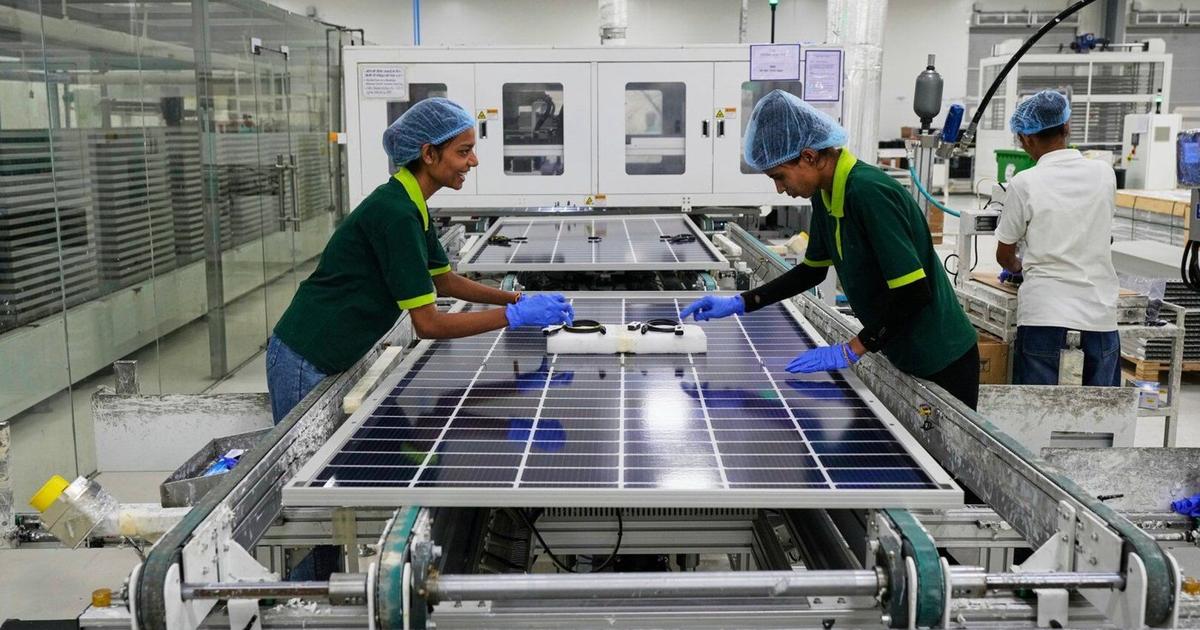
With the United Nations climate talks underway, India has set an ambitious goal of installing enough clean power to supply more than 1 billion homes by 2035, and has approved nearly $20 billion in power grid upgrades to ease bottlenecks that prevent some solar and wind energy from reaching consumers.
asserted
that → set → consumers
The world’s most populous country and one of the biggest carbon polluters is also among the fastest to expand clean power.
asserted
country → expand → power
Accelerating the shift away from fossil fuels is a key goal of this year’s climate talks, known as COP31, in Turkey.
asserted
Accelerating → accelerate → Turkey
India announced the 900-gigawatt goal in late September.
asserted
India → announce → September
It covers nonfossil power sources, including solar, wind, hydropower and nuclear energy.
asserted
It → cover → solar
It is nearly twice India’s existing target of 500 gigawatts of clean power by 2030.
asserted
It → exist → 2030
India’s current clean power capacity of just over 300 gigawatts ranks it third behind China and the United States.
asserted
capacity → rank → China
Experts say meeting the target could lower electricity costs, curb coal construction and accelerate the transition to clean energy.
uncertain
meeting → say → energy
The push comes as India struggles to use all the renewable electricity it can generate because of inadequate transmission infrastructure.
asserted
it → come → infrastructure
The new goal refers to installed generating capacity, rather than the amount of electricity actually produced.
asserted
goal → refer → electricity
“If the grid doesn’t catch up, then there is no way India can meet this target,” Nikit Abhyankar from the India Energy and Climate Center at the University of California, Berkeley, said.
asserted
Abhyankar → catch → California
The government also approved nearly $20 billion in funding for transmission infrastructure and battery storage under its Green Energy Corridor plan.
asserted
government → approve → plan
Cheaper clean electricity could reduce India’s reliance on coal
Economist Ajay Shah of the Mumbai-based XKDR Forum described the transition as the emergence of an Indian “electrostate,” in which electricity increasingly replaces coal and petroleum products.
“So now in India you have two assets — not only do you have cheap labor, you also have cheap energy,” Shah said.
uncertain
Shah → reduce → energy
The shift mirrors a global trend toward cleaner power, even as fossil fuel energy remains a key energy source amid rising electricity demand.
asserted
energy → mirror → demand
Brazil, which ranks close behind India in clean energy capacity, projects renewables will supply nearly 90% of its electricity in the next decade, even as it expands oil and gas production.
asserted
it → rank → production
In the United States, where President Donald Trump supports fossil fuels, electricity demand is expected to grow by 40%, with natural gas remaining a major source.
asserted
gas → support → %
India’s clean energy expansion could help industries replace costly imported fossil fuels with domestically produced electricity.
uncertain
industries → help → electricity
Abhyankar said solar and wind power, even when combined with battery storage, are increasingly cost-competitive with power from coal, oil and natural gas.
asserted
power → say → coal
Lower generation costs could eventually translate into cheaper electricity for households, though utilities also factor in transmission costs and other expenses.
uncertain
utilities → translate → costs
There are concerns about maintaining reliable power supply
However, India’s continued dependence on coal presents a major challenge to its clean energy transition.
asserted
dependence → be → transition
Coal generated about 71% of the country’s electricity in 2025, according to energy think tank Ember.
uncertain
Coal → generate → Ember
India’s power planners remain concerned about meeting growing demand and maintaining reliable electricity when solar and wind output fluctuates.
asserted
output → remain → electricity
Ghanshyam Prasad, chair of the Central Electricity Authority, said earlier this month that India could need as much as 150 gigawatts of additional coal-fired generating capacity by 2035.
uncertain
India → say → 2035
Ember energy analyst Neshwin Rodrigues said coal will remain important for years, particularly until large-scale batteries can store solar energy to reliably meet demand when the sun isn’t shining.
asserted
sun → say → demand
Existing coal plants also pose operational challenges.
asserted
plants → exist → challenges
Many cannot quickly reduce output when renewable electricity becomes available, making it difficult for the grid to accommodate growing solar and wind power.
asserted
grid → reduce → power
Researchers at Berkeley estimate that beyond approximately 35 gigawatts of coal capacity already under construction, additional coal plants would not be economically necessary under the country’s new clean energy goals.
asserted
plants → estimate → goals
Berkeley’s Abhyankar warned that newly built coal plants could become stranded assets if the government meets its renewable energy targets.
uncertain
government → warn → targets
Grid improvements and finance remain hurdles
Meeting the 2035 target requires more than building more renewable power plants.
asserted
Meeting → remain → plants
Their electricity must be able to reach consumers.
asserted
electricity → reach → consumers
India’s rapid clean energy expansion is already testing the grid’s limits.
asserted
expansion → test → limits
Although clean power accounted for 55% of installed power capacity by September, it generated about a third of the country’s electricity in the preceding three months, according to government data.
uncertain
it → account → data
Over the past 16 months, India curtailed enough solar generation to power about 10 million homes because the grid could not accommodate it, according to government data and Ember.
uncertain
grid → curtail → data
The Green Energy Corridor plan aims to help states accommodate up to 135 gigawatts of renewable energy by 2033 by adding thousands of kilometers (miles) of transmission lines.
asserted
states → aim → lines
The plan also includes additional battery storage.
asserted
plan → include → storage
But analysts question whether that’s enough.
asserted
that → question → ?
The Berkeley researchers estimate that India needs as much as 250 gigawatts of energy storage to integrate renewable electricity over the next decade.
asserted
India → estimate → decade
“You either have more transmission to get the power out and transfer it.
asserted
You → have → it
Or if you cannot get the power out, you store it and then transfer it during some other hours,” Ember’s Rodrigues said.
asserted
Rodrigues → get → hours
Shah, the economist, said two types of government policy could discourage investment in renewable energy: requirements that businesses pay higher rates to subsidize other consumers, and restrictions on electricity producers selling directly to private buyers.
uncertain
producers → say → buyers
…and 6 more, not listed.
 The Aporia