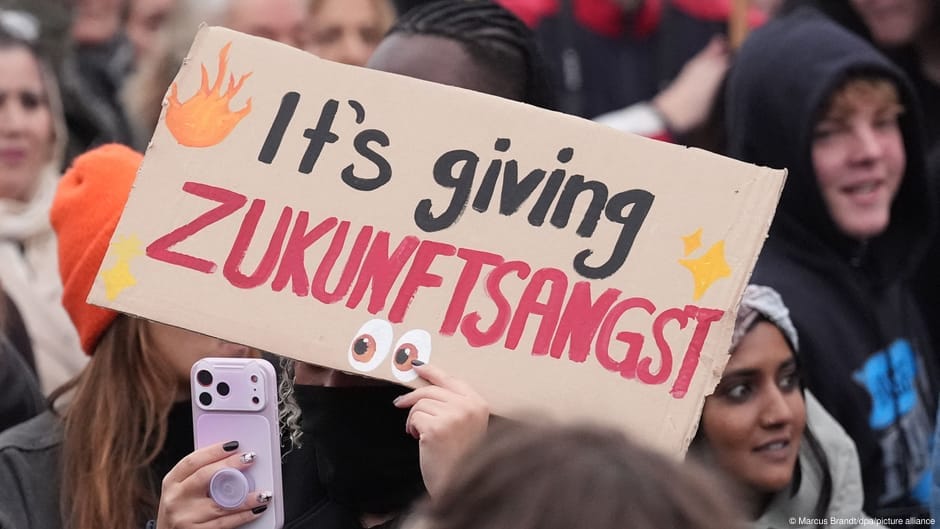
Young people across Germany and Europe are taking to the streets, voicing fears of a bleak future.
asserted
people → take → future
Does Gen Z face greater challenges than Baby Boomers did in the 1990s?
asserted
Boomers → face → 1990s
What do the two generations have in common, and where do their experiences differ?
asserted
experiences → have → What
"Of course, it's fair to ask, 'Were things just as tough for you back then?'" youth researcher Simon Schnetzer tells DW.
asserted
Schnetzer → ask → DW
"But young people see that things are difficult for them now, and say that's why they need support today."
Schnetzer, who wrote the annual Youth in Germany study, highlights one key question raised by the recent demonstrations across Europe as: "Have we given young people the conditions they need to live and work here with confidence, and to keep this system funded?"
asserted
system → see → confidence
A survey of the statistics shows that both Gen Z and the Baby Boomers are affected by major societal changes, but in different ways.
asserted
Z → show → ways
DW surveyed data on pensions, education, housing and climate change to find out more.
asserted
DW → survey → more
Pensions and poverty among the elderly
The facts point to a clear trend: Fewer and fewer young people are having to support an ever-growing number of retirees.
asserted
people → point → retirees
By 2025, that figure had fallen to just 2.1.
asserted
figure → fall → 2.1
By 2045, this number is projected to drop to just 1.73 contributors per retiree.
asserted
number → project → retiree
In absolute terms, this means 35.35 million contributors will be financing pensions for 16.82 million retirees.
asserted
contributors → mean → retirees
To cushion this trend and keep contribution rates stable, the pension system already receives around €118 billion [$131 billion] in annual government subsidies.
asserted
system → cushion → subsidies
This amounts to roughly 25% of the federal budget.
asserted
This → amount → budget
That means an increasing share of the population will be called upon to help fund pensions.
asserted
share → mean → pensions
There are also signs that many people's pensions are already falling short of covering their living expenses.
asserted
pensions → be → expenses
The number of retirees relying on federal basic income support has risen from 257,000 in 2003 to 738,000 in 2024.
asserted
number → rely → 2024
Rent and housing costs
Rising rents hit low-income households particularly hard.
asserted
rents → rise → households
According to a report by the German Institute for Economic Research (DIW), the share of income spent on rent by low-income households rose from around 24% in 1990 to nearly 36% in 2021.
uncertain
share → accord → 2021
This means that in 2021, the lowest-income households spent an average of 14 percentage points more of their income on rent than high-income households.
asserted
households → mean → households
According to Germany's Federal Statistical Office (Destatis), in 2025, an average of 11% of the population spent more than 40% of their disposable income on housing costs.
uncertain
average → accord → costs
However, according to calculations by real estate platform Jacasa, Boomers could actually help ease pressure on the housing market in the coming years.
uncertain
Boomers → accord → years
They currently own around 4.8 million owner-occupied houses and apartments.
asserted
They → own → houses
Over the coming decades, these properties are expected to change hands as former occupants sell them, move into assisted living, or hand them down through inheritance.
asserted
occupants → come → inheritance
In some regions, this could lead to an oversupply of properties and, consequently, lower prices, according to Jacasa's projections.
uncertain
this → lead → projections
According to the federal government's Education Finance Report, public spending on education for people under 30 has doubled since 2011, rising from around €4,000 to approximately €8,000 per person annually.
uncertain
spending → accord → person
Despite this increase, Germany ranks only in the middle of the pack internationally.
asserted
Germany → rank → pack
According to the Federal Statistical Office (Destatis), public education spending accounted for 4.6% of Germany's gross domestic product (GDP) in 2022, compared with an OECD average of 4.7%.
uncertain
spending → accord → %
However, the additional funding cannot solve the problem of teacher shortages.
asserted
funding → solve → shortages
According to estimates by the Standing Conference of the Ministers of Education and Cultural Affairs, Germany will be short of around 27,000 teachers by 2035.
uncertain
Germany → accord → 2035
The main reasons are the wave of Baby Boomer retirements and declining birth rates, which have contributed to a shortage of young teachers.
asserted
which → decline → teachers
Back in 1972, the Club of Rome warned of the consequences of global warming in its landmark publication The Limits to Growth.
asserted
Club → warn → Growth
According to the United Nations, the planet is on track for 2.6°C of warming by the end of the century compared with pre-industrial levels.
uncertain
planet → accord → levels
If the world maintains its current climate policies, children who are six years old today could experience heat waves two to seven times as often as Boomers did over their lifetimes.
uncertain
Boomers → maintain → lifetimes
The deadly impact of extreme weather is already evident in rising death tolls during recent heatwaves.
asserted
impact → rise → heatwaves
According to Germany's Robert Koch Institute (RKI), an estimated 16,000 people died from heat-related causes across Germany by mid-September 2026.
uncertain
people → accord → September
We need to bring them together, because otherwise younger people have no prospects for prosperity, and neither do older generations," youth researcher Schnetzer concludes.
asserted
Schnetzer → need → prosperity
He suggests that both generations take to the streets and protest together, adding that would just be the beginning.
uncertain
that → suggest → streets
"What needs to follow is a constructive process to define goals and measures that everyone can support," he said.
asserted
he → need → that
"Even if it means making sacrifices.
asserted
it → mean → sacrifices
This article was originally published in German.
asserted
article → publish → German
 The Aporia