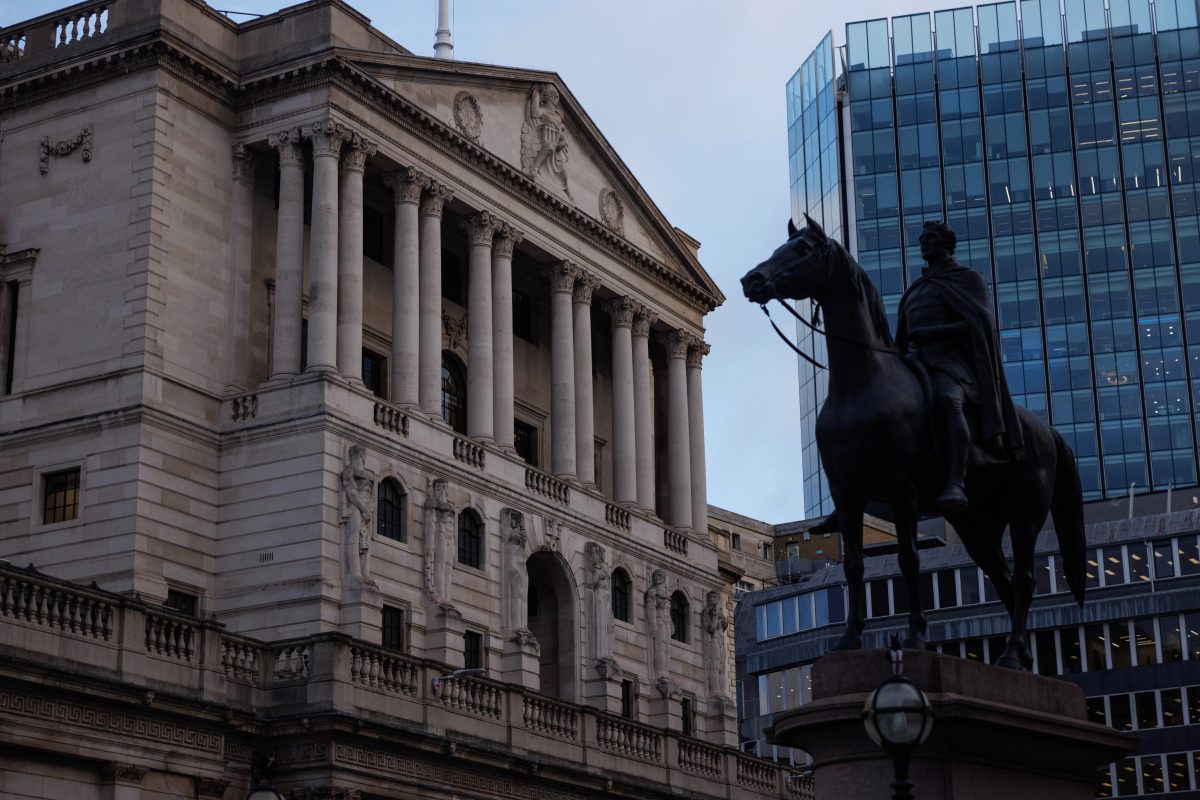
Photo via The Guardian

Interest rate rises likely in coming months, Bank of England economist says

Read the original at The Guardian ↗
Cite

Inman, P. (2026, November 14). Interest rate rises likely in coming months, Bank of England economist says. The Guardian. https://www.theguardian.com/business/2026/nov/14/interest-rate-rises-inflation-bank-of-england-chief-economist

Dated from the outlet's own feed. Check the original for its byline.

The Guardian · collected 2026-11-14 · by Phillip Inman

Quick Summary

Bank of England chief economist Huw Pill reports that the central bank will likely need to raise interest rates next month and again in early 2027 to combat inflation expected to reach 5% by next spring. The report highlights that these moves could cause a sharp rise in mortgage payments for an estimated 2.3 million homeowners needing to refinance next year. Pill takes a hawkish stance, arguing that the bank waited too long to act and must now pursue more substantial increases to counter second-round effects like high wage demands and rising energy costs.
Written by AI on 2026-11-14, from this article's own text only (the story summary below draws on all the coverage).

AI analysis

Story summary

The Bank of England's chief economist, Huw Pill, predicts that interest rates will likely rise again next month and in early 2027 to address rising inflation. Pill stated that he is leaning towards supporting another quarter-point increase, which would raise interest rates from 3.75% to 4%. This move is expected to significantly impact an estimated 2.3 million homeowners who will need to refinance their mortgages, potentially leading to higher mortgage payments. Pill's concerns stem from the ongoing Iran war and persistently high energy prices, which are anticipated to push inflation to 5% in spring 2027. The Bank's policymakers believe the UK economy has strengthened, giving workers more leverage to negotiate higher wages, which could further drive inflation.

Written for “Interest Rate Rises Expected” on 2026-11-14, grounded in this article and the 0 other(s) covering the same event.

Compared with similar articles

This article reads unscored and hedges 13% of its claims. Each row says how that neighbour differs.
City AM
Hedges 8 of 25 claims Outlet record 94/100
“The articles discuss different timeframes and specific interest rate decisions, with the first urging a jump to 5% and the second suggesting smaller incremental rises.”
Evening Standard
Hedges 3 of 15 claims Outlet record 64/100
“The articles discuss similar predictions about future interest rate hikes but refer to different time periods and specific statements by different policymakers.”

Story

Interest Rate Rises Expected
Economy/Business · 1 article(s) covering the same event.
How this article was measured signals, leaning charts, publisher record, byline, topics and claims

Signals How these are calculated →

Claims extracted
15
sentences that state something as happening or true
Uncertain
13%
2 of 15 hedged ("reportedly", "may", "according to")
Leaning
not political
takes no side on a contested political question
Publisher signals
65/100
The Guardian's corrections and hedging, across everything collected from it. Not a measure of accuracy.
Outlets on this story
1
Economy/Business
Same framing elsewhere
1
articles that frame the event the way this one does
Analyzed 2026-11-14 · how these are computed

How this is being covered How these are calculated →

Article leaning vs. publisher reliability
Source leaning vs. consistency

Publisher

The Guardian · 3442 article(s) · 7 correction(s) detected
Running correction rate · 7 correction(s)

Who wrote this

Phillip Inman
10 article(s) here · 1 carrying a prediction
The Bank of England will probably need to raise interest rates next month and again in early 2027 to combat rising inflation, its chief economist has said.
“Inflation is set to rise above 4% in the new year, just as most pay awards for 2027 are being agreed, so the risk that it becomes embedded is rising. “
Many people will be incredulous when they hear of the decision to increase the cost of borrowing by 0.25 percentage points, looking around their neighbourhood for signs of a booming economy. The official figures show the economy has proved resilient in response to the jump in oil and gas prices after the outbreak of war in Iran, but UK high streets are struggling and the underlying drivers of inflation are absent.
The Resolution Foundation said on Thursday that measures to ease household gas and electricity costs would still leave energy bills higher this year than during the last energy shock.
John Healey will present his first budget on Wednesday, which will set the tone for Andy Burnham’s premiership.
The threat of a renewed round of inflation from the persistently high cost of oil has spooked investors, who believe central banks will be forced to raise rates in the coming months to prevent price increases from becoming embedded.
The UK is losing out on annual exports to the EU that could be worth as much as £6.5bn without a deal with Brussels that allows manufacturers to jettison duplicate product testing.
Attacks on the government’s independent economic forecaster from left and right of the political spectrum are akin to “shooting the messenger”, according to an influential group of MPs.
The chancellor could announce tax rises in his first budget to offset the rising cost of government borrowing, which has soared in response to the conflict in the Middle East.
Also by Phillip Inman
Nothing else under this byline is closely related to this article, so these are simply their most recent.
All 10 articles by Phillip Inman →

Topics

Bank MPC The Bank of England the Financial Times the Iran war

Subjects

Pill PERSON · 6× Bank ORG · 3× MPC ORG · 2× Huw Pill PERSON · 1× Iran GPE · 1× The Bank of England ORG · 1× the Financial Times ORG · 1×

Narrative

Pill said he considered an end to the US-Israeli conflict with Iran and a fall in energy prices to be a “very low probability”, signalling to the newspaper that he was poised to vote for another quarter-point increase next month. “My bias, for what it’s worth, is that I worry about the inflationary impact being magnified by second-round effects,” he said, adding that he believed the central bank should have acted sooner to combat inflation.
framing: assertive · carried by 1 article(s) · first seen 2026-11-14
The Bank of England will probably need to raise interest rates next month and again in early 2027 to combat rising inflation, its chief economist has said.
2026-11-14 · The Guardian
Interest rate rises likely in coming months, Bank of England economist says · assertive framing

Claims (15 extracted, 2 hedged)

The Bank of England will probably need to raise interest rates next month and again in early 2027 to combat rising inflation, its chief economist has said. asserted
economist → need → inflation
Signalling a sharp rise in mortgage payments for an estimated 2.3 million homeowners who will have to refinance their loans next year, Huw Pill said that while the decision to nudge interest rates from 3.75% to 4% earlier this month was a “significant step” towards getting monetary policy into a better place, “we have further to go”. asserted
we → signal → further
Pill told the Financial Times: “My view would be, we will see evidence that motivates further rises,” adding that the central bank would “do what is necessary to get inflation back to 2% through time”. asserted
inflation → tell → time
The chief economist is one of a number of the Bank’s policymakers who believe the UK economy has gained in strength over the last year, handing workers the power to bid up wages. asserted
economy → believe → wages
Recent figures showed the economy grew by 0.7% in the third quarter, to give an annual rate of growth that was only surpassed by the US among the G7 group of wealthy countries. asserted
that → show → countries
With inflation expected to rise to 5% in spring next year, driven by high oil and gas prices as a result of the Iran war, Pill expects public and private sector workers to demand substantial pay rises, which would keep inflation high for a longer period. asserted
which → expect → period
Pill said he considered an end to the US-Israeli conflict with Iran and a fall in energy prices to be a “very low probability”, signalling to the newspaper that he was poised to vote for another quarter-point increase next month. “My bias, for what it’s worth, is that I worry about the inflationary impact being magnified by second-round effects,” he said, adding that he believed the central bank should have acted sooner to combat inflation. asserted
bank → say → inflation
“In my view, we waited too long.” asserted
we → wait → view
While the Bank has not seen evidence of wage increases or companies being able to pass on higher costs to consumers, Pill said the absence of evidence was not evidence of absence. asserted
absence → see → absence
“As we go into next year, we will begin to see some evidence, and it could play out in one direction or another — we’ll see.” uncertain
we → go → direction
Financial markets expect UK interest rates to rise to almost 5% in 2027. asserted
rates → expect → 2027
Pill said these expectations were “not outrageous”, hinting that he could vote for more substantial increases in the cost of borrowing at the next meetings of the Bank’s monetary policy committee (MPC) because the “ability to be modest [in the scale of rate rises] has diminished”. uncertain
ability → say → rises
City analysts have interpreted the increasingly hawkish comments of Pill and other MPC members as making an interest rate rise in December almost inevitable. asserted
rise → interpret → December
But there is disagreement about the strength of the economy, with many concerned that further increases in the cost of borrowing will hit the manufacturing sector and the construction industry, which has contracted for much of the year. asserted
which → be → year
Households are also likely to cut back on spending in the new year, when the energy price cap is expected to rise to almost £2,000 for a typical home and council tax bills increase by an average of almost 5%. asserted
bills → cut → %

Give feedback · no sign-in needed

No sign-in needed for now. Your note is sent without a name, so it cannot be answered.

History Support