
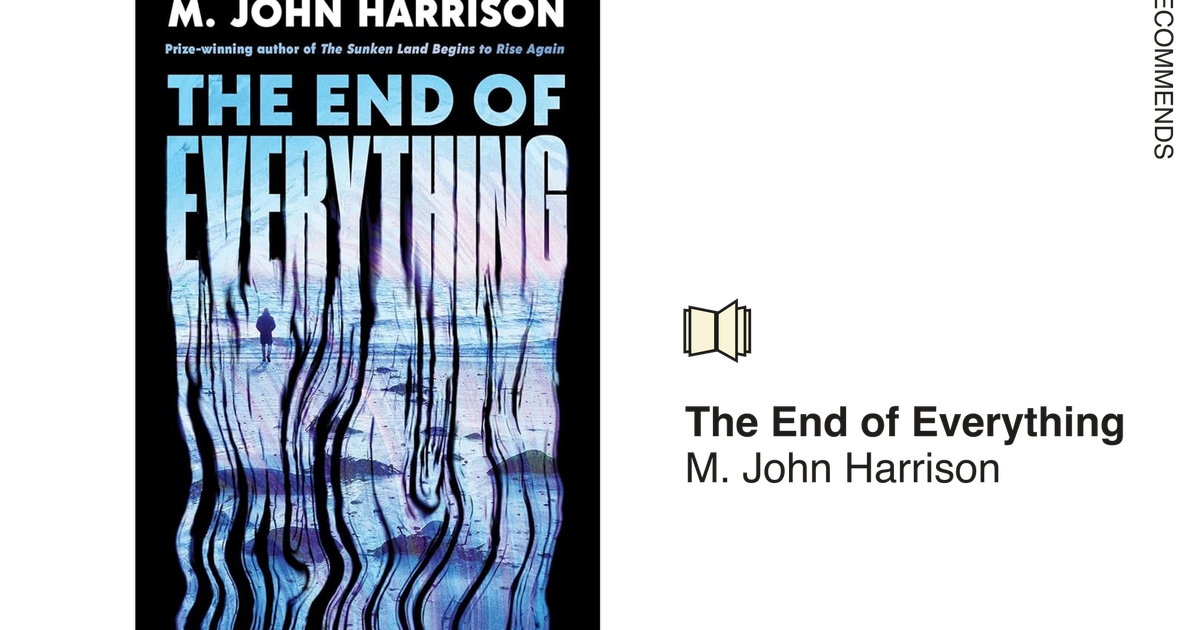
Photo via The Hindu

M. John Harrison | From rebellion to despair

Read the original at The Hindu ↗
Cite

Mukunth, V. (2026, November 14). M. John Harrison | From rebellion to despair. The Hindu. https://www.thehindu.com/books/books-authors/m-john-harrison-from-rebellion-to-despair/article71702830.ece

Dated from the outlet's own feed. Check the original for its byline.

The Hindu · collected 2026-11-14 · by Vasudevan Mukunth

Quick Summary

British author M. John Harrison, known for his dystopian novel "The End of Everything," which won the Booker Prize, expressed despair about humanity's future in 2026, contrasting this with his earlier support for Extinction Rebellion in 2019. Born in 1945 and influenced by T.S. Eliot’s "The Waste Land," Harrison’s literary approach reflects a fragmented yet coherent view of reality. His shift in sentiment highlights his evolving perspective on societal change and environmental activism.
Written by AI on 2026-11-15, from this article's own text only (the story summary below draws on all the coverage).

AI analysis

Story summary

British writer M. John Harrison, who won the Booker Prize for his dystopian novel "The End of Everything," has recently expressed losing hope for humanity's future, despite previously supporting environmental activism. In 2019, Harrison backed the Extinction Rebellion movement and encouraged people to take action to change the world. However, after winning the prestigious prize last week, he revealed his despair. Harrison, born in 1945 in Warwickshire, grew up during World War II and was influenced by T.S. Eliot's "The Waste Land," which inspired him to become a professional writer despite financial hardships. His transformation from a hopeful activist to a despondent author highlights the shifting attitudes towards environmental issues over the past seven years.

Written for “M John Harrison Interview” on 2026-11-17, grounded in this article and the 0 other(s) covering the same event.

Compared with similar articles

This article reads unscored and hedges 17% of its claims. Each row says how that neighbour differs.
The Straits Times
Hedges 0 of 6 claims Outlet record 64/100
“Article A reports on John Harrison winning the Booker Prize, while Article B discusses Harrison's change in outlook after winning the prize, covering a different but related event.”
Semafor
Hedges 0 of 3 claims Outlet record 65/100
“The articles discuss different aspects of M. John Harrison's career and his perspective on humanity, not the same specific event.”

Story

M John Harrison Interview
Entertainment · 1 article(s) covering the same event.
How this article was measured signals, leaning charts, publisher record, byline, topics and claims

Signals How these are calculated →

Claims extracted
6
sentences that state something as happening or true
Uncertain
17%
1 of 6 hedged ("reportedly", "may", "according to")
Leaning
withheld
no quote in the article backed the model's score
Publisher signals
78/100
The Hindu's corrections and hedging, across everything collected from it. Not a measure of accuracy.
Outlets on this story
1
Entertainment
Same framing elsewhere
1
articles that frame the event the way this one does
Analyzed 2026-11-15 · how these are computed

How this is being covered How these are calculated →

Article leaning vs. publisher reliability
Source leaning vs. consistency

Publisher

The Hindu · 1322 article(s) · 2 correction(s) detected
Running correction rate · 2 correction(s)

Who wrote this

Vasudevan Mukunth
11 article(s) here · 1 carrying a prediction
He has said he was impressed by The Waste Land by T.S. Eliot, especially the way its narrative could pull fragments together into a coherent whole without also pretending it depicted a complete reality.
2026-11-14 · assertive framing · M. John Harrison | From rebellion to despair
And while it would be reductive to believe the left is more welcoming of climate action and the right is more disdainful, Mr. Lula also faces significant challenges in his role on the issue both in Brazil and beyond.
With Starshield, however, the provider continued to retain the ability to change the operating conditions of the ‘assistance’ even after the customer had begun using it — like a grenade launcher that could launch grenades to 150 m on most days but suddenly launched only to five metres on one, because you were not fighting your war the way the manufacturer preferred.
2026-10-24 · assertive framing · PROFILES: Starshield | The non-state sovereigns
In May, five of the six military satellites Russia had launched expended a considerable amount of fuel to change their orbital inclination — the tilt of their orbits with respect to the equator — from 97° to 97.8°, which is closer to the inclination of ICEYE-X36.
Alfred Nobel’s will said nothing about the number of people that can be awarded at one time but the Nobel Foundation’s statutes limit each prize to at most three people at a time, and no one that has died by the time a prize is announced.
2026-10-08 · assertive framing · The people this year’s Nobel Prizes left out
Far from critical After the war ended, Heisenberg said the team had come very close; he wrote in a 1947 article in Nature that Haigerloch didn’t have enough resources and that just a little more quantity of uranium would have done the trick.
In 2025, the then-Space Force chief, Gen. Chance Saltzman, said such a device could possess both “kinetic and non-kinetic” capabilities and could disrupt or degrade an adversary’s capabilities.
2026-09-19 · assertive framing · Why has U.S. deployed ‘space weapons’? |Explained
By backing the call, the AU has expressed hope that a fairer projection will restore geographical accuracy and correct what it characterises as centuries of symbolic marginalisation.
Proving it would enhance experts’ ability to predict the distribution of prime numbers, potentially exposing weaknesses in some cryptographic systems.
Also by Vasudevan Mukunth
Nothing else under this byline is closely related to this article, so these are simply their most recent.
All 11 articles by Vasudevan Mukunth →

Topics

British Extinction Rebellion London Warwickshire the Second World War

Subjects

Harrison PERSON · 2× British NORP · 1× Extinction Rebellion ORG · 1× London GPE · 1× M. John Harrison PERSON · 1× T.S. Eliot PERSON · 1× Warwickshire GPE · 1×

Narrative

But last week, after winning the Booker Prize for his “destabilising and satirical dystopian novel”, The End of Everything, he said he had lost hope for humanity — even as people continued to fight to change the world.
framing: assertive · carried by 1 article(s) · first seen 2026-11-15
He has said he was impressed by The Waste Land by T.S. Eliot, especially the way its narrative could pull fragments together into a coherent whole without also pretending it depicted a complete reality.
2026-11-15 · The Hindu
M. John Harrison | From rebellion to despair · assertive framing

Claims (6 extracted, 1 hedged)

In 2019, British writer M. John Harrison said he supported Extinction Rebellion, a global environmental movement, and people taking action to change the world. asserted
he → say → world
But last week, after winning the Booker Prize for his “destabilising and satirical dystopian novel”, The End of Everything, he said he had lost hope for humanity — even as people continued to fight to change the world. asserted
people → win → world
Did something change in seven years? asserted
something → change → years
Harrison was born in 1945 and grew up in the shadow of the Second World War. asserted
Harrison → bear → War
He has said he was impressed by The Waste Land by T.S. Eliot, especially the way its narrative could pull fragments together into a coherent whole without also pretending it depicted a complete reality. uncertain
it → say → reality
Harrison later moved to London from Warwickshire determined to become a professional writer, despite financial difficulties. asserted
Harrison → move → difficulties
Give feedback · no sign-in needed

No sign-in needed for now. Your note is sent without a name, so it cannot be answered.

History Support