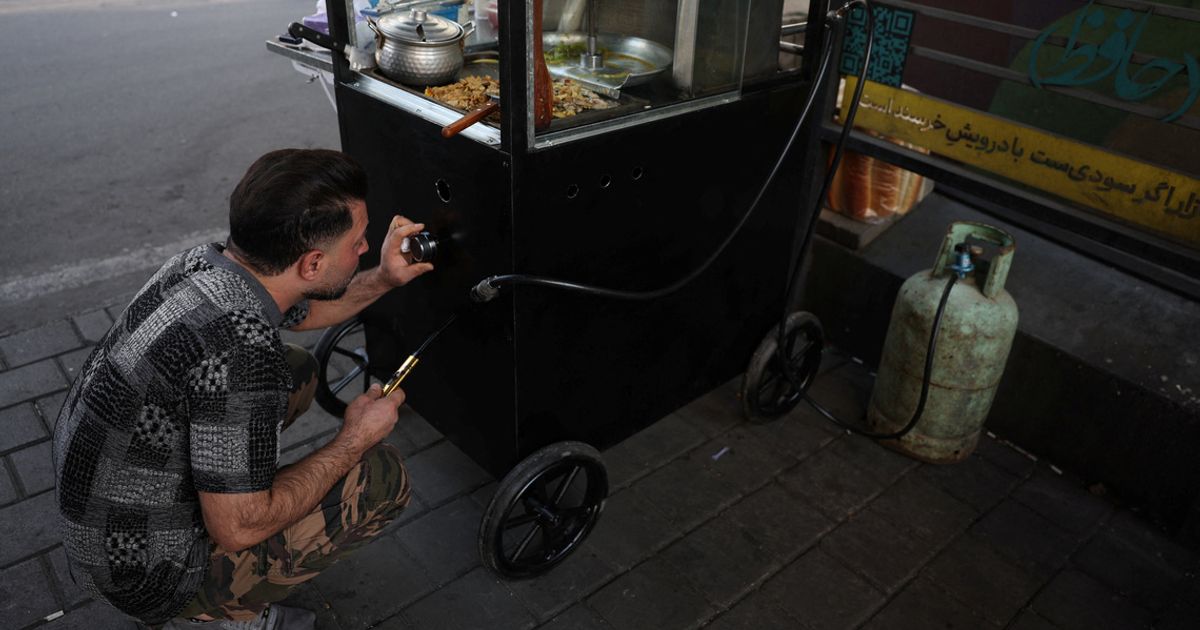
Photo via New York Post

Iran’s fuel rationing system reaches breaking point with hours-long lines, protests on eve of ‘Bloody November’

Read the original at New York Post ↗
Cite

Fahmy, G. (2026, November 14). Iran’s fuel rationing system reaches breaking point with hours-long lines, protests on eve of ‘Bloody November’. New York Post. https://nypost.com/2026/11/14/world-news/hours-long-lines-protests-at-iranian-gas-stations-reach-breaking-point-on-eve-of-bloody-november/

Dated from the outlet's own feed. Check the original for its byline.

New York Post · collected 2026-11-14 · by Gabrielle Fahmy

Quick Summary

On Saturday, Iran experienced severe fuel shortages, with motorists waiting in long lines at gas stations and taxi drivers protesting in several cities. Videos circulating on Telegram show drivers shouting in frustration and taxi drivers refusing to pick up passengers. The situation is particularly tense as it coincides with the anniversary of the 2019 “Bloody November” protests, which began after a sudden increase in fuel prices led to widespread unrest and a violent government crackdown. The current rationing system limits monthly fuel to 160 liters per vehicle, but the government's recent removal of emergency cards for additional fuel has exacerbated the shortages.
Written by AI on 2026-11-17, from this article's own text only.

AI analysis

Why this leaning score
The article's own words the score was based on. Each is quoted verbatim and was checked against the article text before being stored, so you can find it in the original.
Reading Leans strongly left (beta estimate) Confidence high
Leaning: leans strongly left for article 154258 (high confidence, 3 verified quotes) · logged 2026-11-17

Compared with similar articles

This article reads leans strongly left and hedges 6% of its claims. Each row says how that neighbour differs.
The Straits Times
Leans strongly right further right than this Hedges 4 of 26 claims Outlet record 64/100
“The articles describe related issues but focus on different aspects and timeframes of the fuel rationing crisis in Iran.”
How this article was measured signals, leaning charts, publisher record, byline, topics and claims

Signals How these are calculated →

Claims extracted
17
sentences that state something as happening or true
Uncertain
6%
1 of 17 hedged ("reportedly", "may", "according to")
Leaning
Leans strongly left
of the writing, not the subject · beta estimate
Publisher signals
66/100
New York Post's corrections and hedging, across everything collected from it. Not a measure of accuracy.
Outlets on this story
unclustered
not grouped into a story yet
Same framing elsewhere
1
articles that frame the event the way this one does
Analyzed 2026-11-17 · how these are computed

How this is being covered How these are calculated →

Article leaning vs. publisher reliability
Source leaning vs. consistency

Publisher

New York Post · 20671 article(s) · 41 correction(s) detected
Running correction rate · 41 correction(s)

Who wrote this

Gabrielle Fahmy
37 article(s) here · 1 carrying a prediction
Until last month, Iranians could fill up with a gas station’s own “emergency card” after they ran out of their monthly ration, at a higher price of 100,000 rials.
That’s despite both having backed DSA candidates — Jeffries endorsed Mayor Zohran Mamdani last year and Schumer gave a speech at a 2023 re-election fundraiser for City Councilwoman Tiffany Cabán in Astoria, where they were serving up $14 cocktails with names like “The Spirited Socialist.”
Officials reportedly said they could use heavy hypersonic weapons to target bunkers and motorcades carrying Ukrainian leaders and top army commanders.
“The Americans raised the question: ‘What if Ukraine joins NATO? Would Ukraine withdraw from Donbas?’
Peltola, 53, is challenging incumbent Sen. Dan Sullivan (R-Alaska) in a critical and controversial race that could determine the balance of power on Capitol Hill.
“I didn’t go outside at all … where we were, where we lived, we couldn’t get any food.
“If the enemies once again launch military attacks, it is the armed forces of the Islamic Republic and the Iranian nation that will determine the time and conditions for ending them,” he said in a statement on his official social media accounts and broadcast on state media.
Charles E. Williams II, Michigan chapter president of Sharpton’s National Action Network, lambasted El-Sayed’s lack of cultural credibility in undercover footage that lays bare the dilemma facing black leaders torn between their aversion toward El-Sayed — and the community’s expectation they vote blue no matter what. “You can’t pluck the heart strings of people selling them all of the pie in the sky, that’s not realistic,” Williams said in a video taken outside a meeting at his historic King Solomon Missionary Baptist Church last Saturday and obtained by The Midwesterner.
The far-left group that began with the 2018 election of Rep. Alexandria Ocasio-Cortez is set to be a substantial block whose members are itching to leverage their newfound power to try to turn their sprawling agenda — abolishing ICE, Medicare for All, expanding gender-affirming care, and government-run supermarkets — into action.
Also by Gabrielle Fahmy
Nothing else under this byline is closely related to this article, so these are simply their most recent.
All 37 articles by Gabrielle Fahmy →

Topics

Iran Iranian Iranians Kazeroun Telegram

Subjects

Iran GPE · 5× Kazeroun GPE · 4× Iranians NORP · 3× Iranian NORP · 2× Telegram ORG · 2× Ali Khamenei PERSON · 1× Ardabil GPE · 1× Bandar Abbas GPE · 1× Evaz GPE · 1× Lordegan GPE · 1×

Narrative

Fearing a possible repeat, the government has avoided another price hike since, instead rationing gasoline to 160 liters a month per vehicle. But a collapsing economy, due to Washington’s crippling sanctions, government corruption and now the US blockade on the Strait of Hormuz, has deeply worsened shortages and put tensions inside Iran on the brink.
framing: assertive · carried by 1 article(s) · first seen 2026-11-17
Until last month, Iranians could fill up with a gas station’s own “emergency card” after they ran out of their monthly ration, at a higher price of 100,000 rials.

Claims (17 extracted, 1 hedged)

Motorists across Iran were trapped in grueling hours-long lines at gas stations and taxi drivers took to the streets in protest Saturday, as the state’s fuel rationing system reached a breaking point — hours before the infamous anniversary of “Bloody November.” asserted
system → trap → November
In one video shared on Telegram, drivers at a gas station in the southern city of Kazeroun are heard shouting in anger about the fuel shortages. asserted
drivers → share → shortages
This city has shown many times that it does not remain silent in the face of neglect and ignoring the demands of the people,” one Iranian Telegram account commented Saturday. asserted
account → show → people
“These days, long queues at gas stations in Kazeroun have become one of the main concerns of the people.” In other videos, lines of cars can be seen stretching for miles in southern Iranian cities that include Kazeroun, Bandar Abbas, Evaz and Lordegan. asserted
that → become → Kazeroun
In Ardabil in the north, footage shows taxi drivers parking their cars in protest, leaving passengers stranded as they refuse to pick them up. asserted
they → show → them
Sunday marks seven years since Iran was rocked by “Bloody November.” asserted
Iran → mark → November
Just after midnight on Nov. 15, 2019, Iran announced a dramatic price hike — from 10,000 to 15,000 rials per liter for the first 60 liters of gas a month, then 30,000 rials after that — an increase of 50% and 300%, respectively, overnight. asserted
Iran → announce → %
Within hours, nationwide protests sparked, with Iranians blocking highways with their cars, burning banks and tearing down images of then Supreme Leader Ali Khamenei. asserted
Iranians → spark → Khamenei
After a day of unrest, the iron-fisted Ayatollah told senior commanders to “do whatever it takes to end it,” resulting in one of the deadliest crackdowns in the Islamic Republic’s hardline history. asserted
it → tell → history
An estimated 1,500 Iranians were slaughtered over the course of less than two weeks. asserted
Iranians → slaughter → weeks
Fearing a possible repeat, the government has avoided another price hike since, instead rationing gasoline to 160 liters a month per vehicle. But a collapsing economy, due to Washington’s crippling sanctions, government corruption and now the US blockade on the Strait of Hormuz, has deeply worsened shortages and put tensions inside Iran on the brink. asserted
economy → fear → brink
Until last month, Iranians could fill up with a gas station’s own “emergency card” after they ran out of their monthly ration, at a higher price of 100,000 rials. uncertain
they → fill → rials
That accounted for nearly half the gasoline sold across the country. asserted
That → account → country
But since Nov. 1, the regime has taken away emergency cards in more than a third of Iran, with plans to strip the rest within weeks. asserted
regime → take → weeks
A state official even admitted this week, “we really have a supply problem” — in comments that have raised the ire of the government, Iran International reported. asserted
International → admit → government
“All the gasoline the government has, it has given to the people,” said Esmail Sagheb Esfahani, vice president of the State Energy Efficiency Agency. asserted
Esfahani → have → Agency
“Nothing has been held back to supply more.” asserted
Nothing → hold → more

Give feedback · no sign-in needed

No sign-in needed for now. Your note is sent without a name, so it cannot be answered.

History Support