After decades of debating atheists over science and faith, the conservative author says archaeological discoveries changed his understanding of Scripture.
asserted
discoveries → debate → Scripture
Dinesh D'Souza has spent much of his career defending Christianity against its critics.
asserted
D'Souza → spend → critics
But there was one argument he wasn't entirely comfortable making: that the Bible could be trusted as history.
uncertain
Bible → be → history
The conservative author and filmmaker says his exposure to biblical higher criticism in college left him with the impression that Scripture contained a mixture of historical fact, legend, and error.
asserted
Scripture → say → fact
He accepted that its human authors were divinely inspired, but assumed they might have gotten some of the history wrong.
uncertain
some → accept → history
In this kind of latter secular age that we live in, God has sort of decided to start speaking a second language.'
asserted
God → live → language
"I sort of had this view of the Bible in which you couldn't defend the Bible like line by line," D'Souza recalled during a recent appearance on the "Daily Dose of Wisdom" podcast, where he discussed his new book, "The Stones Cry Out: Biblical Archaeology, Prophecy, and the Last Days."
asserted
Stones → have → book
Then, during a visit to Israel in 2022, he encountered archaeological evidence that made him reconsider.
asserted
him → encounter → evidence
The missing argument
D'Souza was no newcomer to Christian apologetics.
asserted
D'Souza → miss → apologetics
His 2007 best-seller "What's So Great About Christianity" challenged prominent atheists on questions of science, philosophy, evolution, and the existence of God.
asserted
What → challenge → God
In a 2007 interview with theologian Albert Mohler, he recalled how the intellectual atmosphere at Dartmouth had shaken his childhood faith.
asserted
atmosphere → recall → faith
"I really couldn't defend my faith, so I found myself drifting away," he said.
asserted
he → defend → faith
He eventually regained his confidence in Christianity and spent several years debating its critics.
asserted
He → regain → critics
But the historical reliability of the Bible remained something of a blind spot.
asserted
reliability → remain → spot
In Israel, D'Souza encountered archaeological evidence for events he knew from Scripture, including the Assyrian invasion of Israel and the Babylonian destruction of Jerusalem.
asserted
he → encounter → Jerusalem
More surprising were the discoveries involving minor biblical figures, some mentioned only in passing.
asserted
discoveries → involve → passing
"I was a little startled by all this," he said.
asserted
he → startle → this
He decided to investigate further, spending the next several years studying biblical archaeology.
asserted
He → decide → archaeology
The result was "The Stones Cry Out," published in October.
asserted
Stones → cry → October
The ancient ‘throne of Satan’ that inspired Hitler returns in 2027
Library of Congress/Wolfgang Kaheler/Getty Images
asserted
that → inspire → Congress
Two men from Jeremiah
Consider the case of Jehucal, son of Shelemiah, and Gedaliah, son of Pashhur.
asserted
men → consider → Pashhur
Unless you have spent considerable time with the book of Jeremiah, those names probably mean nothing to you.
asserted
names → spend → you
They were officials serving King Zedekiah during the final days of the kingdom of Judah.
asserted
They → serve → Judah
Jeremiah had been warning that Jerusalem would fall to the Babylonians.
asserted
Jerusalem → warn → Babylonians
His preaching infuriated the king's officials, who accused the prophet of undermining the city's defenders.
asserted
who → infuriate → defenders
In Jeremiah 38, the two men join other officials in persuading Zedekiah to let them silence him.
asserted
them → join → him
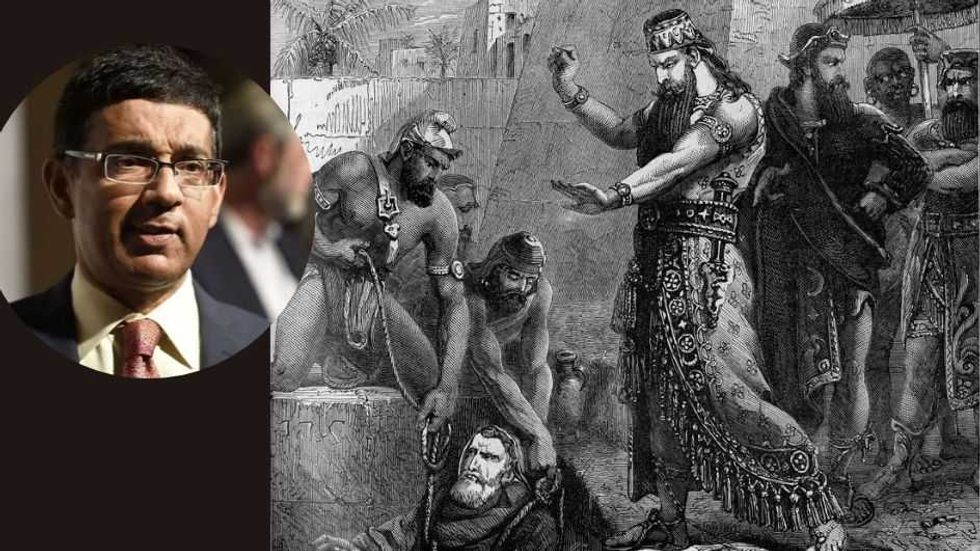
They lower Jeremiah into a cistern, where he sinks into the mud.
asserted
he → lower → mud
Another court official eventually persuades the king to rescue him.
asserted
official → persuade → him
Jehucal and Gedaliah then disappear from the story.
asserted
Jehucal → disappear → story
More than 2,500 years later, their names turned up again.
asserted
names → turn → ?
In 2005, archaeologists excavating Jerusalem discovered a clay seal impression bearing the name Jehucal, son of Shelemiah.
asserted
archaeologists → excavate → Shelemiah
Three years later, they found another bearing the name Gedaliah, son of Pashhur.
asserted
they → find → Pashhur
The discoveries are documented in a 2024 study published in the Jerusalem Journal of Archaeology.
asserted
discoveries → document → Archaeology
The small clay objects, known as bullae, were used to seal documents.
asserted
objects → know → documents
The documents themselves have long since disappeared, but the hardened clay preserved the names impressed upon them.
asserted
clay → disappear → them
"Suddenly these two, you could call them biblical extras, jump into the pages of history via the pathway of archaeology," D'Souza said.
uncertain
D'Souza → call → archaeology
The seals do not tell us whether the two men actually persecuted Jeremiah or helped throw him into the cistern.
asserted
men → tell → cistern
But they provide independent evidence that men bearing those names lived in Jerusalem during the period described in the biblical account.
asserted
men → provide → account
D'Souza finds the specificity remarkable.
asserted
specificity → find → ?
If Jeremiah was composed centuries after the events it describes, how would its author have known the names of two relatively insignificant officials?
asserted
author → compose → officials
…and 8 more, not listed.
 The Aporia