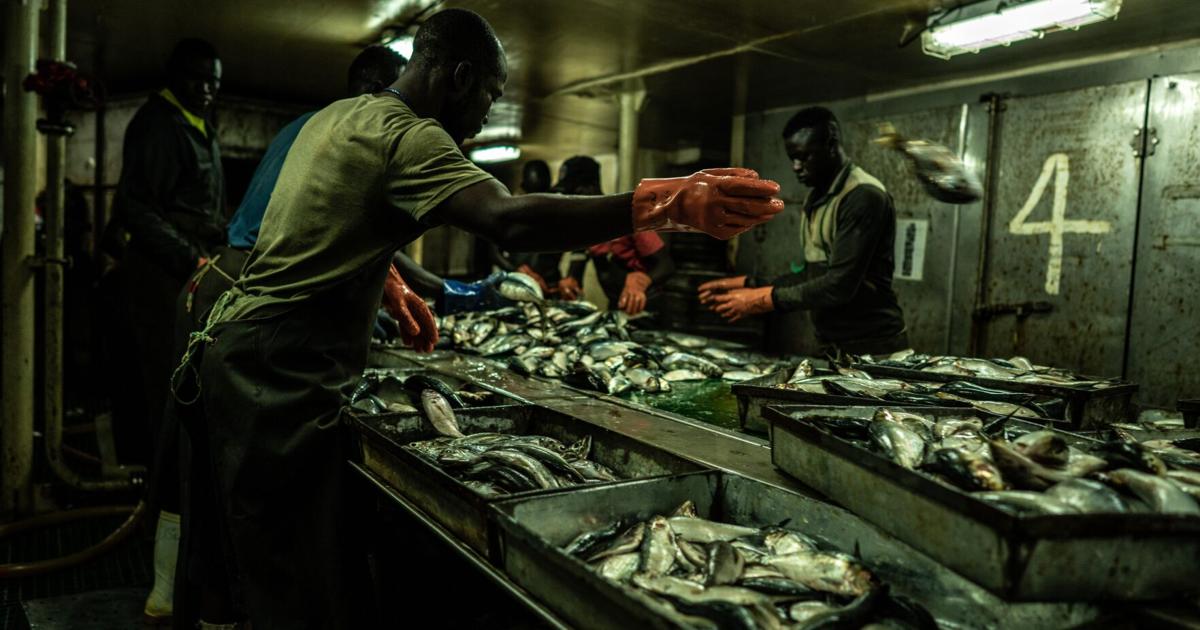
Much of the fish meal and fish oil that support farmed salmon and imported seafood consumed in Canada come from global supply chains linked to pollution, labour abuses, overfishing, and food insecurity in poorer countries.
asserted
that → support → countries
In November 2024, the Canadian Aquaculture Industry Alliance gathered in Ottawa to unveil what it called its first national sustainability report for salmon farming.
asserted
it → gather → farming
The industry’s message was blunt: Wild fisheries had reached their limits, and farmed salmon was the responsible way forward.
asserted
salmon → reach → limits
“Farm-raised salmon have a key role in helping to feed Canada and the world as capture fisheries reach their limits,” the group said.
asserted
group → raise → limits
This ocean-sustainability argument for fish farming — “grow more, so we can catch less” — is one of the reasons that the $313-billion (U.S.) global aquaculture industry is currently the fastest-growing food sector, and why half of the seafood eaten around the world is now farm-raised rather than caught at sea.
asserted
half → grow → sea
There’s a problem, though, one which is not limited to Canada.
asserted
which → ’ → Canada
“The aquaculture industry’s sales pitch is flat wrong,” said Daniel Pauly, project director of the Sea Around Us initiative at the University of British Columbia.
asserted
Pauly → say → Columbia
The most popular types of farmed seafood in the U.S. and elsewhere — salmon, shrimp, trout, sea bass, sea bream — are fed the kinds of wild fish that aquaculture claims to be saving, thereby accelerating ocean depletion, not slowing it, he explained.
uncertain
he → farm → it
Two-thirds of global aquaculture grows species that are fed fish meal and fish oil, ingredients made by cooking and pulverizing wild-caught fish.
asserted
that → grow → fish
Before it reaches market, a farmed salmon, for instance, eats at some farms more than six times its weight in wild-caught fish.
asserted
salmon → reach → fish
An extensive five-year investigation by The Outlaw Ocean Project, a news organization in Washington, DC, uncovered a variety of the hidden costs involved in producing this feed, including the loss of artisanal fishing jobs, chronic chemical exposure, avoidable worker deaths, and violent protests spurred by the horrid stench from fish meal factories.
asserted
investigation → uncover → factories
The investigation found that these social and environmental impacts exact a price primarily paid by the poorer countries where the feed ingredient is harvested and processed, far from where the resulting luxury seafood is eaten.
asserted
seafood → find → countries
In Gambia and Mauritania, the investigation documented how the industry drives food insecurity as fish that once sustained local communities are diverted into fish meal factories for export.
asserted
that → document → export
In remote islands in Russia’s far east and in China’s Xinjiang region, the reporting detailed the use of forced labour on ships, farms, and in factories.
asserted
reporting → detail → factories
In other countries, including India and Peru, this industry was tied to at least 80 incidents of civil unrest, some of them violent, usually in the form of labour strikes and community protests sparked by the water pollution or the stench from factories cooking thousands of tons of decomposing fish.
asserted
some → include → fish
The Outlaw Ocean Project mapped roughly the entire global fish meal industry, including more than 1,400 fish meal factories across 64 countries, tracing supply chains from fishing vessels to processing plants, feed mills, fish farms, and seafood retailers.
asserted
Project → map → plants
The reporting effort involved dozens of journalists from as many countries, visiting factories and farms and boarding fish meal ships at sea.
asserted
effort → involve → sea
The investigation revealed that the fish meal industry also contributes to geopolitical tensions.
asserted
industry → reveal → tensions
For example, in 2021, a dozen Turkish bottom trawlers fishing illegally in the Aegean Sea tried to ram a Greek research vessel when the scientists began filming their activity.
asserted
scientists → fish → activity
In 2018, riots broke out in Saint-Louis, Senegal, after a fisherman was shot and killed by Mauritanian coast guards, during what the Mauritanians said was a cross-border raid by a fish meal boat.
asserted
Mauritanians → break → boat
Since the mid-1970s, Morocco has militarily occupied Western Sahara, a presence that more than 10 EU Court of Justice rulings and various UN resolutions have deemed illegal.
asserted
rulings → occupy → Justice
Still, Moroccan ships routinely fish in Western Saharan waters, turning their illegal catch into fish meal in Western Saharan plants, then exporting it with Moroccan labels to farms globally.
asserted
ships → fish → farms
A violent clash over trucks, many of them carrying this fish and fish meal out of Western Sahara, led to the collapse of a 29-year ceasefire between the countries in 2020.
asserted
many → carry → 2020
Unlike growing bivalves, like oysters, clams, and mussels, which do not typically require external feed, the toughest challenge to raising carnivorous seafood, such as salmon and shrimp, is feeding them.
asserted
challenge → grow → them
Canada prohibits boats targeting fish for the sole purpose of making fish meal or fish oil.
asserted
Canada → prohibit → meal
Therefore, the fish meal produced in Canada is typically made by processing offcuts, or inedible parts of fish that would otherwise be thrown away, which is widely viewed as a more sustainable way to produce feed protein than using whole fish suitable for human consumption.
asserted
which → produce → consumption
Canada has more than 200 fish farms, most of them depending on fish meal or fish oil that, when made domestically, comes primarily from Pacific anchoveta, chub mackerel, herring, haddock, pollock, sardines, and frigate tuna.
asserted
that → have → anchoveta
However, much of the fish meal Canadian fish farms use — roughly 55,000 tons in 2024 — is sourced from abroad, tying Canadian consumers to these hidden and overseas social costs.
asserted
farms → use → costs
Canada also imports more than $4 billion of seafood annually, of which a third is primarily farmed salmon and shrimp that rely heavily on fish meal and fish oil, making the country further complicit.
asserted
country → import → meal
The investigation assessed more than 2,400 ships tied to fish meal production in at least 30 countries.
asserted
investigation → assess → countries
It found that most of these ships do not fully comply with the Global Charter for Fisheries Transparency, a guide created by ocean-focused civil-society groups detailing accountability standards for industrial fishing fleets.
asserted
most → find → fleets
For example, less than 30 per cent of the fleet had publicly available location information, and less than 25 per cent had a unique vessel identification number, or ship licence plate.
asserted
cent → have → number
Such opacity makes the fleet difficult to police.
asserted
fleet → make → ?
Scientific studies classified at least half of the species landed by the assessed fish meal vessels as “overexploited” or worse.
asserted
studies → classify → vessels
Most of the ships in this fleet are purse seiners or trawlers, which deploy vast nets to capture dense schools of fish, often indiscriminately sweeping in large volumes of bycatch and nontarget species.
asserted
which → deploy → bycatch
At least 165 of the ships in the global fish meal fleet were bottom trawlers, conducting a destructive form of fishing that uses weighted nets that scrape the ocean floor, destroying virtually everything in their paths.
asserted
that → conduct → paths
“Any accounting of the true impact of aquaculture has to start not with the farm, but with the feed,” said Pauly.
asserted
Pauly → have → feed
“And that kind of accounting offers a very different picture than the industry offers.”
asserted
industry → offer → picture
The feed industry has emphasized that it is decreasing its reliance on fish meal and fish oil.
asserted
it → emphasize → meal
However, as aquaculture overall grows, so too does the demand for fish meal.
asserted
demand → grow → meal
…and 60 more, not listed.
 The Aporia