"He won the Cold War," Margaret Thatcher said in a video shown at Ronald Reagan's funeral, "not only without firing a shot, but also by inviting enemies out of their fortress and turning them into friends.
asserted
Thatcher → win → friends
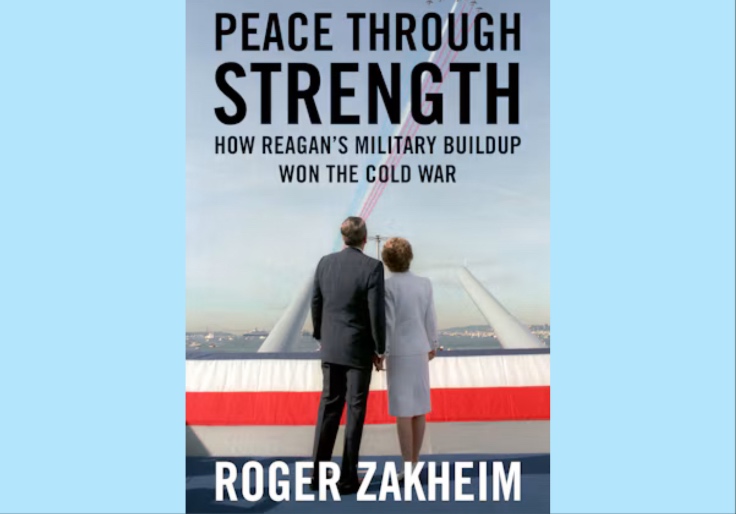
In Peace through Strength: How Reagan's Military Buildup Won the Cold War, Roger Zakheim presents a well-considered, extensively researched, and readable account of what might be—should be—called "the Reagan Miracle."
uncertain
what → win → account
Zakheim brings a largely inside-Washington—and mostly inside the Pentagon and National Security Council—perspective to the telling of this epic tale.
asserted
Zakheim → bring → tale
It was a project to which he came particularly well prepared.
asserted
he → come → which
Son of a senior Reagan and George W. Bush Pentagon appointee, Zakheim grew up in the international security world.
asserted
Zakheim → grow → world
For the past decade he has served as director of the Ronald Reagan Institute, the Washington, D.C., arm of the Simi Valley, California-based, Ronald Reagan Presidential Foundation.
asserted
he → serve → Foundation
He cofounded the Reagan National Defense Forum, ranked among the top annual security conferences in the world.
asserted
He → cofounde → world
He begins his story in the Nixon and Carter years and focuses mostly on the period in which Reagan pulled together his 1980 presidential campaign.
asserted
Reagan → begin → campaign
With the shadow of the Vietnam war still hanging over a dispirited U.S security establishment, Richard Nixon and Gerald Ford, working with Henry Kissinger, had adopted a go-along-get-along but still hard-nosed approach to the Soviet Union: "détente," a managed peace between the great nuclear powers.
asserted
Nixon → hang → powers
Carter went further.
asserted
Carter → go → ?
He vetoed one new or enhanced U.S. weapon system after another, most prominently the B-1B bomber and the Nimitz-class (nuclear-powered) aircraft carriers.
asserted
He → veto → another
In response and well prior to announcing his 1980 candidacy, Reagan frequently criticized Carter's reliance on decades-old systems like the B-52 bomber, as examples of a retreating defense.
asserted
Reagan → announce → defense
Developed and first flown during the Truman years, as candidate Reagan repeatedly told his audiences, B-52s were older than many men who flew them.
asserted
who → develop → them
Keeping the planes in service was no alternative to the new B-1B.
asserted
Keeping → keep → B-1B.
"We are infinitely less capable than we were 10 years ago," Reagan told his radio and event audiences.
asserted
Reagan → tell → audiences
As Zakheim points out, there were solid reasons to conclude that a less capable military was part of Carter's agenda.
asserted
military → point → agenda
A 1977 report from Carter's Office of Management and Budget argued that, as Zakheim reports, well-armed American forces "encouraged U.S. intervention in far off lands like Vietnam and therefore were nothing but trouble.
asserted
forces → argue → trouble
Zakheim develops this portrait of the Carter security world through the first third of his volume.
asserted
Zakheim → develop → volume
Titled "The Campaign," the pre-Reagan survey takes readers on a worthwhile journey.
asserted
survey → title → journey
For from our distance in time and events, it is hard to comprehend the urgency and strategic brilliance of the Reagan build-up without clarity on the policies that preceded it.
asserted
that → comprehend → it
Within its span, in addition to Korea and Vietnam, the United States committed resources to numerous smaller and typically inconclusive conflicts.
asserted
States → commit → conflicts
Then, too, it stood on humiliating sidelines during the Soviets' suppression of uprisings in every major Eastern European vassal state and repeated attempts via proxy to achieve domination throughout Asia, Africa, and Latin America.
asserted
it → stand → Asia
Some of these occurred during Carter's presidency, some before it.
asserted
Some → occur → it
But Reagan came to office with a totally different approach to this muddling through.
asserted
Reagan → come → muddling
As he told Richard Allen, his principal national security aide in the pre-presidential years, "My theory of the Cold War is we win and they lose."
asserted
they → tell → War
After an extended but necessary setting of the too-often-forgotten pre-Reagen stage, Zakheim raises the curtain in the Reagan presidency and its rebuilding of the nation's depleted and decayed military establishment.
asserted
Zakheim → forget → establishment
He starts with early palace intrigue: Who would be Reagan's secretary of defense?
asserted
Who → start → defense
We go with him through the many candidates and many supporters involved in the selection.
asserted
We → go → selection
In the end, though, Reagan tapped someone unanticipated among the cognoscente and barely mentioned in the corners where inside knowledge is passed in whispers.
asserted
knowledge → tap → whispers
Reagan knew his own mind: Caspar Weinberger.
asserted
Reagan → know → mind
Director of finance in California governor Reagan's cabinet, Weinberger subsequently chaired President Nixon's Federal Trade Commission, headed Nixon's Office of Management and Budget, and later served as his secretary of health, education and welfare.
asserted
Weinberger → chair → health
A former representative in the California legislature, Weinberger was, like Reagan, a World War II Army veteran who mustered out with rank of captain.
asserted
who → muster → captain
What followed was the largest peacetime buildout of the U.S. military in history.
asserted
followed → follow → history
The nature of the buildout differed from branch to branch.
asserted
nature → differ → branch
As the service with the greatest manpower needs, the Army prioritized increasing volume and quality of recruitment.
asserted
Army → prioritize → recruitment
In the post-Vietnam era, Army enlistment, retention, and quality of recruits had dropped significantly.
asserted
enlistment → drop → recruits
Under Reagan-Weinberger, Army standards tightened and pay grew significantly.
asserted
pay → tighten → Weinberger
Meanwhile, opportunities were introduced to acquire and broaden skills transferable to civilian employment.
asserted
opportunities → introduce → employment
Enlistments shot up.
asserted
Enlistments → shoot → ?
The quality of recruits soared.
asserted
quality → soar → recruits
…and 26 more, not listed.
 The Aporia