Photo via Toronto Star

Pope crosses Peru in finale of trip home to visit flock high in Andes and deep in Amazon

Read the original at Toronto Star ↗
Cite

Winfield, N., Savarese, M., & Suarez, A. (2026, November 15). Pope crosses Peru in finale of trip home to visit flock high in Andes and deep in Amazon. Toronto Star. https://www.thestar.com/news/world/americas/pope-crosses-peru-in-finale-of-trip-home-to-visit-flock-high-in-andes-and-deep-in-amazon/article_8a32530b-5869-5499-ab1e-27c97f6be95f.html

Dated from the outlet's own feed. Check the original for its byline.

Toronto Star · collected 2026-11-15 · by Nicole Winfield, Mauricio Savarese, Astrid Suarez

Quick Summary

Pope Leo XIV travels across Peru on the penultimate day of his visit, addressing the issues of Indigenous rights and environmental protection. He visits Cusco, a city high in the Andes, and then flies to Pucallpa, deep in the Amazon, where illegal mining and deforestation are major concerns. Cardinal Pedro Barreto emphasizes the continuity of Leo’s commitment to these issues, following Pope Francis’s lead. In Pucallpa, Pope Leo is expected to listen to Indigenous communities and symbolically plant a rainforest tree, underscoring the church’s dedication to environmental and human rights protection.
Written by AI on 2026-11-15, from this article's own text only.

AI analysis

Why this leaning score
The model judged this article politically coded and scored it -0.65, but 2 quote(s) could not be found in the article and the other 2 are attributed speech rather than the article's own narration, so the score is not published.
Written under an earlier scoring contract, which gave a paragraph rather than checkable quotes. Re-analysing this article replaces it.
Leaning score withheld for article 155079: no verified evidence · logged 2026-11-15

Compared with similar articles

This article reads unscored and hedges 0% of its claims. Each row says how that neighbour differs.
The Straits Times
Hedges 1 of 21 claims Outlet record 64/100
“The articles describe different stops of the Pope's visit to Peru, with Article A focusing on Cusco and Pucallpa and Article B on a remote Andean town.”
How this article was measured signals, leaning charts, publisher record, byline, topics and claims

Signals How these are calculated →

Claims extracted
36
sentences that state something as happening or true
Uncertain
0%
0 of 36 hedged ("reportedly", "may", "according to")
Leaning
withheld
no quote in the article backed the model's score
Publisher signals
64/100
Toronto Star's corrections and hedging, across everything collected from it. Not a measure of accuracy.
Outlets on this story
unclustered
not grouped into a story yet
Same framing elsewhere
1
articles that frame the event the way this one does
Analyzed 2026-11-15 · how these are computed

How this is being covered How these are calculated →

Article leaning vs. publisher reliability
Source leaning vs. consistency

Publisher

Toronto Star · 14631 article(s) · 29 correction(s) detected
Running correction rate · 29 correction(s)
2026-10-26
Correction
2026-10-24
Correction
2026-10-07
Correction
2026-09-24
Correction

Who wrote this

Nicole Winfield
34 article(s) here · 1 carrying a prediction
On the penultimate day of his visit to his adopted homeland, Leo is expected to echo Pope Francis, emphasizing Catholic teaching that links care for the most vulnerable with care for God’s creation.
Back then, Prevost would make the arduous drive to Santa Cruz de Succhabamba himself.
When Susana Baca, the Latin Grammy-winning Afro-Peruvian singer, serenaded Pope Leo XIV upon his arrival in Peru, it was a sign that the visit would provide an unparalleled spotlight on the culture that grew out of the African slave trade in this country.
But much of the world heard about it on the night of Leo’s election, May 8, 2025, when he gave Chiclayo a shoutout, in Spanish, from the loggia of St. Peter’s Basilica.
He joked with the bishops that some “doubting Thomases” had predicted he wouldn't be able to come.
Leo thrilled the crowd by looping around the plaza in his popemobile before accepting the keys to the city from Lima’s mayor.
Pope Leo XIV will wrap up his visit to Argentina with two poignant moments on Wednesday — a meeting with inmates at a prison with a history linked to the country’s military dictatorship, and a final Mass at Argentina’s national shrine.
"I am very happy, and I am certain that his visit will bring us much good fortune and many blessings," said retiree Marie Hernández, a 75-year-old Catholic.
The Uruguay leg is the first stop on what will be the longest and farthest trip of his pontificate, all being undertaken as the 71-year-old pope continues his recovery.
Leo will start his trip on Friday in Uruguay, the least Catholic, most secular country in all of Latin America, where not even the big Catholic feast days get their due: Christmas in Uruguay is officially “Family Day” and Holy Week is “Tourism Week.”
Also by Nicole Winfield
Nothing else under this byline is closely related to this article, so these are simply their most recent.
All 34 articles by Nicole Winfield →
Mauricio Savarese
27 article(s) here · 1 carrying a prediction
On the penultimate day of his visit to his adopted homeland, Leo is expected to echo Pope Francis, emphasizing Catholic teaching that links care for the most vulnerable with care for God’s creation.
He joked with the bishops that some “doubting Thomases” had predicted he wouldn't be able to come.
Leo thrilled the crowd by looping around the plaza in his popemobile before accepting the keys to the city from Lima’s mayor.
Politicians say Lula could have won by more but voters were hampered by bus shortages in Sao Paulo and Salvador, where the president is popular.
Brazilians will choose between incumbent President Luiz Inácio Lula da Silva and Flávio Bolsonaro in Sunday’s polarizing presidential election, a contest that will determine whether the U.S. will significantly expand its growing influence in Latin America.
Polls published on Saturday suggest it will be a nail-biting election that could be decided on details.
Meta will continue to enforce its rules, comply with Brazilian electoral legislation, correct errors when they occur, and ensure a level playing field for everyone who uses our services,” Meta said.
Brazil’s Senate approved a constitutional amendment Wednesday to reduce the country’s maximum workweek from 44 to 40 hours without a salary cut, a move backed by President Luiz Inácio Lula da Silva, who hopes it will boost his standing against Flávio Bolsonaro in the Oct. 25 presidential runoff.
FIFA will propose to its members a $6.35 billion fund for soccer development between 2027 and 2030, including a boosted amount of $25 million for each national association, according to a document reviewed by The Associated Press on Tuesday.
The U.S. and Brazil have had an extradition agreement since 1961, but it wasn’t immediately clear whether the terms would apply.
Also by Mauricio Savarese
Nothing else under this byline is closely related to this article, so these are simply their most recent.
All 27 articles by Mauricio Savarese →
Astrid Suarez
3 article(s) here · 1 carrying a prediction
On the penultimate day of his visit to his adopted homeland, Leo is expected to echo Pope Francis, emphasizing Catholic teaching that links care for the most vulnerable with care for God’s creation.
Back then, Prevost would make the arduous drive to Santa Cruz de Succhabamba himself.
He joked with the bishops that some “doubting Thomases” had predicted he wouldn't be able to come.
Also by Astrid Suarez
Nothing else under this byline is closely related to this article, so these are simply their most recent.

Topics

Amazonian CUSCO Indigenous Peru Pucallpa

Subjects

Leo PERSON · 6× Francis PERSON · 4× Peru GPE · 4× Amazonian NORP · 3× CUSCO GPE · 3× Indigenous NORP · 2× Pucallpa GPE · 2× Zanta PERSON · 2× Catholic NORP · 1× Leo XIV PERSON · 1×

Narrative

“The church in Peru perceives the continuity of his commitment to accompany Indigenous peoples in the defense of life and the care of the territory, which is increasingly threatened by deforestation and illegal mining,” Peruvian Cardinal Pedro Barreto, president of the Amazon bishops conference, told The Associated Press.
framing: assertive · carried by 1 article(s) · first seen 2026-11-15
On the penultimate day of his visit to his adopted homeland, Leo is expected to echo Pope Francis, emphasizing Catholic teaching that links care for the most vulnerable with care for God’s creation.

Claims (36 extracted, 0 hedged)

The plight of Indigenous peoples and the protection of the Amazon take center stage Sunday as Pope Leo XIV travels across Peru to visit communities high in the Andes and deep in the rainforest. asserted
XIV → take → rainforest
On the penultimate day of his visit to his adopted homeland, Leo is expected to echo Pope Francis, emphasizing Catholic teaching that links care for the most vulnerable with care for God’s creation. asserted
that → adopt → creation
He travels first to Cusco, the former capital of the Inca empire, before flying to the Amazonian city of Pucallpa, where illegal mining, deforestation and threats to Indigenous communities will be central concerns. asserted
mining → travel → communities
“The church in Peru perceives the continuity of his commitment to accompany Indigenous peoples in the defense of life and the care of the territory, which is increasingly threatened by deforestation and illegal mining,” Peruvian Cardinal Pedro Barreto, president of the Amazon bishops conference, told The Associated Press. asserted
Barreto → perceive → Press
“Leo is clearing the path laid out” by Francis on environmental protection and human rights, Barreto said. asserted
Barreto → clear → protection
He added that the pope would hear about violence affecting children and young people. asserted
pope → add → children
From the Andes to the Amazon The visit to Cusco, 3,400 meters (more than 11,000 feet) above sea level, will test the stamina of the pope, who is recovering from lung cancer surgery. asserted
who → test → surgery
His schedule begins at the historic Sacsayhuamán fortress, where he will speak about local religious devotion. asserted
he → begin → devotion
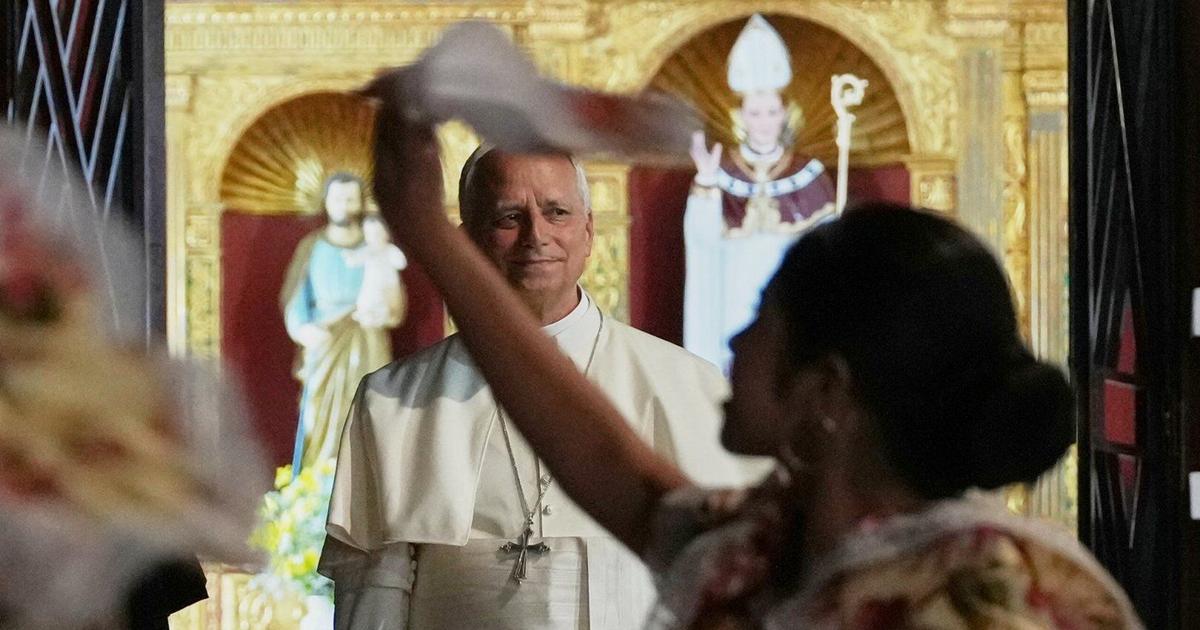
In the Plaza de Armas, he will present a shroud from the Holy See for the image of the Lord of the Earthquakes, a focus of devotion in a country prone to seismic activity. asserted
he → present → activity
He will then deliver a message to the sick before leaving for Pucallpa. asserted
He → deliver → Pucallpa
In the rainforest city of 434,000 people, Leo is expected to reinforce Francis’ teachings on protecting the environment and Indigenous communities threatened by illegal mining and other forms of exploitation. asserted
Leo → expect → exploitation
The Rev. Luca Zanta, one of the visit’s organizers, said Leo would “primarily listen to the Amazonian Indigenous peoples, including the Shipibo, Asháninka, and Kukama communities” gathered beside Lake Yarinacocha. asserted
Leo → say → Yarinacocha
Zanta said Leo would lead a symbolic planting of a shihuahuaco, a native rainforest tree that can live for more than 1,000 years and grow dozens of meters tall. asserted
that → say → meters
“That is a symbol of how we want our common house to be. asserted
house → want → ?
We want the Catholic Church to live long, protect those who need it and see its values and beauty admired by generations and generations,” Zanta told local radio Saturday. asserted
Zanta → want → radio
Indigenous communities face mounting threats asserted
communities → face → threats
The Rev. Peter Hughes, an 84-year-old Irish priest who has lived in Peru for more than six decades, said the visit reflects the church’s concern for the poor. asserted
visit → live → poor
“In Latin American terms, the Indigenous peoples, or what is left of them, are the most important collective representing the truly poor,” he said. asserted
he → leave → poor
“That is what makes leaders like Pope Francis and Pope Leo speak the language of the Gospel in very human terms, putting a premium on justice and peace. asserted
leaders → make → justice
In the Christian sense of justice, the most important people are the poor, the marginalized, and those who have no voice. asserted
who → marginalize → voice
Illegal gold mining has become an increasingly lucrative business in the Amazon, devastating forests and polluting rivers. asserted
mining → become → rivers
Miners use makeshift suction dredges and mercury, a toxic metal, to extract gold. asserted
Miners → use → gold
“This global context of war and conflict has contributed to gold prices rising to historic highs, and the direct impact of this is that gold — which is present in all Amazonian rivers — can be extracted using mercury, particularly if you want to do this on a large scale asserted
you → contribute → scale
,” said Raphael Hoetmer, Western Amazon program director at Amazon Watch. “It’s causing pollution, health issues, and environmental degradation,” he said. asserted
he → say → pollution
On Saturday, police reported three operations against illegal mining in Madre de Dios, one of the country’s most biodiverse regions. asserted
police → report → regions
They said they destroyed extraction equipment, including rafts and motors, valued at $4.1 million. asserted
they → say → million
Illegal mining also drives deforestation and encroaches on Indigenous territories, threatening ancestral lands and exposing communities to violence and organized crime. asserted
mining → drive → violence
Isolated peoples are especially vulnerable Leo is also expected to address sexual violence against women and girls. asserted
Leo → expect → women
Barreto said the pope would likely pay particular attention to a recent case in Condorcanqui province in the northern Amazon, where teachers sexually abused Indigenous Awajún and Wampis girls. asserted
teachers → say → girls
Images released by Survival International in 2024 showed dozens of Mashco Piro people near logging concessions. asserted
Images → release → concessions
Clashes between Indigenous people and loggers that year left at least two loggers dead. asserted
Clashes → leave → loggers
Concerns also extend to Kakataibo communities living in isolation or initial contact. asserted
Concerns → extend → isolation
“They have reservations that should protect them. asserted
that → protect → them
But the Peruvian government is increasingly unwilling to acknowledge the existence of these peoples,” Hoetmer said. asserted
Hoetmer → acknowledge → peoples
“And their reserves are also being invaded by drug cartels because, of course, they’re ideal places for them to operate since no one can get in.” asserted
one → invade → course
—- Winfield reported from Chiclayo, Peru; Suarez reported from Lima, Peru. asserted
Suarez → report → Lima

Give feedback · no sign-in needed

No sign-in needed for now. Your note is sent without a name, so it cannot be answered.

History Support