Photo via NBC News

Most Americans think AI is doing more harm than good in schools

Read the original at NBC News ↗
Cite

Smith, A. (2026, September 17). Most Americans think AI is doing more harm than good in schools. NBC News. https://www.nbcnews.com/politics/politics-news/poll-americans-think-ai-harm-good-schools-rcna597777

Dated when The Aporia collected the article, usually within hours of publication. Check the original for its exact date and byline.

NBC News · collected 2026-09-17 · by Allan Smith

Quick Summary

A recent NBC News poll found that most American adults believe artificial intelligence (AI) is doing more harm than good in education, with 53% saying it does more harm than good in K-12 schools and 54% holding the same view for colleges and universities. The survey also revealed a growing skepticism towards integrating AI into classrooms: 56% of respondents now believe that banning AI will better prepare students for the future, up from June when this figure was lower. Meanwhile, acceptance of specific AI uses in schoolwork remains low, with only proofreading and editing seen as generally acceptable by nearly half of those surveyed.
Written by AI on 2026-09-17, from this article's own text only (the story summary below draws on all the coverage).

AI analysis

Story summary

According to an NBC News Decision Desk Poll powered by SurveyMonkey, 53% of American adults believe that artificial intelligence (AI) does more harm than good in K-12 education, compared to 27% who think it does more good. The sentiment is similar for higher education, where 54% say AI causes more harm and only 24% see it as beneficial. When asked about preparing students for the future, 44% of respondents believe integrating AI tools in classrooms helps more than banning them, while 56% think prohibiting AI use will better prepare students for their futures. This shift reflects a growing skepticism towards AI's role in education, with concerns raised by parents and advocates that AI may stunt students' educational growth. For instance, New York City recently restricted the use of AI for K-12 students until high school, allowing limited cases thereafter.

Written for “AI In Schools Controversy” on 2026-11-02, grounded in this article and the 0 other(s) covering the same event.

Story

📰 AI In Schools Controversy
Education · 1 article(s) covering the same event.

Compared with similar articles

This article reads unscored and hedges 6% of its claims. Each row says how that neighbour differs.
CBS News
Hedges 0 of 3 claims Outlet record 66/100
“The articles discuss different aspects of public opinion on AI, with one focusing specifically on its impact in education and the other on overall attitudes toward AI development.”
How this article was measured signals, leaning charts, publisher record, byline, topics and claims

Signals How these are calculated →

Claims extracted
18
sentences that state something as happening or true
Uncertain
6%
1 of 18 hedged ("reportedly", "may", "according to")
Leaning
not political
takes no side on a contested political question
Publisher signals
60/100
NBC News's corrections and hedging, across everything collected from it. Not a measure of accuracy.
Outlets on this story
1
Education
Same framing elsewhere
1
articles that frame the event the way this one does
Analyzed 2026-09-17 · how these are computed

How this is being covered How these are calculated →

Article leaning vs. publisher reliability
Source leaning vs. consistency

Publisher

NBC News · 1977 article(s) · 1 correction(s) detected
Running correction rate · 1 correction(s)

Who wrote this

Allan Smith
3 article(s) here · 1 carrying a prediction
🔮 Earlier Monday, The New York Times reported that Building the Future is also set to spend about $1.5 million in advertising to boost GOP Sen. Darline Graham in the South Carolina Senate race.
🔮 “The Nobel Peace Prize has been forever discredited by a handful of radical ideologues who are antidemocracy and really enemies of civilization, and we will not forget Norway.
🔮 And a growing share of U.S. adults believe schools that shun the technology will better help students grow than schools that embrace it.
Also by Allan Smith
Nothing else under this byline is closely related to this article, so these are simply their most recent.

Topics

American NBC News NBC News Decision Desk SurveyMonkey U.S.

Subjects

Melania Trump PERSON · 2× NBC News ORG · 2× SurveyMonkey ORG · 2× American NORP · 1× NBC News Decision Desk ORG · 1× New York City GPE · 1× U.S. GPE · 1× United States GPE · 1× the] GPE · 1×

Narrative

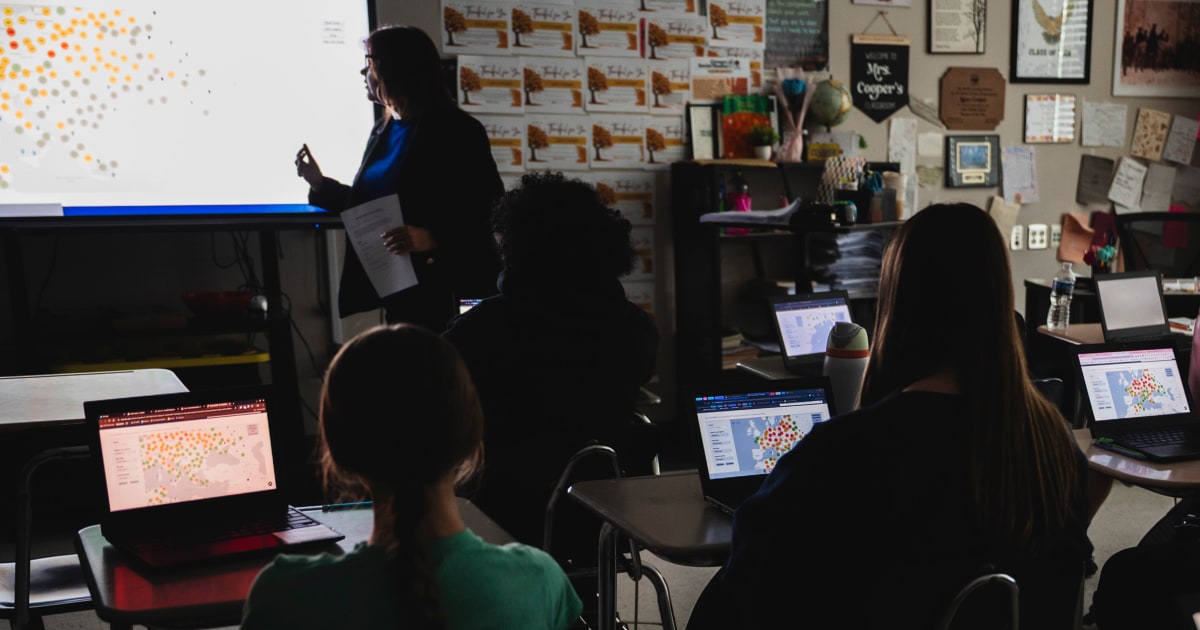
Parents and advocates nationwide have raised concerns about AI use, saying it has stunted students’ educational growth, and some school districts have enacted restrictions. New York City announced this month that the use of AI for students will be restricted until high school, with only limited use cases allowed then. Melania Trump says young students 'need to learn' about AI
framing: assertive · carried by 1 article(s) · first seen 2026-09-17
🔮 And a growing share of U.S. adults believe schools that shun the technology will better help students grow than schools that embrace it.
2026-09-17 · NBC News
Most Americans think AI is doing more harm than good in schools · assertive framing

Claims (18 extracted, 1 hedged)

Most American adults think artificial intelligence is going to do more good than harm in education, according to this month’s NBC News Decision Desk Poll powered by SurveyMonkey. uncertain
intelligence → think → SurveyMonkey
And a growing share of U.S. adults believe schools that shun the technology will better help students grow than schools that embrace it. asserted
that → grow → it
The survey found that 53% of adults believe AI does more harm than good in K-12 education, compared with 27% who believe it does more good than harm. asserted
it → find → harm
That’s similar to the 54% who said it does more harm than good in colleges and universities, while 24% said they believed it did more good than harm in higher education. asserted
it → ’ → education
When it comes to preparing students for the future, 44% of respondents said a school that integrates AI tools into the classroom will better help students than a school that bans using it — down 9 percentage points from June 2025. asserted
that → come → June
On the flip side, 56% of respondents said they believe a school that prohibits using AI will better help prepare students for the future, up 9 points since the June 2025 survey. asserted
that → say → survey
Respondents were mixed on what — if any — ways of using AI were acceptable for a student completing a school assignment. asserted
ways → use → assignment
Proofreading and editing was seen as the most acceptable use case among those tested, with 49% of adults saying that was OK. asserted
that → see → adults
That was followed by 41% who said it is acceptable for students to use AI to help with researching and brainstorming and 38% who believed it is OK to use AI to organize or outline ideas. asserted
it → follow → ideas
About a third of respondents, 31%, said no AI use was acceptable for schoolwork. asserted
use → say → schoolwork
Just 7% said it was OK for students to have AI do writing and generate content for them. asserted
AI → say → them
The subject of AI use in the classroom is raging in school districts and on campuses across the country. asserted
subject → rag → country
Parents and advocates nationwide have raised concerns about AI use, saying it has stunted students’ educational growth, and some school districts have enacted restrictions. New York City announced this month that the use of AI for students will be restricted until high school, with only limited use cases allowed then. Melania Trump says young students 'need to learn' about AI asserted
students → raise → AI
On Tuesday, first lady Melania Trump told NBC News that she believes it is important for students to get hands-on experience with AI, a technology that is likely to shape their futures far beyond the classroom. asserted
that → tell → classroom
“Of course, they need to be vigilant, as well,” she said. asserted
she → need → ?
“But this is our future, and we need to guide them and teach them what is available. asserted
what → need → them
If not, they will stay behind, and we need to be the first, in [the] United States, to lead.” asserted
we → stay → States
The NBC News Decision Desk Poll powered by SurveyMonkey surveyed 7,105 adults online from Aug. 20 to Sept. 1 and has a margin of error of plus or minus 3.3 percentage points. asserted
Poll → power → points

💬Give feedback
🕘History 🎫Support