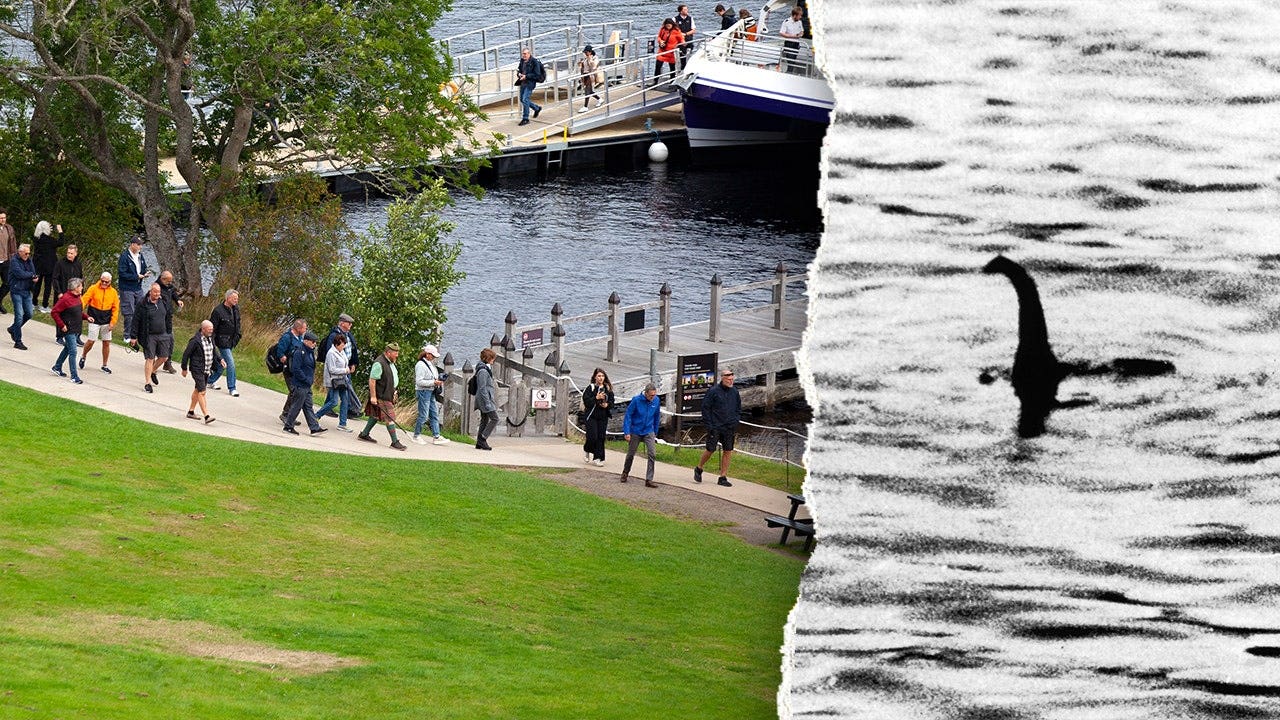
The Loch Ness Monster is making waves again amid an uptick in reported sightings — but one researcher told Fox News Digital he still isn't convinced the legendary Scottish creature is real.
asserted
creature → make → Digital
Reported sightings of Nessie, as the creature is popularly known, have more than doubled in 2026, climbing to 15 from six in 2025, according to the Official Loch Ness Monster Sightings Register.
uncertain
creature → report → Register
The register contains eyewitness accounts from visitors and locals around Loch Ness, a freshwater lake in the Scottish Highlands, roughly 20 miles southwest of Inverness.
asserted
register → contain → Inverness
In March, an American man said he saw "the dark-greenish gray body of what appeared to be Nessie emerge from the water."
asserted
what → say → water
The man wrote, according to the register, "Nessie hovered for about 5 seconds, then dipped back into the water.
uncertain
Nessie → write → water
Her body emerged against the chop of the surf, but appeared clearly defined against the waves, leading me to believe it wasn't just the current."
asserted
it → emerge → me
In July, a local sailor said he saw a "large oversized crocodile head above the water" while he was out on his yacht.
asserted
he → say → yacht
"The head quickly disappeared before I could get a photo," the man said.
uncertain
man → disappear → photo
"It took me a few minutes to process what I was seeing.
asserted
I → take → what
We made it into Fort Augustus safely with no further sightings."
asserted
We → make → sightings
One visitor from Malta said he saw a creature in August that looked like a "very large eel" moving against the current.
asserted
that → say → current
"He estimated that the size was at least 7 meters [about 23 feet] in length," the register stated.
asserted
register → estimate → length
Though the increase in sightings may seem significant, one expert disagrees.
uncertain
expert → seem → sightings
Charles Paxton, a research fellow in statistical ecology at the University of St. Andrews in Scotland, told Fox News Digital there was "nothing special" about the jump in reported sightings from 2025 to 2026.
"The numbers fluctuate a lot year on year," he said.
asserted
he → tell → year
Paxton said the modern phenomenon of Loch Ness Monster sightings began in the 1930s, particularly between 1933 and 1934.
asserted
phenomenon → say → 1933
The reported sightings quickly became a major draw for tourists, bringing crowds to the area.
"In 1934, the local government slashed its tourist budget, because they felt it wasn't necessary to do any advertising for tourism whatsoever," he said.
asserted
he → report → tourism
That surge of interest fell off over the years, but was revived again in the 1960s when the Loch Ness Investigation Bureau began collecting data on Nessie sightings.
asserted
Bureau → fall → sightings
"And then, since the '70s, numbers have generally sort of dwindled, but with fluctuations" from year to year, Paxton said.
asserted
Paxton → dwindle → year
Paxton also clarified that the database used to track modern sightings is not an official record, despite its name.
asserted
database → clarify → name
"In a real sense, there isn't an official database," he said.
asserted
he → be → sense
"There are people collecting reports of the Loch Ness Monster from a variety of sources," added Paxton.
asserted
Paxton → be → sources
"But that website has become a central location for people to [share] their reports."
"People have these exciting, strange experiences, and the question is, what caused them?"
asserted
what → become → them
Paxton, who is currently researching how cultural influences may contribute to reported sightings, said statistics can help researchers better understand why people report unusual experiences.
uncertain
people → research → experiences
He and his colleagues have studied patterns in Loch Ness Monster sightings, "mainly for fun, I must admit," he said.
asserted
he → study → fun
"And people have these exciting, strange experiences, and the question is, what caused them?
asserted
what → cause → them
And I think we can use statistics to kind of investigate patterns in what's going on."
asserted
what → think → patterns
Though Paxton doesn't believe there is an unknown animal lurking in the loch, he said he doesn't think those who report seeing the monster are lying.
asserted
who → believe → monster
"I don't think that's the case at all," he said.
asserted
he → think → ?
He cited several possible explanations, including "people seeing animals in the loch, people seeing boat wakes, people seeing wind waves, floating vegetation."
asserted
He → cite → waves
Paxton added, "In my view, the Loch Ness Monster has lots of different sources."
asserted
Monster → add → sources
 The Aporia