A ranching family in South Dakota has reported a major increase in plant and wildlife diversity after changing how they manage their cattle.
asserted
they → ranch → cattle
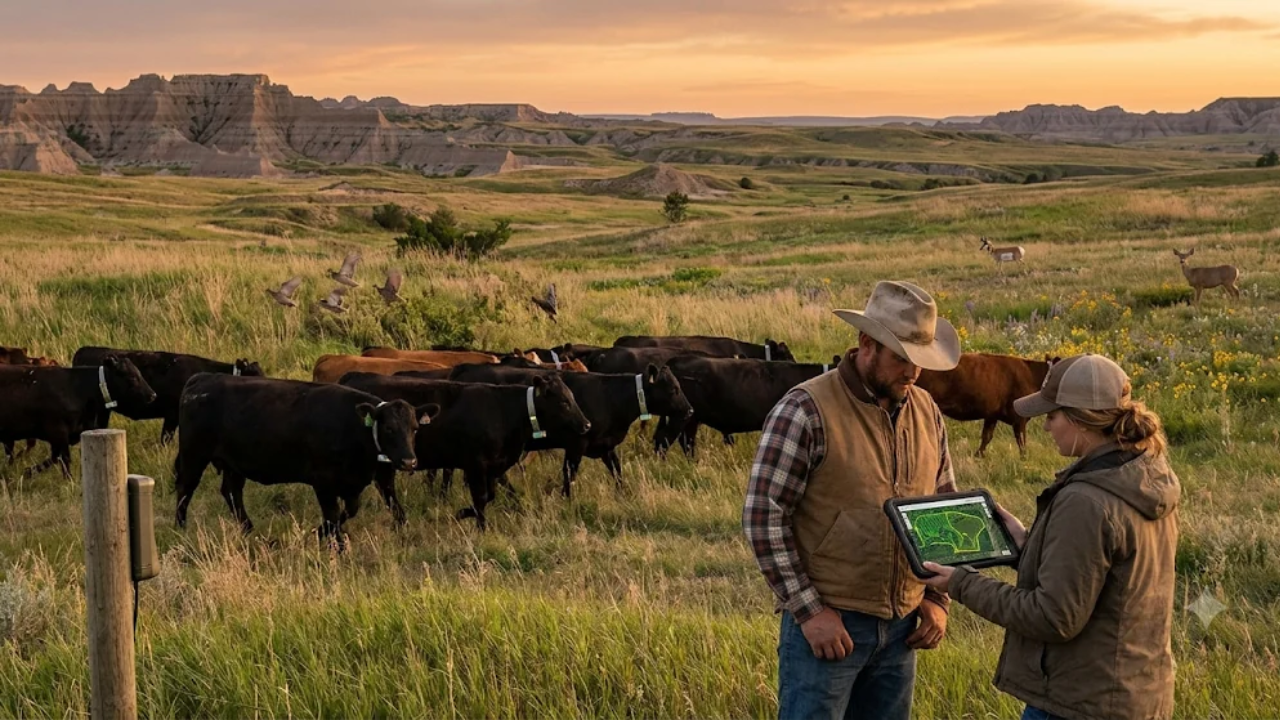
Nearly a decade after adopting rotational grazing and satellite-based fencing, Caden and Jori Smiley say their land has healthier grass, more plant varieties and a growing number of wild animals.
asserted
land → adopt → animals
Caden Smiley returned to his family's ranch near Kadoka, South Dakota, in 2016.
asserted
Smiley → return → 2016
He and his wife, Jori, later moved away from traditional grazing methods and introduced a system that allows grasslands to recover between periods of grazing.
asserted
grasslands → move → grazing
In a report to the Tri-State Neighbor, the couple said the changes, supported by virtual fencing technology, have improved the condition of their pastures and helped wildlife return to the ranch.
asserted
wildlife → say → ranch
Instead of allowing cattle to feed in the same pasture throughout the season, the system moves them between different sections of land.
asserted
system → allow → land
When Caden returned to the family ranch in 2016, he said the operation followed "conventional grazing, pretty standard for this area."
asserted
operation → return → area
Under that approach, cattle had continuous access to the same areas.
asserted
cattle → have → areas
This could lead to overgrazing, particularly where the grass was most attractive to the animals, while other parts of the pasture received less attention.
uncertain
parts → lead → attention
The Smileys have since introduced a virtual fencing system called Vence to manage cattle movements.
asserted
Smileys → introduce → movements
The technology uses satellite connections and GPS-enabled collars, allowing ranchers to control where their animals graze without building physical fences.
asserted
animals → use → fences
Using a computer or tablet, the couple can draw boundaries on a digital map.
asserted
couple → use → map
These boundaries create grazing areas, known as cells, which can be made larger or smaller depending on the management plan.
asserted
which → create → plan
When cattle approach a virtual boundary, their collars produce a sound warning.
asserted
collars → approach → warning
If they continue towards the boundary, the collars deliver a mild electrical signal.
asserted
collars → continue → signal
The animals learn to respond to the warnings and remain within the assigned area.
asserted
animals → learn → area
The Smileys plan their grazing schedules in advance.
asserted
Smileys → plan → advance
They decide how long cattle should stay in each cell by considering the amount of available grass and the size of the herd.
asserted
cattle → decide → herd
Once the grazing period ends, they move the virtual boundary to guide the cattle into another area.
asserted
they → end → area
Recovery of the native grasslands
One of the biggest benefits of rotational grazing is the time it gives grass to recover.
asserted
it → give → grass
Allowing plants to grow again between grazing periods helps improve their health and strengthens their roots.
asserted
plants → allow → roots
Caden Smiley told the Tri-State Neighbor that he had seen a clear difference since changing the way the ranch operates.
asserted
ranch → tell → way
Just by giving that rest... the plant community is just so much healthier."
asserted
community → give → rest
Under traditional grazing methods, cattle can repeatedly eat the new growth before plants have enough time to recover.
asserted
plants → eat → time
This forces plants to use stored energy in their roots to produce more growth.
asserted
This → force → growth
Over time, repeated grazing can weaken the roots and damage the plants.
asserted
grazing → repeat → plants
Rotational grazing helps prevent this problem.
asserted
grazing → help → problem
Cattle remain in one grazing cell only long enough to feed before being moved to another area.
asserted
Cattle → remain → area
The land then gets a longer period to recover.
asserted
land → get → period
During this time, plants can grow new leaves, absorb sunlight and rebuild their root systems.
asserted
plants → grow → systems
Stronger roots help hold soil together, improve water absorption and allow the ground to retain more moisture.
asserted
ground → hold → moisture
This is particularly important around Kadoka, which lies near the Badlands in a semi-arid region.
asserted
which → lie → region
Rainfall and soil moisture are limited, so keeping grasslands healthy is important for the long-term productivity of the ranch.
asserted
keeping → limit → ranch
Giving native plants enough time to recover also helps maintain the natural vegetation that supports wildlife across the region.
asserted
that → give → region
Return of varied wildlife populations
The improvements to the grasslands have also benefited wildlife.
asserted
improvements → benefit → wildlife
Jori Smiley told the Tri-State Neighbor that healthier pastures have brought greater variety in both plant life and animal populations.
asserted
pastures → tell → life
Rotational grazing creates different types of vegetation across the ranch.
asserted
grazing → create → ranch
Some areas are being grazed, while others are recovering and developing taller grass.
asserted
others → graze → grass
This creates a mixture of habitats that offers wildlife different sources of food and shelter.
asserted
that → create → food
The Smileys have noticed a clear increase in wildlife, particularly birds.
asserted
Smileys → notice → wildlife
…and 27 more, not listed.
 The Aporia