The Adelaide-to-Bridgewater passenger service ended in 1987.
asserted
service → end → 1987
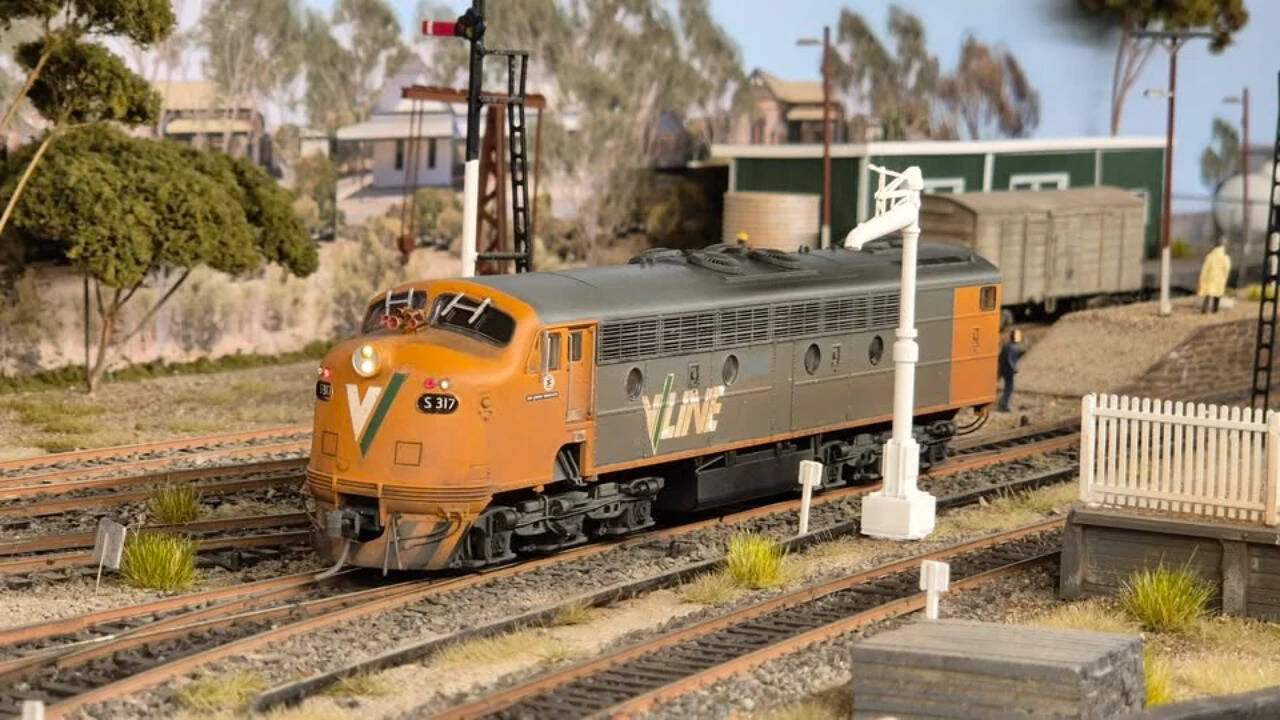
In Peter Michalak’s backyard shed, the train still makes the journey.
asserted
train → make → journey
It passes the station, the old mill and a tree-covered hillside, moving through a miniature version of South Australia where some journeys never stopped.
asserted
journeys → pass → Australia
For 13 years, Michalak has been building the Hills Line, an HO-scale, i.e. 1:87, railway recreating the 315-kilometre corridor between Adelaide and Serviceton, just across the Victorian border.
asserted
Michalak → build → border
About 50 metres of mainline track loops through three levels, passing stations, freight yards and hills.
asserted
metres → loop → stations
Passenger trains once carried people from Adelaide into the Adelaide Hills, but services beyond Belair were withdrawn in 1987.
asserted
services → carry → 1987
Patronage had fallen, particularly after the South Eastern Freeway offered a faster route into the city.
asserted
Freeway → fall → city
Today, passenger trains terminate at Belair.
asserted
trains → terminate → Belair
In Michalak’s version of events, the service to Bridgewater never disappeared.
asserted
service → disappear → Bridgewater
“I grew up catching SteamRanger trains to Bridgewater as a kid in the school holidays,” he told the ABC.
asserted
he → grow → ABC
“I had a lot of memories of going up there, and I had to create it.”
asserted
I → have → it
Bridgewater was the first station he built, originally as a portable model for exhibitions.
asserted
he → build → exhibitions
It has since become the centrepiece of a much larger railway.
asserted
It → become → railway
“Bridgewater, in this reality, still has passenger train services to it,” he said.
asserted
he → have → it
The Adelaide-to-Melbourne route was once part of a broad-gauge network, with the lines meeting at Serviceton in 1887.
asserted
lines → meet → 1887
In 1995, the interstate corridor was converted to standard gauge.
asserted
corridor → convert → gauge
Serviceton’s two-storey brick station, built in 1888, was a border hub with customs offices and a place for South Australian and Victorian train crews to change over.
asserted
crews → build → offices
Michalak has left space for it, although its full model is still a work in progress.
asserted
model → leave → progress
Michalak calls it “selectively compressed”: the trains are HO scale, but distances, platforms and infrastructure have been shortened to fit the space.
asserted
distances → call → space
A 70-wagon freight train, for instance, becomes a 10-wagon one.
asserted
train → become → instance
He describes himself as a “proto freelancer”, taking recognisable elements of the real railway and recreating a version that works within the shed.
asserted
that → describe → shed
Mile End, once a huge rail yard, is represented by three tracks.
asserted
End → represent → tracks
The layout also includes Pinnaroo, Tailem Bend, Mount Lofty and a branch to Port Adelaide, where a miniature version of the heritage Hart’s Mill stands beside the tracks.
asserted
version → include → tracks
Buildings are made by hand, while the roads carry period cars, including a green VB Commodore matching the family car Michalak remembers from childhood.
asserted
Michalak → make → childhood
Tiny signs and a Country Fire Service truck at a level crossing placed the railway in the late 1980s and early 1990s.
asserted
signs → place → 1980s
Trees around Bridgewater are fashioned from sedum, a garden plant.
asserted
Trees → fashion → sedum
Some trains can be bought ready-made.
asserted
trains → buy → ?
Others, particularly those unique to South Australia, have to be built from scratch.
asserted
Others → have → scratch
That includes the Redhen railcars, locally built passenger trains that served Adelaide from the 1950s until 1996.
asserted
that → include → 1996
Michalak’s brother, Nick, prepares computer-aided design drawings, while Michalak 3D-prints components for engines and carriages.
asserted
Michalak → prepare → engines
He still cuts, folds and solders brass by hand, a process that comes with burnt fingers and a fair amount of swearing.
asserted
that → cut → swearing
Railway history runs through Michalak’s family.
asserted
history → run → family
His grandfather began working as a porter at Tailem Bend station, and Michalak received his first electric train set when he was three.
asserted
he → begin → set
Local history groups have helped him find photographs and records missing from museums.
asserted
groups → help → museums
His brother is building Blackwood station, while a friend and former railway controller has drawn up train-control graphs for operating sessions, compressing a 12-hour shift into about two and a half hours.
asserted
friend → build → hours
Beyond the shed, Michalak is vice-president of SteamRanger Heritage Railway, which operates tourist trains between Mount Barker and Victor Harbor.
asserted
which → operate → Barker
In 2026, he documented its history in a 116-page book illustrated with more than 200 images and accounts from volunteers.
asserted
he → document → volunteers
The Hills Line began in 2013 as a portable model of Bridgewater.
asserted
Line → begin → Bridgewater
By 2016, Michalak and his wife had decided to turn it into a permanent home layout.
asserted
Michalak → decide → layout
It has since outgrown its original purpose and is now too large to travel.
asserted
It → outgrow → purpose
…and 10 more, not listed.
 The Aporia