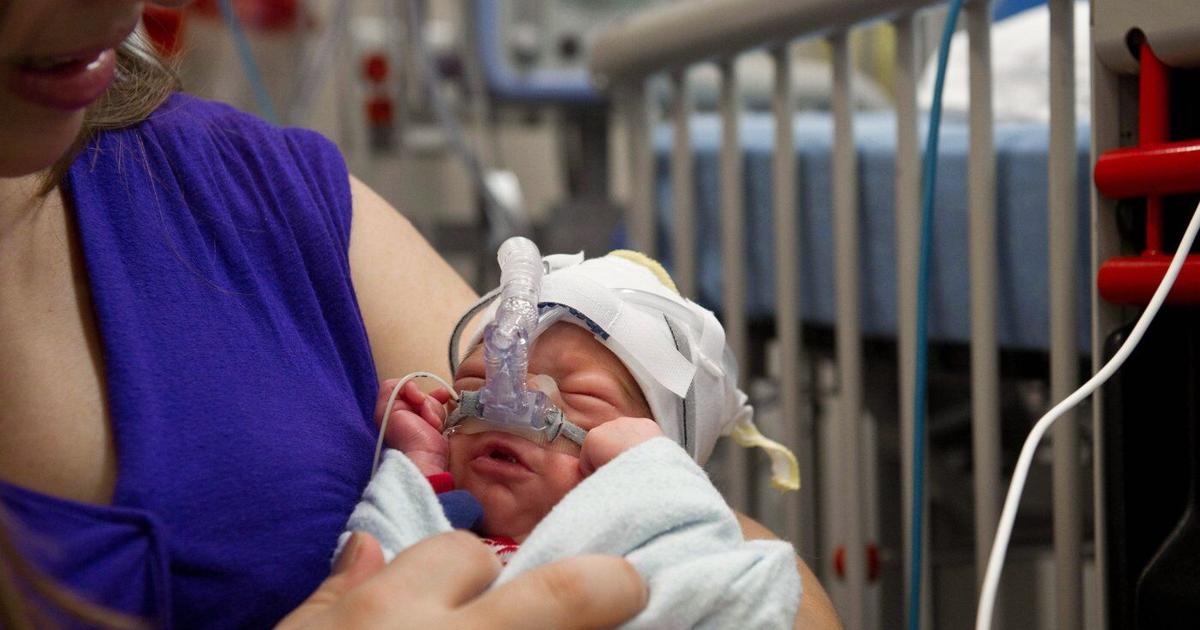
When Annie Sicotte gave birth to her first daughter 11 weeks early, she couldn’t hold her baby in her arms.
asserted
she → give → arms
She had to wait until the following day to see her, lying in an incubator and connected to a ventilator.
asserted
She → have → ventilator
“It’s the unknown.
asserted
It → ’ → ?
There’s so much fear, it’s unbelievable,” Sicotte recalled.
asserted
Sicotte → ’ → ?
“You don’t see your baby, you don’t have time to hold her in your arms.
asserted
you → see → arms
It’s very traumatic.”
asserted
It → ’ → ?
With her daughter in intensive care, one of the few things Sicotte could do to help was pump breast milk—a vital source of nutrition for premature babies.
uncertain
Sicotte → do → babies
As World Prematurity Day is marked Sunday, Quebec charity Préma-Québec is highlighting the importance of breast milk for premature newborns and a program that provides mothers with free access to specialized breast pumps.
asserted
that → mark → pumps
About 6,000 babies are born prematurely in Quebec each year, accounting for seven per cent of births in the province.
asserted
babies → bear → province
Ginette Mantha, founder and executive director of Préma-Québec, says the province offers exceptional care for premature newborns, with specialized services available across much of its territory.
asserted
services → say → territory
“Care for premature babies is quite widespread and available in several regions, practically every region of Quebec,” she said.
asserted
she → say → Quebec
Quebec has six hospitals with neonatal intensive care units staffed by neonatologists around the clock.
asserted
Quebec → have → clock
About 10 other centres care for babies born between 32 and 34 weeks, while additional facilities care for those born later.
asserted
facilities → care → those
Premature babies fall into three categories: those born between 33 and 36 weeks, those born between 29 and 32 weeks, and those born before 28 weeks.
asserted
babies → fall → weeks
Most premature babies in Quebec — about 4,800 each year — are born at 32 weeks or later.
asserted
babies → bear → weeks
According to Préma-Québec, about 400 babies are born at 28 weeks or earlier each year, often requiring prolonged stays in neonatal intensive care.
Sicotte knows that reality well.
uncertain
Sicotte → accord → reality
daughter, Béatrice, now four and a half, was born at 29 weeks and spent three months in hospital.
asserted
daughter → bear → hospital
Her youngest, 16-month-old Mathilde, was born at 33 weeks and remained hospitalized for a month.
asserted
youngest → bear → month
Sicotte said parents must quickly learn to navigate an unfamiliar, highly medicalized environment while trying to understand what lies ahead.
asserted
what → say → environment
“The only things you can do as a parent are be there and, for the mother, try to pump your milk,” she said.
asserted
she → do → milk
“Thankfully, I had access to that hospital-grade breast pump.”
asserted
I → have → pump
Sicotte received a hospital-grade breast pump through Préma-Québec’s free lending program, which allowed her to express milk both at the hospital and at home throughout her daughters’ stays in intensive care.
asserted
her → receive → care
Premature babies, particularly those born very early, may be too weak to breastfeed directly, while mothers who give birth prematurely may need help establishing their milk supply.
uncertain
who → bear → supply
Hospital-grade pumps can help mothers express milk regularly, but the equipment is expensive.
asserted
equipment → help → milk
According to Préma-Québec, a hospital-grade pump can cost about $2,700, compared with roughly $400 for a regular model.
uncertain
pump → accord → model
Some pharmacies and breastfeeding support organizations rent the specialized pumps for about $100 a month.
asserted
pharmacies → rent → 100
Mantha said pumps are generally available in neonatal units, but access can become more difficult when parents leave the hospital.
asserted
parents → say → hospital
“The problem is with parents who leave the neonatal unit and go home in the evening because they have other children,” she said.
asserted
she → leave → children
“They had less access to breast pumps.”
asserted
They → have → pumps
Mantha said breast milk can be particularly important for babies born extremely prematurely.
asserted
milk → say → babies
“For some health-care professionals, a mother’s milk becomes like medicine, nothing more, nothing less,” she said.
asserted
she → become → medicine
“Because it helps protect the baby’s intestinal flora and provides antibodies.”
asserted
it → help → antibodies
She said breast milk can also reduce the risk of death among extremely premature babies.
asserted
milk → say → babies
“We know that among extremely premature babies born at 28 weeks or earlier, for every 20 babies who receive their mother’s milk, one death is prevented,” she said.
asserted
she → know → milk
“It’s no small thing ... with milk!”
asserted
It → ’ → milk
For some families, the experience of premature birth ends in the loss of a child.
asserted
experience → end → child
Préma-Québec provides psychological support to grieving families, including siblings struggling to understand the loss.
asserted
Québec → provide → loss
“Supporting the siblings, too, who are at home, who were expecting a little brother or sister who arrived too early, who see their parents crying and don’t understand,” Mantha said.
asserted
Mantha → support → brother
Being close to a premature baby can also help with recovery.
asserted
Being → help → recovery
Health-care professionals encourage kangaroo care, which involves holding a baby skin-to-skin against a parent’s chest.
asserted
which → encourage → chest
…and 6 more, not listed.
 The Aporia