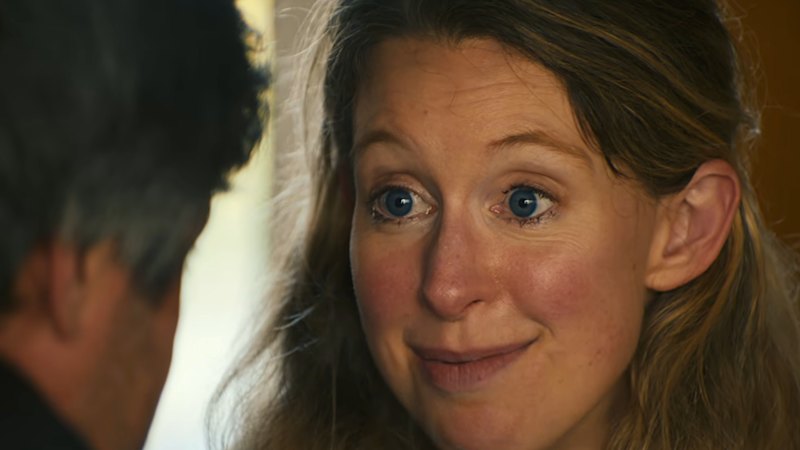
She appears about halfway through Nathan Fielder and Lance Oppenheim’s You Can See Everything and, at first, she solves a very specific problem.
asserted
she → appear → problem
Elizabeth Holmes, the disgraced Theranos founder, has just gone off to start her 11-year prison sentence for defrauding investors, and – after 34 days ensconced with Holmes, her partner Billy Evans, and their two young children – Fielder and Oppenheim no longer have an accessible documentary subject.
asserted
Fielder → go → subject
So they call in the next best thing: Amanda Seyfried, who won an Emmy playing Holmes in the TV series The Dropout.
asserted
who → call → series
In outlandish re-enactments that echo Fielder’s approach on The Rehearsal, Seyfried steps into Holmes’ shoes, a literal stand-in for Fielder’s interactions with Holmes that weren’t captured on camera.
asserted
that → echo → camera
Seyfried is so key to the film that studio A24 is now intent on securing for her a best supporting actress nomination for next year’s Oscars, a wild wrinkle for a Hollywood star ostensibly appearing as themselves in a documentary.
asserted
A24 → secure → documentary
Fielder got to Seyfried through their mutual friend Emma Stone, with whom he worked on the TV series The Curse.
asserted
he → get → series
The pair’s first interaction airs in the doco: a classic bit of metatextual Fielder cringe comedy where he forces Seyfried to watch Holmes watching Seyfried’s performance of her in The Dropout.
asserted
Holmes → air → Dropout
Holmes is in tears at Seyfried’s portrayal, and how it – as she sees it – cemented public perception against her.
asserted
she → see → her
Despite that uncomfortable first exposure to the real Holmes, Seyfried dives in further.
asserted
Seyfried → dive → Holmes
With a conspiratorial smirk, she quickly becomes an enthusiastic sidekick in Fielder’s quest to understand whether Holmes is for real, and to sate her own curiosity about someone who’s become a key figure in her professional life.
asserted
who → become → life
Seyfried’s been described in reviews and articles as the viewer’s cypher, the level-headed presence who calls out Holmes’ controlling partner Evans and checks Fielder when she suspects he’s fallen under Holmes’ spell.
asserted
he → describe → spell
But, more than that, her appearance has thematic heft: she’s central to Fielder and Oppenheim’s dissection of media ethics, of the vampiric relationship between a storyteller and their subject (Oppenheim has named Janet Malcolm’s The Journalist and the Murderer as his favourite book), and the blurriness of truth, the way narratives get manipulated depending on who’s doing the perceiving.
asserted
who → have → perceiving
In the documentary, we see Seyfried’s empathic response when Holmes calls her family from prison, understanding the pain of a mother missing the best years of her young children’s lives.
asserted
Holmes → see → lives
But she’s also compromised: in another scene, Seyfried gets visibly defensive when Evans suggests her performance in The Dropout made Holmes’ life infinitely worse.
uncertain
life → ’ → Dropout
No one wants to think they’ve caused another human being to suffer, even if they think that person’s behaviour borders on sociopathy.
asserted
behaviour → want → sociopathy
In an interview with Vulture, Oppenheim admitted Seyfried was initially worried about getting “punked” by Fielder, familiar as she was with his past work as an agent of chaos on Nathan For You.
asserted
she → admit → You
In a sadistic touch, Fielder even gets Seyfried as Holmes to re-enact lines where Holmes expresses hurt at Seyfried’s portrayal in The Dropout: “How could a woman do that to another woman?” she says, of herself, in Holmes’ mealy-mouthed voice.
uncertain
she → get → voice
Fielder, the dead-faced imp, stares blankly.
asserted
Fielder → star → ?
The protective cloak of fiction has tripped up many actors who’ve faced public fallout for their performances of real-life figures.
asserted
who → trip → figures
As Julian Assange once noted in a letter urging Benedict Cumberbatch to rethink his role in the “debauched” project The Fifth Estate, “feature films are the most powerful and insidious shapers of public perception”.
asserted
films → note → perception
Olivia Wilde’s performance as late journalist Kathy Scruggs in Clint Eastwood’s Richard Jewell sparked a firestorm in 2019, after Scruggs’ friends criticised the film’s suggestion that Scruggs slept with sources for information.
asserted
Scruggs → spark → information
On the hit TV series Love Story, Dree Hemingway played JFK Jr’s ex-partner Daryl Hannah so whiningly that Hannah penned an op-ed in The New York Times, where she slammed the show’s depiction as “textbook misogyny” and said she’d received “hostile and even threatening messages” from viewers.
asserted
she → play → viewers
Pamela Anderson called Lily James’ portrayal of her in Pam & Tommy, the 2022 series about the couple’s notorious tape, “a Halloween costume” and demanded a public apology from the show’s creators, whom she labelled “assholes”.
asserted
she → call → whom
Sometimes actor-y pretension gets in the way.
asserted
pretension → get → way
In an infamous interview with Chuck Klosterman, Val Kilmer insisted he understood exactly “what it feels like to pull the trigger and take someone’s life” because he played Doc Holliday in the 1993 film Tombstone.
asserted
he → insist → film
“So you’re saying you understand how it feels to shoot someone as much as a person who has actually committed a murder?”
asserted
who → say → murder
Klosterman followed up incredulously.
asserted
Klosterman → follow → ?
“I understand it more,” Kilmer replied.
asserted
Kilmer → understand → it
“It’s an actor’s job.”
asserted
It → ’ → ?
Seyfried comes close to such an actor’s moment in You Can See Everything, when she proudly gloats that she convinced the world her version of Holmes was the real deal.
asserted
version → come → Holmes
But her contradictions amid Fielder’s cracked hall of mirrors make her the film’s most genuine participant.
asserted
her → make → mirrors
In an interview making the rounds on Reddit, filmed around the time she would’ve just finished working on You Can See Everything, Seyfried is again asked about her performance on The Dropout.
asserted
Seyfried → make → Dropout
“I am very proud of my work, but it’s a tricky thing to play somebody who’s real,” she says.
asserted
she → ’ → somebody
“There [are] real consequences for the things she did, and if I have any negative impact on her, then that’s not necessarily easy to swallow.”
asserted
that → do → her
If anyone in this film can see everything, it’s Amanda Seyfried.
asserted
it → see → everything
You Can See Everything is in cinemas now.
asserted
See → see → cinemas
- U2’s latest album reminds us of that time a free gift proved costly.
asserted
gift → remind → time
- Why Robert Pattinson changed his mind about Primetime.
asserted
Pattinson → change → Primetime
- “Sorry Dave”: How cinema warned us about AI.
asserted
cinema → warn → AI
- John Malkovich on the film that is generating Oscars buzz.
Must-see movies, interviews and all the latest from the world of film delivered to your inbox.
asserted
that → generate → inbox
 The Aporia