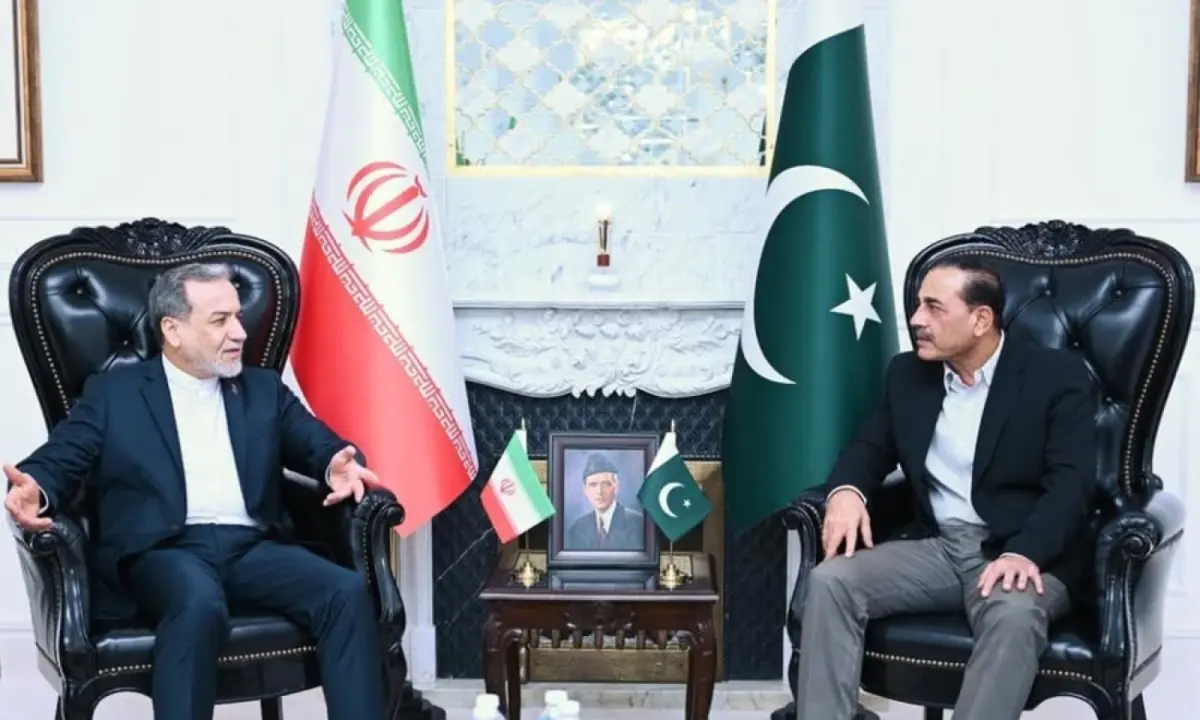
Photo via The Hindu

Pakistan, Iran stress sustained engagement, coordination for regional stability

Read the original at The Hindu ↗
Cite

Pakistan, Iran stress sustained engagement, coordination for regional stability. (2026, November 17). The Hindu. https://www.thehindu.com/news/international/pakistan-iran-stress-sustained-engagement-coordination-for-regional-stability/article71711296.ece

Dated from the outlet's own feed. Check the original for its byline.

The Hindu · collected 2026-11-17 · by PTI

Quick Summary

Pakistan's Chief of Defence Forces Asim Munir emphasized the importance of close coordination with Iran for regional stability during a meeting with an Iranian delegation in Rawalpindi on November 16, 2026. The talks occurred amid ongoing tensions in West Asia following a conflict that began with U.S.-Israeli strikes on Iran in February, leading to missile and drone attacks by Iran on Gulf countries. Pakistan played a mediating role in efforts to end the hostilities, but a final settlement has yet to be reached. The meeting also addressed the need for dialogue to address common security challenges and to promote regional peace and stability.
Written by AI on 2026-11-17, from this article's own text only (the story summary below draws on all the coverage).
See how they differ ↓

AI analysis

Story summary

Chief of Defence Forces and Chief of the Army Staff Field Marshal Asim Munir underscored the importance of sustained engagement, mutual trust, and close coordination between Pakistan and Iran to promote regional peace and stability during a meeting with Iranian Foreign Minister Abbas Araghchi in Rawalpindi on Monday. According to a statement by the Inter-Services Public Relations (ISPR), both sides discussed matters of mutual interest, regional security dynamics, and evolving geopolitical developments. They also exchanged views on exploring avenues to address common security challenges. Araghchi appreciated Pakistan’s constructive role in promoting regional peace and stability and expressed his desire to further strengthen bilateral relations.

Written for “CDF Munir Meets Iran’s Araghchi” on 2026-11-17, grounded in this article and the 1 other(s) covering the same event.
Why this leaning score
This article does not take a side on a contested political question, so it has no leaning score. That is an answer rather than a gap: a match report or a rescue can be warmly or critically written without being left or right, and scoring it anyway is how approval of a subject gets recorded as a political position.
No political leaning scored for article 159929 · logged 2026-11-17

How they differ

2 outlets covered “CDF Munir Meets Iran’s Araghchi”.

What each outlet says

One AI summary per outlet of its latest article on this story, written from that article alone and checked against it. Open the article for the outlet's own words.

The HinduThis outlet17 Nov

Pakistan's Chief of Defence Forces Asim Munir emphasized the importance of close coordination with Iran for regional stability during a meeting with an Iranian delegation in Rawalpindi on November 16, 2026. The talks occurred amid ongoing tensions in West Asia following a conflict that began with U.S.-Israeli strikes on Iran in February, leading to missile and drone attacks by Iran on Gulf countries. Pakistan played…

Pakistan, Iran stress sustained engagement, coordination for regional stability (this article)
Dawn17 Nov

Field Marshal Asim Munir, Pakistan's Chief of Defence Forces, met with Iranian Foreign Minister Abbas Araghchi in Rawalpindi on Monday. During the meeting, the ISPR reported that both leaders emphasized the need for sustained engagement and mutual trust to enhance regional peace and stability. They also discussed regional security dynamics and explored ways to tackle shared security challenges. Araghchi acknowledged…

CDF Munir underscores importance of sustained engagement, mutual trust in meeting with Iran’s Araghchi →

Compared with similar articles

This article reads unscored and hedges 11% of its claims. Each row says how that neighbour differs.

Story

CDF Munir Meets Iran’s Araghchi
Politics · 2 article(s) covering the same event. See how they differ ↑
How this article was measured signals, leaning charts, publisher record, byline, topics and claims

Signals How these are calculated →

Claims extracted
18
sentences that state something as happening or true
Uncertain
11%
2 of 18 hedged ("reportedly", "may", "according to")
Leaning
not political
takes no side on a contested political question
Publisher signals
78/100
The Hindu's corrections and hedging, across everything collected from it. Not a measure of accuracy.
Outlets on this story
2
Politics
Same framing elsewhere
1
articles that frame the event the way this one does
Analyzed 2026-11-17 · how these are computed

How this is being covered How these are calculated →

Article leaning vs. publisher reliability
Source leaning vs. consistency

Publisher

The Hindu · 1322 article(s) · 2 correction(s) detected
Running correction rate · 2 correction(s)

Who wrote this

No reporter is named on this article, beyond the feed's “ PTI”.

Topics

ECO Iran Iranian Pakistan U.S.

Subjects

Iran GPE · 7× Pakistan GPE · 6× Araghchi PERSON · 5× ECO ORG · 3× Iranian NORP · 2× U.S. GPE · 2× Army ORG · 1× Asim Munir PERSON · 1× Defence Forces ORG · 1× Munir PERSON · 1×

Narrative

The interim agreement envisaged an end to military operations, the reopening of the Strait of Hormuz and the lifting of the U.S. naval blockade of Iranian ports. However, the arrangement failed to produce a lasting settlement, with the two sides unable to bridge differences over sanctions relief, the naval blockade, shipping arrangements through the Strait of Hormuz and Iran's nuclear programme.
framing: assertive · carried by 1 article(s) · first seen 2026-11-17

Claims (18 extracted, 2 hedged)

Pakistan's Chief of Defence Forces Asim Munir has stressed the importance of sustained engagement and close coordination with Iran to promote regional peace and stability, the army said on Tuesday (November 17, 2026). asserted
army → stress → Tuesday
Field Marshal Munir, who is also the Chief of Army Staff, made the remarks during a meeting with a high-level Iranian delegation led by Foreign Minister Abbas Araghchi in Rawalpindi on Monday (November 16), according to a statement by the Pakistan Army. uncertain
who → make → Army
The two sides "underscored the importance of sustained engagement, mutual trust and close coordination between the two brotherly countries for promoting regional peace and stability," the statement said. asserted
statement → underscore → peace
Mr. Araghchi appreciated Pakistan's constructive role in promoting regional peace and stability and expressed Iran's desire to further strengthen bilateral relations, it said. asserted
it → appreciate → relations
The two sides also exchanged views on exploring avenues to address common security challenges. asserted
sides → exchange → challenges
The remarks come amid continuing tensions in West Asia following the outbreak of a military conflict on February 28, when joint U.S.-Israeli strikes killed Iran's Supreme Leader Ayatollah Ali Khamenei and several senior political and military officials. asserted
strikes → come → Leader
Iran subsequently launched large-scale retaliatory missile and drone attacks on Gulf countries hosting U.S. military facilities, including the UAE, Qatar, Kuwait, Bahrain and Saudi Arabia. asserted
Iran → launch → UAE
The attacks disrupted regional airspace and damaged civilian and energy infrastructure. asserted
attacks → disrupt → infrastructure
The conflict has also severely disrupted commercial shipping through the Strait of Hormuz, a key global energy route through which a significant share of the world's oil and liquefied natural gas supplies passes. asserted
share → disrupt → supplies
Pakistan played a key mediating role in efforts to end the hostilities, with an interim agreement, known as the Islamabad Memorandum of Understanding, signed between Washington and Tehran in June. asserted
Pakistan → play → June
The interim agreement envisaged an end to military operations, the reopening of the Strait of Hormuz and the lifting of the U.S. naval blockade of Iranian ports. However, the arrangement failed to produce a lasting settlement, with the two sides unable to bridge differences over sanctions relief, the naval blockade, shipping arrangements through the Strait of Hormuz and Iran's nuclear programme. asserted
sides → envisage → Hormuz
The 60-day period envisaged for negotiations towards a final settlement expired without an agreement. asserted
period → envisage → agreement
Mr. Araghchi was in Pakistan to attend the 30th meeting of the Economic Cooperation Organisation (ECO) Council of Ministers, which concluded on Monday (November 16). asserted
which → attend → Monday
The ECO, originally called the Regional Cooperation for Development, was established in 1964 by Iran, Pakistan and Turkiye. asserted
ECO → call → Iran
On the sidelines of the meeting, Mr. Araghchi also held talks with Pakistan's Deputy Prime Minister and Foreign Minister Ishaq Dar. asserted
Araghchi → hold → Minister
Mr. Dar and Mr. Araghchi agreed that dialogue and diplomacy were the only means to achieve lasting peace in the region, according to a Foreign Office statement. uncertain
dialogue → agree → statement
Mr. Araghchi also said at the ECO meeting that Iran remained committed to diplomacy and peaceful solutions, while accusing the United States of choosing a different path marked by aggression, targeted assassinations and economic coercion. asserted
Iran → say → aggression
He called for an independent regional security framework and a reliable energy mechanism to safeguard supplies and reduce vulnerabilities amid geopolitical tensions. asserted
He → call → tensions
Give feedback · no sign-in needed

No sign-in needed for now. Your note is sent without a name, so it cannot be answered.

History Support