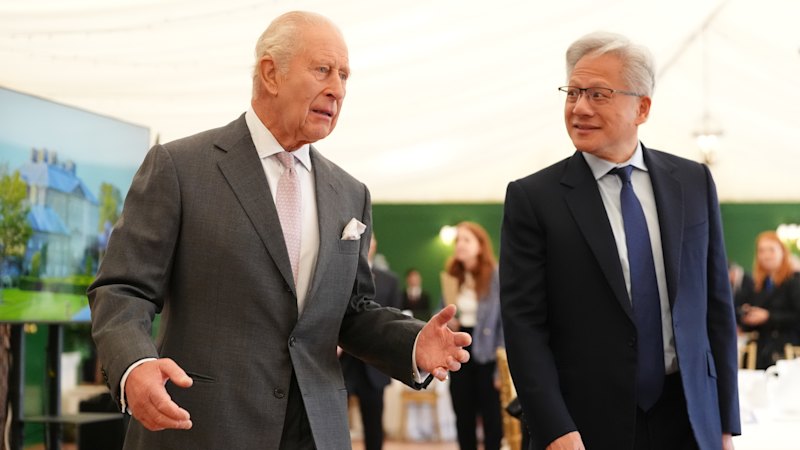
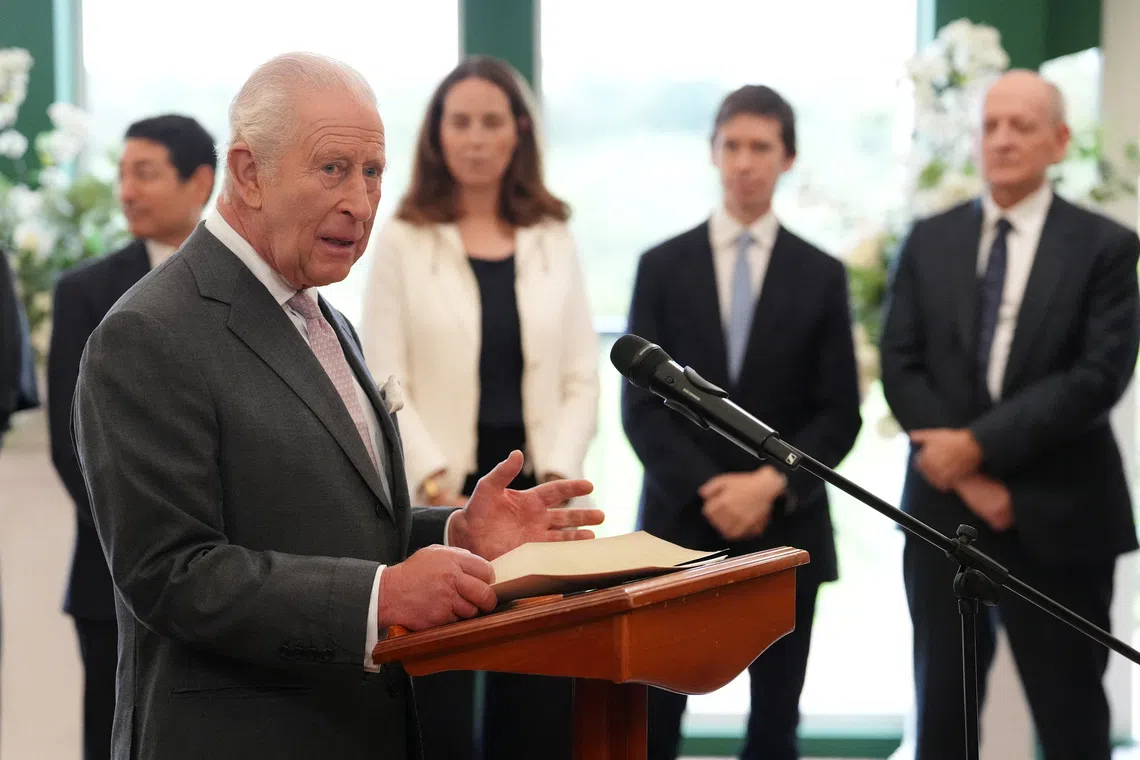
Photo via The Sydney Morning Herald

King warns AI leaders of ‘existential dangers’ if tech falls into wrong hands

Read the original at The Sydney Morning Herald ↗
Cite

Holton, K., & Sandle, P. (2026, September 17). King warns AI leaders of ‘existential dangers’ if tech falls into wrong hands. The Sydney Morning Herald. https://www.smh.com.au/world/europe/king-warns-ai-leaders-of-existential-dangers-if-tech-falls-into-wrong-hands-20260918-p60yf3.html?ref=rss&utm_medium=rss&utm_source=rss_feed

Dated when The Aporia collected the article, usually within hours of publication. Check the original for its exact date and byline.

The Sydney Morning Herald · collected 2026-09-17 · by Kate Holton, Paul Sandle

Quick Summary

King Charles hosted leaders from major AI companies like Nvidia, Google DeepMind, OpenAI, and Anthropic in Scotland, warning them about the "existential dangers" of AI technology falling into the wrong hands. Attendees included executives such as Jensen Huang and Demis Hassabis, who discussed the need for safeguards before it’s too late to prevent catastrophic consequences from advanced AI systems. The meeting emphasized the urgency of considering how to control AI development responsibly, despite not producing any binding agreements.
Written by AI on 2026-09-17, from this article's own text only (the story summary below draws on all the coverage).

AI analysis

Story summary

King Charles III hosted a summit at Dumfries House in Scotland this week to discuss the risks and benefits of artificial intelligence (AI) with top executives from companies like Anthropic, Nvidia, Google DeepMind, and OpenAI. The meeting came amid growing concerns that AI could pose existential threats if not properly regulated, including warnings from two Anthropic researchers that advanced AI systems might eventually lead to human extinction. Executives present included Nvidia's CEO Jensen Huang and Google DeepMind’s founder Demis Hassabis. During the event, King Charles emphasized the need for global leaders in AI to ensure technological development remains centered on human benefit rather than potential catastrophic misuse by bad actors.

Written for “King Warns AI Leaders Existential Dan…” on 2026-10-31, grounded in this article and the 16 other(s) covering the same event.

Story

📰 King Warns AI Leaders Existential Dan…
Technology · 17 article(s) covering the same event. Compare every outlet's account →

Compared with similar articles

This article reads unscored and hedges 21% of its claims. Each row says how that neighbour differs.
Al Jazeera
Hedges 2 of 15 claims Outlet record 60/100
BBC News
Hedges 4 of 19 claims Outlet record 68/100
New York Post
Hedges 3 of 20 claims Outlet record 66/100
The Straits Times
Hedges 1 of 4 claims Outlet record 66/100
Global News
Hedges 4 of 20 claims Outlet record 63/100
CBC News
Hedges 0 of 2 claims Outlet record 60/100
Evening Standard
Hedges 6 of 28 claims Outlet record 65/100
Evening Standard
Hedges 6 of 26 claims Outlet record 65/100
Evening Standard
Hedges 3 of 25 claims Outlet record 65/100
ABC News (AU)
Hedges 1 of 4 claims Outlet record 68/100
How this article was measured signals, leaning charts, publisher record, byline, topics and claims

Signals How these are calculated →

Claims extracted
14
sentences that state something as happening or true
Uncertain
21%
3 of 14 hedged ("reportedly", "may", "according to")
Leaning
withheld
no quote in the article backed the model's score
Publisher signals
61/100
The Sydney Morning Herald's corrections and hedging, across everything collected from it. Not a measure of accuracy.
Outlets on this story
17
Technology
Same framing elsewhere
1
articles that frame the event the way this one does
Analyzed 2026-09-17 · how these are computed

How this is being covered How these are calculated →

Article leaning vs. publisher reliability
Source leaning vs. consistency

Publisher

The Sydney Morning Herald · 5640 article(s) · 15 correction(s) detected
Running correction rate · 15 correction(s)

Who wrote this

Kate Holton
2 article(s) here · 1 carrying a prediction
🔮 Earl Spencer said the tabloid treatment of both Diana and Harry and Meghan could be “really, really unpleasant”, and that it was “beholden on people” to learn from that experience. Diana died aged 36 in a 1997 Paris car crash as photographers pursued her car on motorbikes, and her death sparked an outpouring of grief and a reckoning over whether the media bore some responsibility after it splashed details of her life across front pages for years. “From a security aspect, as an uncle who’s seen his sister die in very, very preventable circumstances, I would veer towards protection,” Charles Spencer told the BBC, citing Harry’s position as fifth in line to the British throne and as a former soldier.
🔮 But its creators were increasingly warning that it could develop darker capacities, “perhaps even to take life”, he said.
Also by Kate Holton
Nothing else under this byline is closely related to this article, so these are simply their most recent.
Paul Sandle
1 article(s) here · 1 carrying a prediction
🔮 But its creators were increasingly warning that it could develop darker capacities, “perhaps even to take life”, he said.
The only article under this byline in the corpus.

Topics

Anthropic Google DeepMind Nvidia OpenAI Scotland

Subjects

Charles PERSON · 6× Anthropic ORG · 2× Google DeepMind ORG · 2× Nvidia ORG · 2× OpenAI ORG · 2× Scotland GPE · 2× Demis Hassabis PERSON · 1× Donald Trump PERSON · 1× Jensen Huang PERSON · 1× Leo XIV PERSON · 1×

Narrative

Anthropic chief executive Dario Amodei has also called for companies to slow the pace of AI development. However, that has sparked an international debate over whether some executives have ulterior motives, such as setting rules that preserve the lead of particular companies, acting now to avoid a broader government backlash, or simply slowing spending in the race to develop AI.
framing: mixed · carried by 1 article(s) · first seen 2026-09-17
🔮 But its creators were increasingly warning that it could develop darker capacities, “perhaps even to take life”, he said.
2026-09-17 · The Sydney Morning Herald
King warns AI leaders of ‘existential dangers’ if tech falls into wrong hands · mixed framing

Claims (14 extracted, 3 hedged)

King Charles has warned AI leaders of the “existential dangers” posed by the technology falling into the wrong hands, with potentially catastrophic consequences, saying safeguards were needed before it becomes “too late”. asserted
it → warn → consequences
Charles was hosting the co-founders of Nvidia and Google DeepMind, along with leaders from OpenAI and Anthropic, in Scotland on Thursday as concern grows that AI safety efforts are lagging behind the development of increasingly powerful systems. asserted
efforts → host → systems
In recent weeks, the debate has centred on whether the industry can and should regulate itself, drawing interventions from global figures including Pope Leo XIV, Charles and US President Donald Trump. asserted
industry → centre → XIV
Charles said artificial intelligence had the potential to improve and save lives, particularly in life sciences and medicine. asserted
intelligence → say → sciences
But its creators were increasingly warning that it could develop darker capacities, “perhaps even to take life”, he said. uncertain
he → warn → life
“There seems urgency in adequately considering the existential dangers of such technologies falling into the wrong hands, and being used in potentially catastrophic ways,” he told leaders gathered at his Dumfries House estate. “Surely, we need sufficient means of control before it is all too late?” asserted
it → seem → control
Attendees included Nvidia founder and chief executive Jensen Huang, Google DeepMind founder and chairman Demis Hassabis, OpenAI Chief Financial Officer Sarah Friar and Britain’s Minister for Artificial Intelligence Kanishka Narayan. asserted
Attendees → include → Intelligence
Paolo Benanti, an adviser to the pope who has called for governments to slow AI development, was also expected to attend. asserted
governments → call → development
The debate over AI has been thrust back into the spotlight after two Anthropic researchers warned that the rapidly advancing technology could lead to human extinction in the not-too-distant future. uncertain
technology → thrust → future
Anthropic chief executive Dario Amodei has also called for companies to slow the pace of AI development. However, that has sparked an international debate over whether some executives have ulterior motives, such as setting rules that preserve the lead of particular companies, acting now to avoid a broader government backlash, or simply slowing spending in the race to develop AI. asserted
that → call → AI
While the meeting in Scotland is not expected to produce any binding agreements, and Charles is not known for his technological expertise, it highlights how he, first as Prince of Wales and now as King, has used his position to convene discussions on a range of global issues. asserted
he → expect → issues
In references to the risks around AI, Charles has also warned about the potential impact on the environment, reflecting his decades of campaigning on the natural world. asserted
Charles → warn → world
Buckingham Palace said the discussions would consider whether a shared set of principles could guide the future application of AI, “not merely as a driver of capability and efficiency, but as a tool that upholds human dignity and contributes to the flourishing of both people and the planet”. uncertain
that → say → people
Reuters Get a note directly from our foreign correspondents on what’s making headlines around the world. asserted
what → get → world

💬Give feedback
🕘History 🎫Support