Photo via Al Jazeera

Ghalibaf’s maths missile at Trump decoded: Is Iran fixing US interest rates?

Read the original at Al Jazeera ↗
Cite

Siddiqui, U. (2026, September 17). Ghalibaf’s maths missile at Trump decoded: Is Iran fixing US interest rates? Al Jazeera. https://www.aljazeera.com/news/2026/9/17/ghalibafs-maths-missile-at-trump-decoded-is-iran-fixing-us-interest-rates?traffic_source=rss

Dated when The Aporia collected the article, usually within hours of publication. Check the original for its exact date and byline.

Al Jazeera · collected 2026-09-17 · by Usaid Siddiqui

Quick Summary

Iranian Parliament Speaker Mohammad Bagher Ghalibaf posted an equation used by central banks to determine interest rates on X, alongside wartime rhetoric implying Iran's influence over US economic decisions. He suggested that Tehran could manipulate U.S. interest rates and control the Strait of Hormuz strategically. This comes amid ongoing tensions between Iran and the United States since February 28 when a war allegedly initiated by the US and Israel against Iran began. Economists use the Taylor equation to estimate central bank interest rates based on inflation and economic output, but Ghalibaf's post is more an act of propaganda than practical economics.
Written by AI on 2026-09-17, from this article's own text only (the story summary below draws on all the coverage).

AI analysis

Story summary

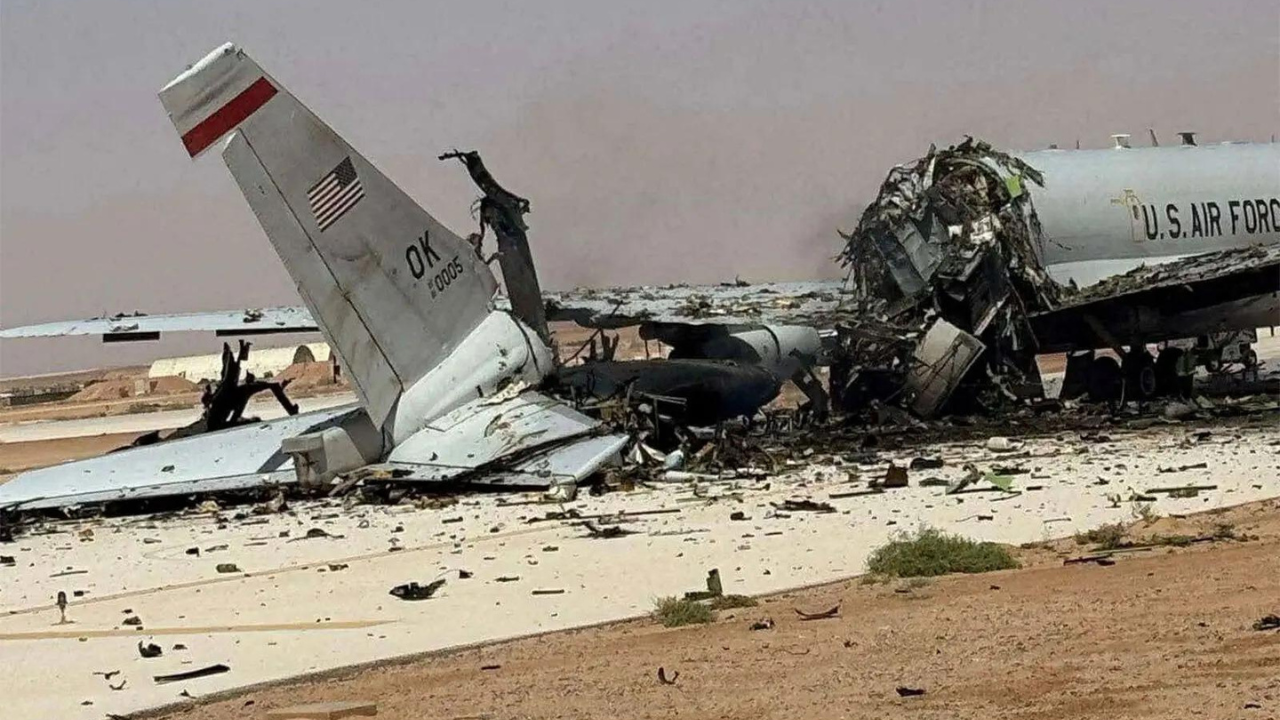
CBS News has obtained leaked photos from anonymous U.S. military personnel stationed in Saudi Arabia and Kuwait, showing extensive damage at U.S. bases following Iranian missile and drone strikes. The images depict destroyed aircraft, collapsed buildings, and burned-out vehicles. One photo captures a $270 million Boeing E-3 Sentry spy plane severely damaged at Prince Sultan Air Force Base in Saudi Arabia, with its tail section ripped off. These photos highlight significant destruction across multiple U.S. positions, raising concerns about the impact of President Trump's war on Iran, which began seven months prior and shows no signs of ending. The Pentagon’s inspector general reported that hundreds of buildings and structures at U.S. bases in eight countries, including Kuwait, Bahrain, Saudi Arabia, Iraq, and Jordan, were damaged or destroyed by Iranian strikes.

Written for “Iran Attacks Damage US Bases” on 2026-10-30, grounded in this article and the 29 other(s) covering the same event.

Story

📰 Iran Attacks Damage US Bases
World · 30 article(s) covering the same event. Compare every outlet's account →

Compared with similar articles

This article reads leans left and hedges 16% of its claims. Each row says how that neighbour differs.
Al Jazeera
⚖️ Leans left Hedges 0 of 46 claims Outlet record 60/100
Al Jazeera
⚖️ Leans left Hedges 8 of 54 claims Outlet record 60/100
“Both articles discuss aspects of the ongoing conflict between Iran and the US, but they cover different elements: Article A focuses on the financial cost and economic impact, while Article B discusses military actions and a specific tactic involving mathematics.”
Times of India
⚖️ Leans left Hedges 2 of 25 claims Outlet record 59/100
“While both articles discuss financial and military costs related to a war involving Iran and the US, they do not describe the exact same incident or occurrence.”
How this article was measured signals, leaning charts, publisher record, byline, topics and claims

Signals How these are calculated →

Claims extracted
37
sentences that state something as happening or true
Uncertain
16%
6 of 37 hedged ("reportedly", "may", "according to")
Leaning
Leans left
of the writing, not the subject · beta estimate
Publisher signals
60/100
Al Jazeera's corrections and hedging, across everything collected from it. Not a measure of accuracy.
Outlets on this story
30
World
Same framing elsewhere
1
articles that frame the event the way this one does
Analyzed 2026-09-17 · how these are computed

How this is being covered How these are calculated →

Article leaning vs. publisher reliability
Source leaning vs. consistency

Publisher

Al Jazeera · 4438 article(s) · 2 correction(s) detected
Running correction rate · 2 correction(s)

Who wrote this

Usaid Siddiqui
11 article(s) here · 1 carrying a prediction
🔮 So a great divide could really mean an opportunity divide, and really could deepen the socioeconomic divide,” he said.
🔮 “Trade will prosper, and long-term investment will create its potential only with a safe and stable environment.”
🔮 Iranian strikes on Qatar’s Ras Laffan industrial complex in March damaged facilities, with repairs expected to take several years. “We were surprised,” Al Thani said when asked about the attack, adding that there had since been “a lot of discussion with Iran”.
🔮 “On the other hand, AI gives individuals access to types and quantities of information they didn’t have previously that may facilitate the commission of mass casualty events, a concern it’s not easy to dismiss.”
🔮 Varga said current flows could be maintained as long as those methods and routes remain secure.
🔮 Gulf countries, she suggested, may be paying Iran to allow their oil through – potentially handing Tehran a significant portion of the value of the cargo.
🔮 Sami Abu Shehadeh, the leader of the Balad party, withdrew his candidacy after the Supreme Court warned he could be disqualified from the race.
🔮 As Iran and the United States work with mediators to end seven months of hostilities, the reality in the Strait of Hormuz is shifting in ways that could prove to be a game-changer in ongoing negotiations.
🔮 The proposal, effectively an “AI hotline”, was discussed on Sunday during talks in New York between US Treasury Secretary Scott Bessent and Chinese Vice Premier He Lifeng, ahead of a summit between US President Donald Trump and Chinese President Xi Jinping in Washington this week. Recommended Stories list of 3 items- list 1 of 3Doomsday AI: panic, regulation and the China fear - list 2 of 3Australia seeks big tech support for internet safety, AI regulation - list 3 of 3Trump says he will create ‘AI Force’ with new ‘AI czar’ The two leaders are expected to consider establishing a broader US-China dialogue on AI, including the proposed notification system, around which details remain limited.
🔮 “Let’s see if a hike could open SOH or produce a single barrel,” he wrote, referring to interest rate hikes and the Strait of Hormuz, a crucial waterway Iran has effectively blocked for global shipping.
Also by Usaid Siddiqui
Nothing else under this byline is closely related to this article, so these are simply their most recent.
All 11 articles by Usaid Siddiqui →

Topics

Al Jazeera Iran Tehran Washington the United States’

Subjects

Iran GPE · 11× Ghalibaf PERSON · 4× Fed ORG · 3× Taylor PERSON · 3× Tehran GPE · 3× the US Federal Reserve ORG · 3× Al Jazeera ORG · 2× Trump PERSON · 2× Washington GPE · 2× the United States’ GPE · 1×

Narrative

Early in the war, which was launched by the US and Israel against Iran on February 28, Ghalibaf frequently used financial arguments to mock how the conflict was being conducted by the administration of US President Donald Trump, to point to Iran’s ability to hurt Washington economically unless it changed its approach.
framing: assertive · carried by 1 article(s) · first seen 2026-09-17
🔮 “Let’s see if a hike could open SOH or produce a single barrel,” he wrote, referring to interest rate hikes and the Strait of Hormuz, a crucial waterway Iran has effectively blocked for global shipping.

Claims (37 extracted, 6 hedged)

Iran’s missiles and drones have downed dozens of US aircraft, damaged or destroyed hundreds of the United States’ buildings at its bases in the Middle East, and drained its inventories of military equipment worth billions of dollars, the Pentagon conceded earlier this week. asserted
Pentagon → down → dollars
On Wednesday, Tehran unleashed another unlikely weapon in its war against the US: a maths equation. asserted
Tehran → unleash → US
Recommended Stories list of 4 items- list 1 of 4‘They called us’: Has Trump abandoned Bab al-Mandeb to the Houthis? asserted
Trump → call → Houthis
- list 2 of 4US CENTCOM tells Al Jazeera Hormuz blockade ‘highly effective’ - list 3 of 4Trump claims direct talks with Iran: Is diplomacy picking up again? - list 4 of 4Why is inflation rising again around the world? Iranian Parliament Speaker Mohammad Bagher Ghalibaf, who has also been a lead negotiator during talks between Tehran and Washington at different stages during the past six months, typed out a version of the Taylor equation, a formula used by central banks to determine interest rates, in a post on X loaded with a wartime message. uncertain
who → tell → message
“Let’s see if a hike could open SOH or produce a single barrel,” he wrote, referring to interest rate hikes and the Strait of Hormuz, a crucial waterway Iran has effectively blocked for global shipping. uncertain
Iran → see → shipping
“You can’t 25bp [basis points] a chokepoint,” he added, seemingly again referring to the strait. asserted
he → add → strait
“It’s SOH risk premium, and We set it.” asserted
We → ’ → it
Hours after Ghalibaf’s post, the US Federal Reserve did raise the benchmark interest rate by 25 basis points. asserted
Reserve → raise → points
Early in the war, which was launched by the US and Israel against Iran on February 28, Ghalibaf frequently used financial arguments to mock how the conflict was being conducted by the administration of US President Donald Trump, to point to Iran’s ability to hurt Washington economically unless it changed its approach. asserted
it → launch → approach
Now he’s turned to maths. asserted
he → turn → maths
“This is a spectacular bit of agitprop from Iran, a country which, if nothing else in 2026, has demonstrated an impressive ability to needle its US opponent,” Chris Beauchamp, chief market analyst at IG Group, told Al Jazeera. asserted
Beauchamp → demonstrate → Jazeera
But what exactly is Ghalibaf trying to say? What is the Taylor equation, has the Iran war influenced the US interest rate, and does Tehran “set it”, as the parliament speaker has suggested? uncertain
speaker → try → it
What is the Taylor equation that Ghalibaf cited? asserted
Ghalibaf → cite → that
The rule is a formula economists use to estimate where a central bank should set interest rates based on inflation and the strength of the economy. asserted
bank → use → economy
Developed by economist John Taylor in the early 1990s, the rule links the US federal funds rate to inflation and the “output gap” – the difference between actual economic output and its potential. asserted
rule → develop → output
In its simplest form, the formula is: Interest rate = inflation + 0.5(output gap) + 0.5(inflation − 2%) + 2%. This means the recommended interest rate rises when inflation moves above the 2 percent target or when economic output exceeds its potential. asserted
output → mean → potential
It falls when inflation weakens or the economy operates below potential. asserted
economy → fall → potential
However, the equation is a benchmark, not a set rule that is strictly followed. asserted
that → set → ?
Policymakers at the US Federal Reserve weigh other economic factors when setting interest rates. asserted
Policymakers → weigh → rates
Trump’s tariffs, the energy shock following the US-Israeli war with Iran, and heavy investment associated with the artificial intelligence boom, taken together, have kept inflationary pressures strong, experts say. asserted
experts → follow → pressures
On Wednesday, when the US Federal Reserve raised interest rates by 25bp, it was the first increase in three years. asserted
it → raise → years
Fed Chairman Kevin Warsh, in his speech following the rate hike, said renewed fighting between the US and Iran, which has pushed up petrol prices, helped convince Fed officials to support higher rates. asserted
which → follow → rates
“There’s no hiding from hot spots around the world,” Warsh said. asserted
Warsh → hide → world
IG Group’s Beauchamp said, “The Iran war, indirectly, is a huge driver of last night’s hike, though no one wants to admit it.” asserted
one → say → it
“The energy spike has combined with the rise in yields to drive the Fed into a corner with no way out,” he said. asserted
he → combine → way
Susannah Streeter, chief investment strategist at the Wealth Club, said there is “no denying” that Iran’s retaliatory action against the US and its allies across the Gulf region has “intensified concerns about energy supplies and led to hotter inflation forecasts”. asserted
action → say → forecasts
“The ongoing geopolitical turmoil and elevated crude prices certainly were key issues behind the Fed’s decision to hike rates,” she said. asserted
she → hike → rates
Is Iran ‘setting’ the US interest rate? asserted
Iran → set → rate
Wealth Club’s Streeter cautioned that while the war in the Middle East and rising oil prices were certainly an element in the Fed’s decision, they weren’t the “only factors at play”. asserted
they → caution → play
“The spending might of AI hyperscalers has also pulsed through the veins of the economy, with strong capital investment and resilient domestic demand adding to inflationary pressures, so policymakers will have been looking at the whole picture,” she noted. uncertain
she → pulse → picture
“So, while Tehran has arguably had an influence on some of the forces feeding into US monetary policy, particularly through the impact of the conflict on oil supplies and prices, it is not ‘setting’ US interest rates.” asserted
it → have → rates
Streeter said the US Federal Reserve was responding to a much broader set of economic conditions. asserted
Reserve → say → conditions
“Iran’s actions have affected the inflation outlook, but the decision on where to set interest rates ultimately rests with the Federal Reserve, and there are plenty of other data points policymakers use,” she noted. asserted
she → affect → points
What’s behind Ghalibaf’s maths mocking? asserted
What → ’ → mocking
In March, Iran’s parliamentary speaker had repeatedly used social media to comment on markets and energy prices, including mocking efforts by the Trump administration to influence oil futures and arguing that financial manoeuvring could not create “actual fuel” at petrol stations. uncertain
manoeuvring → use → stations
Last month, Ghalibaf posted a graphic bearing the phrase “Make America Hungry Again” – a play on Trump’s slogan “Make America Great Again” – together with statistics on food insecurity and hunger in the US. asserted
America → post → US
“You can’t cover up defeats with false claims,” he said. uncertain
he → cover → claims

💬Give feedback
🕘History 🎫Support