
Photo via New York Post

1,700-year-old ‘Odyssey’ fragment found in library book — here’s what it revealed

Read the original at New York Post ↗
Cite

Cost, B. (2026, September 17). 1,700-year-old ‘Odyssey’ fragment found in library book — here’s what it revealed. New York Post. https://nypost.com/2026/09/17/science/researchers-finds-iconic-1700-odyssey-fragment-in-library-book/

Dated when The Aporia collected the article, usually within hours of publication. Check the original for its exact date and byline.

New York Post · collected 2026-09-17 · by Ben Cost

Quick Summary

Mark de Kreij, a Greek literature expert and professor, found a 1,700-year-old fragment from "The Odyssey" inside a book at Utrecht University. The parchment measures just 2.6 by 3 inches and describes the moment Helios discovers Odysseus and his men feasting on his sacred cows, leading to their destruction by Zeus. De Kreij believes this rare fragment was part of an ancient pocketbook edition from Egypt around 300 A.D., highlighting the enduring popularity of Homer’s epic. This discovery is one of only about 30 known fragments of "The Odyssey" worldwide.
Written by AI on 2026-09-17, from this article's own text only (the story summary below draws on all the coverage).

AI analysis

Story summary

Dr. Mark de Kreij, a Greek literature expert from Radboud University in the Netherlands, discovered a 1,700-year-old fragment of Homer's "Odyssey" while examining ancient manuscripts at Utrecht University. The tiny piece of paper, measuring just 2.6 by 3 inches, was found inside a library book and is believed to have come from an early Christian manuscript collection purchased in the mid-20th century. Researchers initially thought it dated back to the 7th century but later identified it as part of Homer's epic poem dating to around 300 AD. Only about 30 such fragments exist worldwide, making this discovery highly significant for scholars studying ancient Greek literature and its historical context in early Christian Egypt.
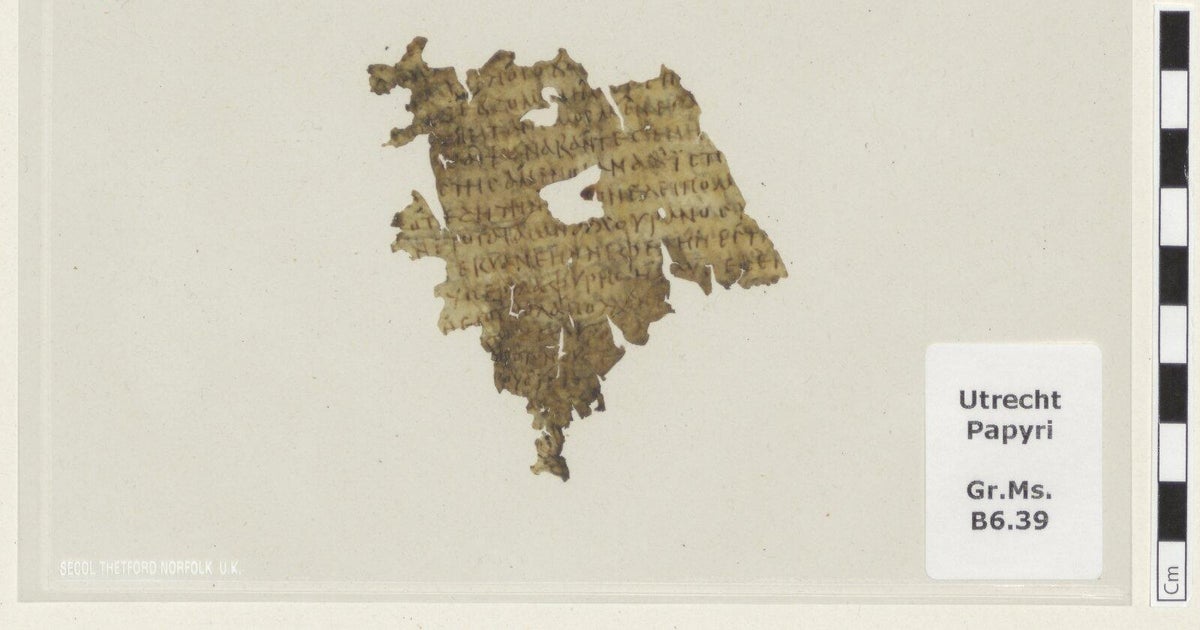
Written for “Ancient Odyssey Fragment Found” on 2026-11-02, grounded in this article and the 1 other(s) covering the same event.

Story

📰 Ancient Odyssey Fragment Found
Science · 2 article(s) covering the same event. See how they differ ↓

Compared with similar articles

This article reads unscored and hedges 0% of its claims. Each row says how that neighbour differs.
CBS News
Hedges 2 of 20 claims Outlet record 66/100
How this article was measured signals, leaning charts, publisher record, byline, topics and claims

Signals How these are calculated →

Claims extracted
16
sentences that state something as happening or true
Uncertain
0%
0 of 16 hedged ("reportedly", "may", "according to")
Leaning
not political
takes no side on a contested political question
Publisher signals
66/100
New York Post's corrections and hedging, across everything collected from it. Not a measure of accuracy.
Outlets on this story
2
Science
Same framing elsewhere
1
articles that frame the event the way this one does
Analyzed 2026-09-17 · how these are computed

How this is being covered How these are calculated →

Article leaning vs. publisher reliability
Source leaning vs. consistency

Publisher

New York Post · 16140 article(s) · 35 correction(s) detected
Running correction rate · 35 correction(s)

Who wrote this

Ben Cost
36 article(s) here · 0 carrying a prediction
🔮 Andrew Jones, project head and founder of Noah’s Ark Scans, told the Daily Mail that they’ve discovered both charred and uncharred wood nearly 30 feet underground, which could potentially be “the charred remains of Noah’s Ark.”
🔮 Due to their negligence, officials said the hikers would have to foot their own rescue bill, which could range from $1,000 to $20,000 depending on the cost, according to the Boston Globe.
🔮 They couldn’t slow its roll.
🔮 Mummies might not curse defilers from the afterlife, but that doesn’t mean you should display their remains, apparently.
🔮 The company’s investigators reportedly discovered a glitch that allowed them to access pages from over 6,800 links Muse had created so users could share pages with each other, Ars Technica reported.
🔮 In their final post before their death, the duo could be seen taking to the streets on a wheeled contraption.
🔮 The 78-year-old Nobel Prize winner notably stepped down from Google in 2023 over fears that the tech could manufacture killer robots capable of exterminating humanity.
🔮 Despite logging onto the Apple Store app “the moment it opened,” it reportedly glitched out and they couldn’t press buy.
🔮 That means that high-latitude nations like the UK, Canada, and Norway will face the greatest solar storm risk between December and February.
🔮 While humans might be mostly to blame for Antarctica’s snow melt, scientists are pointing to another surprising source of the a-thaw-calypse — penguin poop.
Also by Ben Cost
Nothing else under this byline is closely related to this article, so these are simply their most recent.
All 36 articles by Ben Cost →

Topics

Christian Dutch Egyptian Greek Utrecht University

Subjects

Greek NORP · 3× Helios PERSON · 3× de Kreij PERSON · 3× Dutch NORP · 2× Egyptian NORP · 2× Odysseus PERSON · 2× Christian NORP · 1× Mark de Kreij PERSON · 1× RTV Utrecht ORG · 1× Utrecht University ORG · 1×

Narrative

Researchers suspect that the parchment belonged to a pocketbook edition of the sword-and-sandals epic that was produced in the Fayum Oasis in Egypt around 300 A.D., proving that the tale was a fixture long before Christopher Nolan’s 2026 blockbuster.
framing: assertive · carried by 1 article(s) · first seen 2026-09-17

Claims (16 extracted, 0 hedged)

A Dutch scientist’s library research took a dramatic turn after he discovered a 1,700-year-old fragment from “The Odyssey” hidden inside a book from Utrecht University. asserted
he → take → University
Mark de Kreij, a Greek literature expert and professor, was researching ancient Egyptian and Greek texts in the Dutch city. asserted
Kreij → research → city
As he skimmed a collection of early Christian manuscripts, he happened upon a peculiar scrap of parchment. asserted
he → skim → parchment
It measured just 2.6 by 3 inches — the size of a playing card — and with its water stains, discoloration and tiny, neat letters, the piece looked unremarkable at first. asserted
piece → measure → stains
But Professor de Kreij recognized it as a key plot point in the classic saga. asserted
Kreij → recognize → saga
“This happens to be a really fun passage,” he told RTV Utrecht. asserted
he → happen → Utrecht
This pivotal passage describes the unfortunate moment that the Sun god, Helios, discovers that Odysseus and his men have feasted on his herd of sacred golden cows. asserted
Odysseus → describe → cows
Earlier in the epic, the Greek hero was warned by the sorceress Circe to watch out for Helios; ultimately, he ignored her advice and let his sailors run rampant on the enchanted land. asserted
sailors → warn → land
His mariners decided to barbecue the divine bovines, causing Helios to plot bloody revenge on the ship’s crew. asserted
Helios → decide → crew
At the end of the chapter, ever sailor except Odysseus has been killed by Zeus and his lightning bolts. asserted
sailor → kill → Zeus
Researchers suspect that the parchment belonged to a pocketbook edition of the sword-and-sandals epic that was produced in the Fayum Oasis in Egypt around 300 A.D., proving that the tale was a fixture long before Christopher Nolan’s 2026 blockbuster. asserted
tale → suspect → blockbuster
Professor de Kreij dubbed the parchment an anomaly, claiming that most unearthed passages are quite “boring,” per a release from the university. asserted
passages → dub → university
He said the Egyptian excerpt likely only survived because it was protected by the other pages. asserted
it → say → pages
Even more remarkably, the Odyssey fragment is one of just 30 that have been discovered — including one that’s currently at the Metropolitan Museum of Art. asserted
that → discover → Art
“I have the best job in the world,” said de Kreij. asserted
Kreij → have → world
Every day you find something nice. asserted
you → find → something
💬Give feedback
🕘History 🎫Support