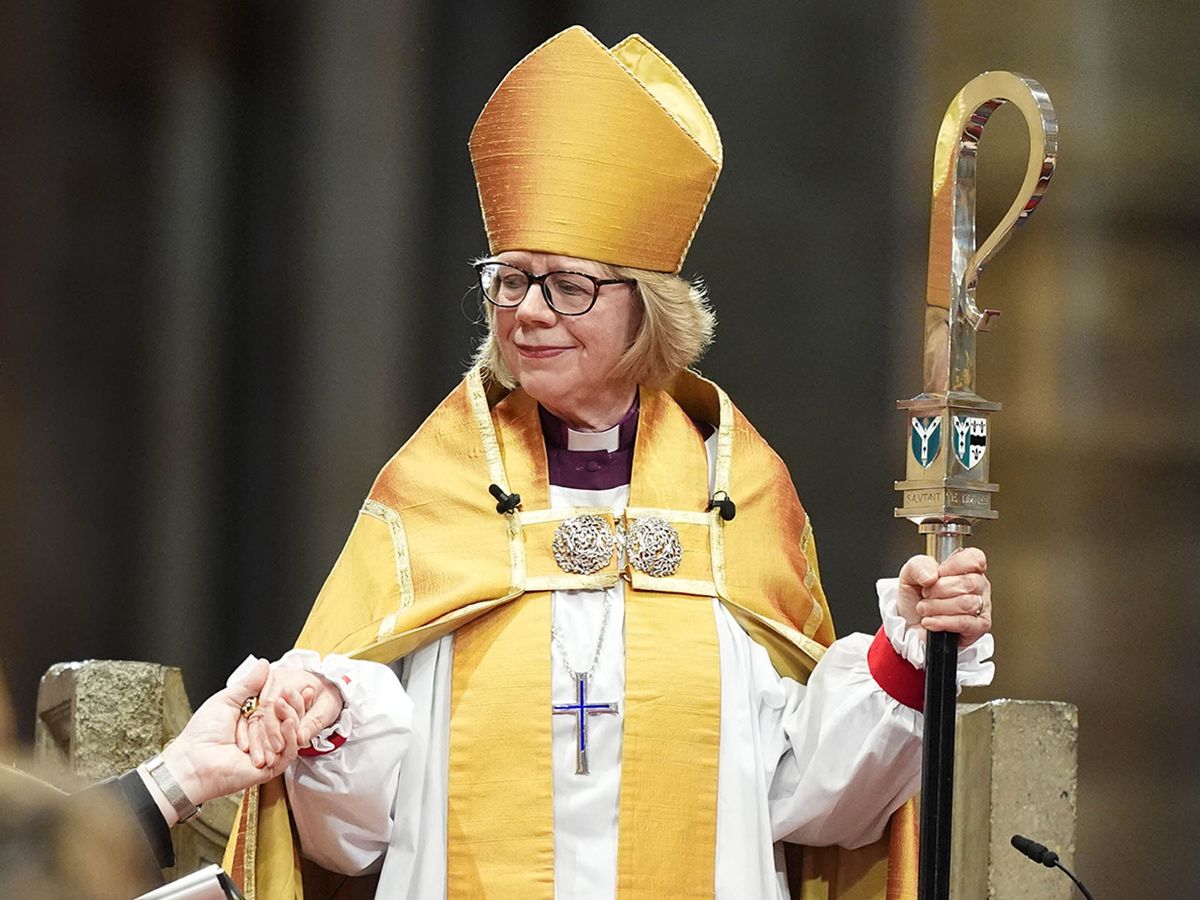
Photo via BBC News

Archbishop of Canterbury withdraws award from Muslim cleric who praised Osama bin Laden

Read the original at BBC News ↗
Cite

Maqbool, A. (2026, September 17). Archbishop of Canterbury withdraws award from Muslim cleric who praised Osama bin Laden. BBC News. https://www.bbc.co.uk/news/articles/ckr50lrz5e6zo?at_medium=RSS&at_campaign=rss

Dated when The Aporia collected the article, usually within hours of publication. Check the original for its exact date and byline.

BBC News · collected 2026-09-17 · by Aleem Maqbool

Quick Summary

The Archbishop of Canterbury withdrew an award given last week to Muslim cleric Hafiz Muhammad Tahir Mehmood Ashrafi after it was revealed that Ashrafi had praised Osama bin Laden in 2007. The controversy arose when it came to light that Ashrafi referred to Bin Laden as someone who "had been fighting for Islam against the Russians, Americans and British," despite his office's claim that he was honored for promoting interfaith harmony and religious tolerance. Critics also pointed out that Ashrafi supports Pakistan’s blasphemy laws, which Human Rights Watch says are used to discriminate against minorities and target marginalized communities.
Written by AI on 2026-09-18, from this article's own text only (the story summary below draws on all the coverage).

AI analysis

Story summary

The core issue highlighted across these articles is the Archbishop of Canterbury's decision to withdraw an award given to a prominent Muslim cleric from Pakistan named Maulana Hafiz Muhammad Tahir Mehmood Ashrafi. The reason for this withdrawal was that it came to light that Ashrafi had praised Osama bin Laden in the past, even giving him a title of honor.

Key points

The main controversy stems from

This incident highlights tensions and challenges in interfaith relations, especially regarding historical context and the potential consequences of past statements. It also raises questions about how religious leaders should balance respect for diverse views with addressing extreme or controversial positions within their faith communities.

Written for “Archbishop Withdraws Controversial Award” on 2026-10-31, grounded in this article and the 8 other(s) covering the same event.

Story

📰 Archbishop Withdraws Controversial Award
Politics · 9 article(s) covering the same event. Compare every outlet's account →

Compared with similar articles

This article reads unscored and hedges 6% of its claims. Each row says how that neighbour differs.
National Post
Hedges 0 of 17 claims Outlet record 60/100
Evening Standard
Hedges 0 of 20 claims Outlet record 65/100
Evening Standard
Hedges 0 of 7 claims Outlet record 65/100
Daily Mail
Hedges 5 of 66 claims Outlet record 68/100
“While both articles discuss an award given by the Archbishop of Canterbury to a Muslim cleric who praised Osama bin Laden, Article B does not mention the withdrawal of the award and focuses on additional controversial statements made by the cleric that are not covered in Article A.”
Daily Mail
Hedges 1 of 24 claims Outlet record 68/100
“The first article describes the Archbishop of Canterbury giving an award to a Muslim cleric on the anniversary of 9/11, while the second article reports that the award was later withdrawn due to backlash. These describe two different specific events: the initial award ceremony and its subsequent withdrawal.”
Daily Mail
Hedges 4 of 40 claims Outlet record 68/100
“Article A describes the withdrawal of an award due to backlash over a cleric's praise for Osama Bin Laden, while Article B focuses on criticism of the Archbishop's photograph with the wife of the same cleric.”
How this article was measured signals, leaning charts, publisher record, byline, topics and claims

Signals How these are calculated →

Claims extracted
16
sentences that state something as happening or true
Uncertain
6%
1 of 16 hedged ("reportedly", "may", "according to")
Leaning
withheld
no quote in the article backed the model's score
Publisher signals
68/100
BBC News's corrections and hedging, across everything collected from it. Not a measure of accuracy.
Outlets on this story
9
Politics
Same framing elsewhere
1
articles that frame the event the way this one does
Analyzed 2026-09-18 · how these are computed

How this is being covered How these are calculated →

Article leaning vs. publisher reliability
Source leaning vs. consistency

Publisher

BBC News · 4753 article(s) · 6 correction(s) detected
Running correction rate · 6 correction(s)

Who wrote this

Aleem Maqbool
3 article(s) here · 1 carrying a prediction
🔮 Now, with so many unknowns about the pontiff's prognosis and what treatment he might need, questions swirl around what may have to change in his routine, and for how long.
🔮 This may suggest there has been a genuine increase in hate crime offences over the last two years.
🔮 Ashrafi also reportedly said he would give Bin Laden the title Saifullah, which means "Sword of God".
Also by Aleem Maqbool
Nothing else under this byline is closely related to this article, so these are simply their most recent.

Topics

BBC Islam Muslim Pakistan Russians

Subjects

Ashrafi PERSON · 8× Bin Laden PERSON · 4× Pakistan GPE · 4× BBC ORG · 2× Hafiz Muhammad Tahir Mehmood Ashrafi PERSON · 1× Islam ORG · 1× Muslim NORP · 1× Osama Bin Laden PERSON · 1× Russians NORP · 1× Sarah Mullally PERSON · 1×

Narrative

In giving him his award for promoting interfaith harmony last week, Lambeth Palace had cited the fact that Ashrafi had intervened in the 2012 case of Rimsha Masih, a young Christian girl in Pakistan falsely accused of blasphemy. But Ashrafi has otherwise been supportive of Pakistan's blasphemy laws that have led to an estimated 2000 people being prosecuted since the late 1980s.
framing: assertive · carried by 1 article(s) · first seen 2026-09-18
🔮 Ashrafi also reportedly said he would give Bin Laden the title Saifullah, which means "Sword of God".

Claims (16 extracted, 1 hedged)

- Published The Archbishop of Canterbury has withdrawn an award given to a Muslim cleric who praised Osama Bin Laden. asserted
who → publish → Laden
Hafiz Muhammad Tahir Mehmood Ashrafi received the award for reconciliation and interfaith cooperation from Dame Sarah Mullally last week, on the 25th anniversary of the 9/11 attacks. asserted
Ashrafi → receive → attacks
Lambeth Palace faced a backlash after it emerged Ashrafi praised Bin Laden - the architect of the 2001 attacks - as someone who had "been fighting for Islam against the Russians, Americans and British", in comments from 2007. asserted
who → face → 2007
Ashrafi also reportedly said he would give Bin Laden the title Saifullah, which means "Sword of God". uncertain
which → say → God
He told the BBC his remarks had been "totally taken out of context". asserted
remarks → tell → context
In presenting the award last week, the Archbishop's office said Ashrafi was being honoured for "his outstanding work as an ambassador of interfaith harmony in Pakistan, known for his commitment to promoting religious tolerance". asserted
Ashrafi → present → tolerance
His award was presented by Dame Sarah in a ceremony that coincided with the 25th anniversary of the 9/11 attacks in the US in which nearly 3,000 people were killed. asserted
people → present → which
Ashrafi told the BBC that his remarks had been "totally taken out of context" and the backlash had been "an unfair campaign" against him. asserted
backlash → tell → him
He said that he was only speaking about Bin Laden in 2007 in response to "the hurt felt by many Muslims" over a knighthood being awarded to the Satanic Verses author Sir Salman Rushdie. asserted
knighthood → say → author
But he defended the comparison he made between an author and a man who was behind the deaths of thousands of people. asserted
who → defend → people
Criticism of Ashrafi has gone beyond his comments about Bin Laden. asserted
Criticism → go → Laden
In giving him his award for promoting interfaith harmony last week, Lambeth Palace had cited the fact that Ashrafi had intervened in the 2012 case of Rimsha Masih, a young Christian girl in Pakistan falsely accused of blasphemy. But Ashrafi has otherwise been supportive of Pakistan's blasphemy laws that have led to an estimated 2000 people being prosecuted since the late 1980s. asserted
people → give → 1980s
They include a disproportionately high number of Pakistan's minority Christians and Ahmadis in particular, but many majority Sunni Muslims too. asserted
They → include → Christians
Ashrafi claimed the blasphemy laws actually "save lives", stopping people taking matters into their own hands. asserted
people → claim → hands
But Human Rights Watch said last year that "the laws perpetuate religious discrimination and are used to target the poor and minorities in unlawful evictions and land grabs". asserted
laws → say → evictions
The organisation has called on the Pakistani government to urgently reform the laws to prevent them "being weaponised to [...] attack marginalised communities". asserted
them → call → communities

💬Give feedback
🕘History 🎫Support