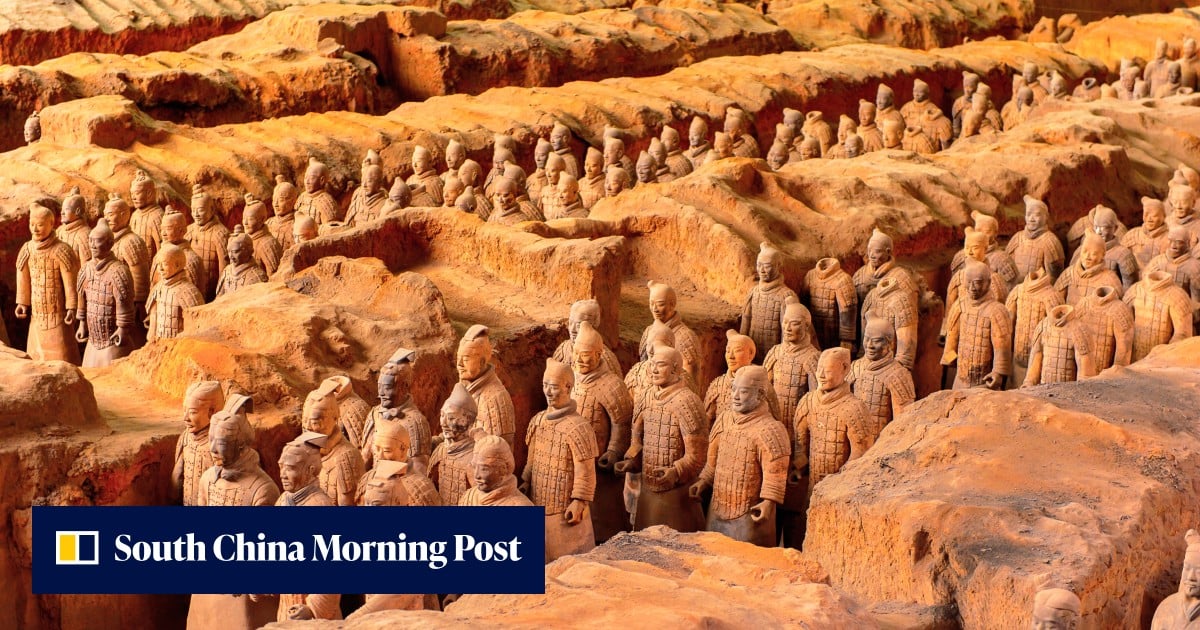
Photo via South China Morning Post

Scientists trace half the DNA in Xinjiang’s oldest tombs to Yellow River farmers

Read the original at South China Morning Post ↗
Cite

Huang, S. (2026, September 18). Scientists trace half the DNA in Xinjiang’s oldest tombs to Yellow River farmers. South China Morning Post. https://www.scmp.com/news/china/science/article/3367886/scientists-trace-half-dna-xinjiangs-oldest-tombs-yellow-river-farmers?utm_source=rss_feed

Dated when The Aporia collected the article, usually within hours of publication. Check the original for its exact date and byline.

South China Morning Post · collected 2026-09-18 · by Shi Huang

Quick Summary

Scientists have found that half of the DNA from individuals buried in Xinjiang's oldest tombs at the Tianshanbeilu cemetery dates back to Yellow River farmers, challenging previous assumptions about a purely Eurasian steppe origin. Located in the Hami oasis, approximately 500 kilometers east of Urumqi, the site contains over 700 Bronze Age tombs that were originally thought to belong to nomadic populations from west of China. The study published in Science shows that these individuals had genetic ties to both Yellow River farmers and Eurasian steppe groups, dating back around 3,600 years during the Shang dynasty.
Written by AI on 2026-09-18, from this article's own text only (the story summary below draws on all the coverage).

AI analysis

Story summary

Scientists have discovered that half of the DNA from the oldest tombs in Xinjiang's Tianshanbeilu cemetery, located about 500km east of Urumqi, traces back to Yellow River farmers rather than Eurasian nomads as previously thought. The study, published in the journal Science, analyzed more than 700 Bronze Age tombs, revealing a genetically mixed population with roots in both Yellow River agriculturalists and Eurasian steppe groups that existed during China’s Shang dynasty (1600-1050BC). This finding challenges earlier assumptions about the origins of Xinjiang's earliest inhabitants, suggesting a more complex migratory history than previously understood.

Written for “Ancient DNA Origins China” on 2026-10-30, grounded in this article and the 0 other(s) covering the same event.

Story

📰 Ancient DNA Origins China
Science · 1 article(s) covering the same event.

Compared with similar articles

Nothing to compare against. No article is close enough to this one for the pipeline to have linked or judged the pair.
How this article was measured signals, leaning charts, publisher record, byline, topics and claims

Signals How these are calculated →

Claims extracted
4
sentences that state something as happening or true
Uncertain
0%
0 of 4 hedged ("reportedly", "may", "according to")
Leaning
not political
takes no side on a contested political question
Publisher signals
64/100
South China Morning Post's corrections and hedging, across everything collected from it. Not a measure of accuracy.
Outlets on this story
1
Science
Same framing elsewhere
1
articles that frame the event the way this one does
Analyzed 2026-09-18 · how these are computed

How this is being covered How these are calculated →

Article leaning vs. publisher reliability
Source leaning vs. consistency

Publisher

South China Morning Post · 3417 article(s) · 6 correction(s) detected
Running correction rate · 6 correction(s)

Who wrote this

Shi Huang
11 article(s) here · 0 carrying a prediction
🔮 Terracotta Warriors could be mainly built by women and children, batch fingerprints show Qin dynasty artisans included women and children assigned to pottery crafting, legal records and physical evidence show Some 5 metres underground near one of China’s oldest cities lies the life-size army of thousands of terracotta warriors. Now, a new study shows that a portion of the terracotta warriors was largely made by adult women and minors, not solely by men as previously thought.
🔮 Pioneering heart stem cell expert Li Renke dies at 65 during a Chinese conference A memorial service will be held for the Chinese cardiovascular scientist who used engineering principles to treat heart conditions His death on October 10 was announced by The Chinese University of Hong Kong, Shenzhen (CUHK-Shenzhen), where he was presidential chair professor and associate dean of research and translation at the school of medicine, which he joined in March last year.
🔮 Lu is a fellow of the Singapore National Academy of Science and president of the Singapore National Institute of Chemistry, in addition to his position as NUS Provost’s Chair Professor. “According to the plan, I will join EIT in Ningbo full time in January 2027,” he said, adding that he remained fully committed to his present duties at NUS for the coming months.
🔮 I’ll write romance novels if AI solves all maths problems, Chinese Fields winner jokes As AI models prove they can push the boundaries, mathematicians are grappling with the threat that they could become obsolete On Tuesday, he wrote on social media that “if AI can solve all maths problems, I’ll go home and write my yuri novel”.
Also by Shi Huang
Nothing else under this byline is closely related to this article, so these are simply their most recent.
All 11 articles by Shi Huang →

Topics

Eurasian Tianshan Urumqi Xinjiang Xinjiang Uygur

Subjects

Eurasian NORP · 2× China GPE · 1× Tianshan GPE · 1× Urumqi GPE · 1× Xinjiang GPE · 1× Xinjiang Uygur GPE · 1×

Narrative

Scientists trace half the DNA in Xinjiang’s oldest tombs to Yellow River farmers Study of Bronze Age remains uncovers a population with roots in both Yellow River farmers and Eurasian steppe groups 2-MIN READ2-MIN Nestled between the Tianshan Mountains and the Gobi Desert, the Hami oasis in Xinjiang Uygur autonomous region is a land of little rain, battered by wind and sand year-round.
framing: assertive · carried by 1 article(s) · first seen 2026-09-18
2026-09-18 · South China Morning Post
Scientists trace half the DNA in Xinjiang’s oldest tombs to Yellow River farmers · assertive framing

Claims (4 extracted, 0 hedged)

Scientists trace half the DNA in Xinjiang’s oldest tombs to Yellow River farmers Study of Bronze Age remains uncovers a population with roots in both Yellow River farmers and Eurasian steppe groups 2-MIN READ2-MIN Nestled between the Tianshan Mountains and the Gobi Desert, the Hami oasis in Xinjiang Uygur autonomous region is a land of little rain, battered by wind and sand year-round. asserted
oasis → trace → wind
It is also home to the region’s oldest known burial site, the Tianshanbeilu cemetery, located around 500km (310 miles) east of Urumqi, the regional capital. asserted
It → know → Urumqi
More than 700 Bronze Age tombs have been unearthed here, long assumed to belong to Eurasian nomads who migrated eastward from the steppes. asserted
who → unearth → steppes
But a study published on Friday in the journal Science upends that view, revealing a previously unknown, genetically mixed population that lived in the eastern Tianshan region 3,600 years ago, during China’s Shang dynasty (1600-1050BC). Select Voice Select Speed 1x AI-generated voice asserted
that → publish → voice
💬Give feedback
🕘History 🎫Support