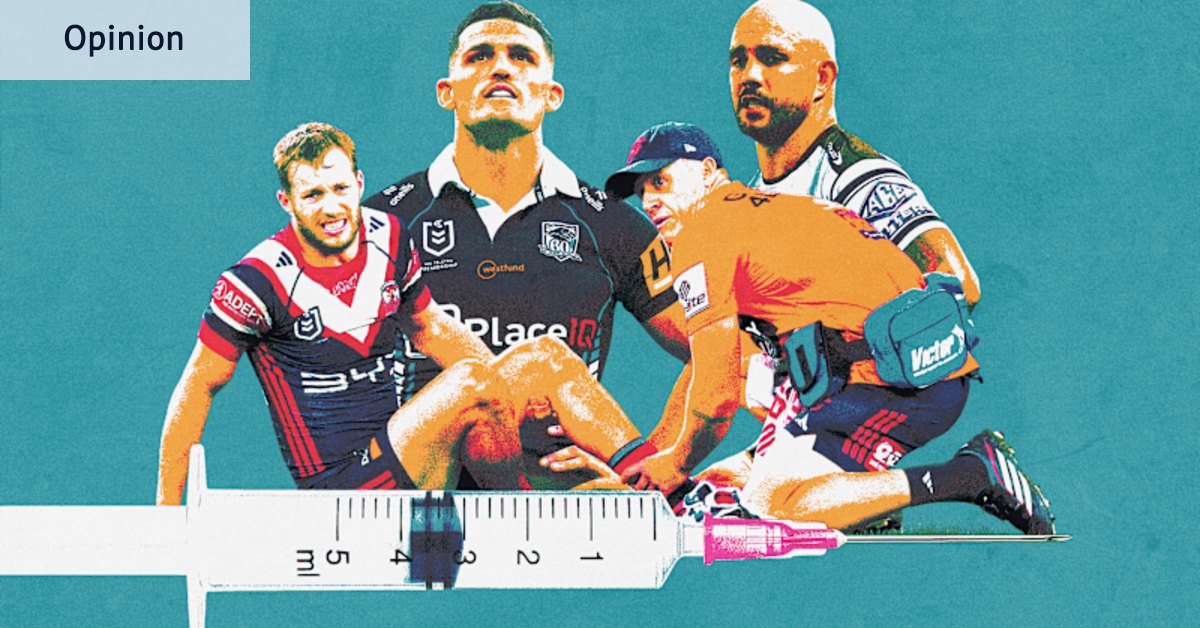
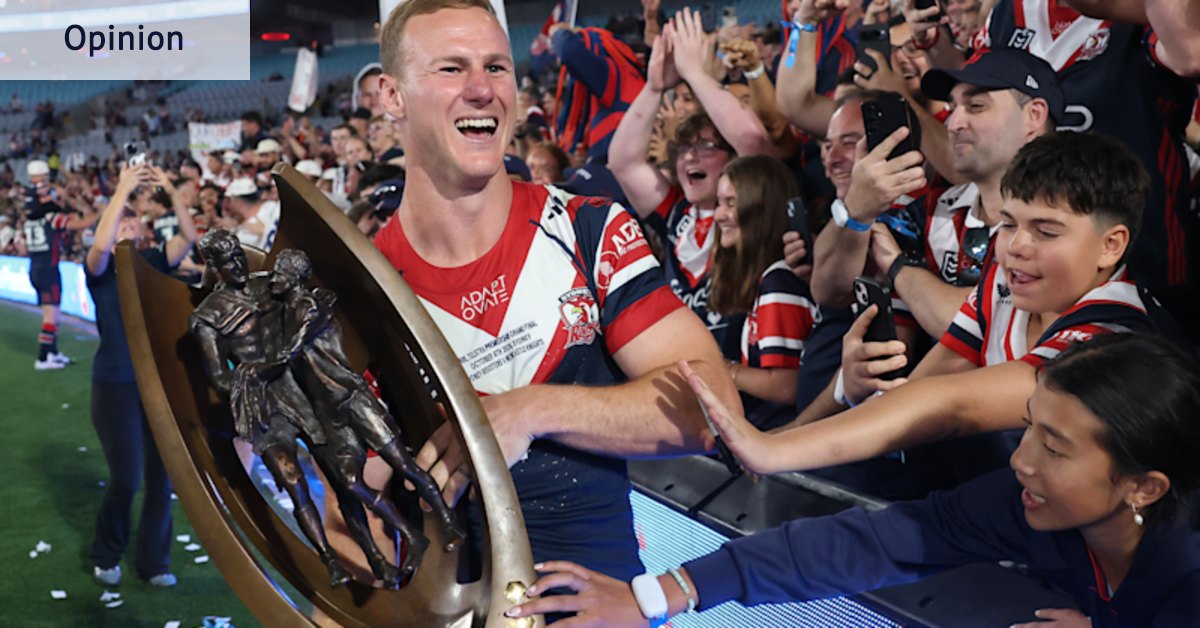
We’ve arrived in rugby league’s painkiller knockouts, when the winner will be decided less by aesthetics than anaesthetics.
asserted
winner → arrive → anaesthetics
Injuries are no longer what we normally think of as injuries.
asserted
we → think → injuries
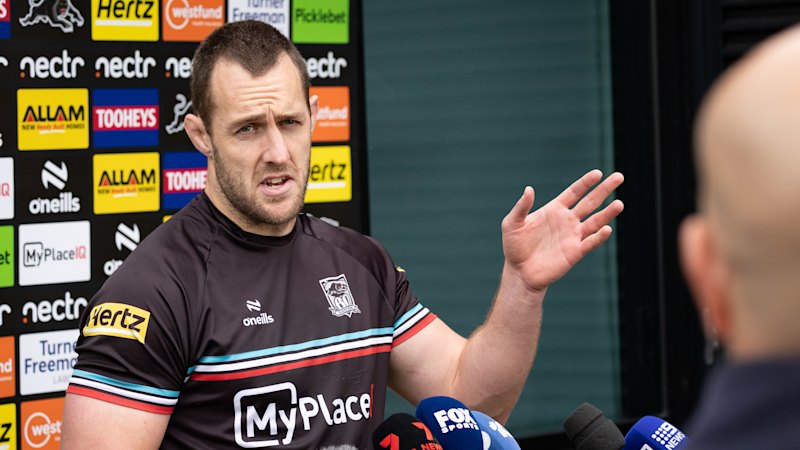
Isaah Yeo’s pectoral rupture, usually requiring months of rehab, kept him off the field for four weeks.
asserted
rupture → require → weeks
Nathan Cleary’s foot and Brayden Trindall’s shoulder can be needled into the never-never.
asserted
foot → needle → never
Even Sam Walker’s season-ending syndesmosis injury looks like it might only be season-pausing.
uncertain
it → end → ?
It’s the finals.
asserted
It → ’ → ?
The future be damned.
asserted
future → damn → ?
These are just the miraculous recoveries we know about.
asserted
we → know → ?
Barrels of powerful painkillers have enjoyed fabled triumphs in rugby league history.
asserted
Barrels → enjoy → history
Liam Martin played almost every week of Penrith’s last premiership with injections in his shoulder.
asserted
Martin → play → shoulder
Cleary stopped feeling his excruciating hip after a needle during this year’s Origin series.
asserted
Cleary → stop → series
Famously, Andrew Johns played the 1997 grand final with a punctured lung and broken ribs that he only began to feel again after the injections and the celebrations wore off.
asserted
injections → play → lung
Cameron Smith played his last match, the 2020 grand final, with painkilling injections for broken ribs.
asserted
Smith → play → ribs
Cooper Cronk played the 2018 grand final with a broken shoulder blade and a brain switched off to the agony via ultrasound-guided drugs administered 15 minutes before kick-off and again at half-time.
asserted
Cronk → play → time
We don’t hear so much about the failures, not since the horrible result of Graeme “Changa” Langlands’ needle before the 1975 grand final, when instead of numbing his groin it gave him a dead leg.
asserted
it → hear → leg
Nor do we hear much about the everyday reality of painkiller use in professional sport.
asserted
we → hear → sport
If more was heard about it, someone might start to think something is wrong.
uncertain
something → hear → it
The use of strong opioids like morphine and synthetics like fentanyl are “controlled” in hospital settings.
asserted
use → control → settings
Mild pain relievers and anti-inflammatories such as paracetamol or ibuprofen are commonly used and legal.
asserted
relievers → use → paracetamol
But between these poles are a large spectrum of painkillers, and they cause more ongoing problems for athletes than many substances on the banned list.
asserted
they → cause → list
Josh Addo-Carr, who has allegedly tested positive for cocaine, had finished his season, and the only performance he could have enhanced was that of having a good time.
uncertain
he → test → time
Nick Kyrgios, a vocal critic of Jannik Sinner’s positive tests for performance-enhancing drugs, copped it sweet when he tested positive for cocaine after a night out.
asserted
he → enhance → night
If we compared how many ex-athletes have harmful long-term addictions to painkillers to how many develop a cocaine habit, we might re-think what’s legal and what’s not.
uncertain
what → compare → habit
The World Anti-Doping Authority (WADA) makes an exemption for “therapeutic use” of drugs that might otherwise be illegal.
uncertain
that → make → drugs
These include drugs for conditions ranging from asthma to acne as well as potentially addictive painkillers.
asserted
These → include → acne
The rationale, according to WADA, is that “there are no reasonable, permitted, alternative treatments available” and “the substance does not enhance performance, it just brings the athlete back to normal health.”
uncertain
it → accord → health
Of course there are no alternative treatments: this is why injuries are injuries.
asserted
injuries → be → ?
They hurt.
asserted
They → hurt → ?
You can only play with injuries by numbing the pain.
asserted
You → play → pain
As for “not enhancing performance”, let me suggest that an athlete who can run and pass and kick with the help of painkillers is enjoying a more enhanced performance than if he was lying on his couch watching – which is what, for the sake of his “normal health”, he should be doing.
asserted
he → enhance → health
And what is a drug addict doing if not taking a substance to feel “normal”?
asserted
addict → do → substance
The therapeutic exemption for strong painkillers exposes the arbitrariness of deciding which drugs are banned and which are allowed.
asserted
which → expose → arbitrariness
Cocaine enhances no-one’s performance unless they take it on the field – it acts quickly and then stops.
asserted
it → enhance → field
Since Diego Maradona’s time, no top athletes have been spotted having a bump during play.
asserted
athletes → spot → play
This is not to say anything positive about cocaine, just that it’s not a performance-enhancing drug.
asserted
it → say → cocaine
Likewise, cannabinoids are on the banned list even though the only Olympian who performs better for having it in their system is Snoop Dogg.
asserted
who → ban → system
Interestingly, many ex-athletes are using cannabis, legally, for pain management after they have retired.
asserted
they → use → management
Yet, it has no exemption while they are still playing.
asserted
they → have → exemption
Painkiller abuse is sport’s biggest dirtiest secret, and it starts with prescribed, approved painkiller use.
asserted
it → start → use
There is a distressingly long list of athletes who have begun using them while playing and then, unable to stop, have their lives wrecked by them in retirement.
asserted
lives → be → retirement
…and 12 more, not listed.
 The Aporia