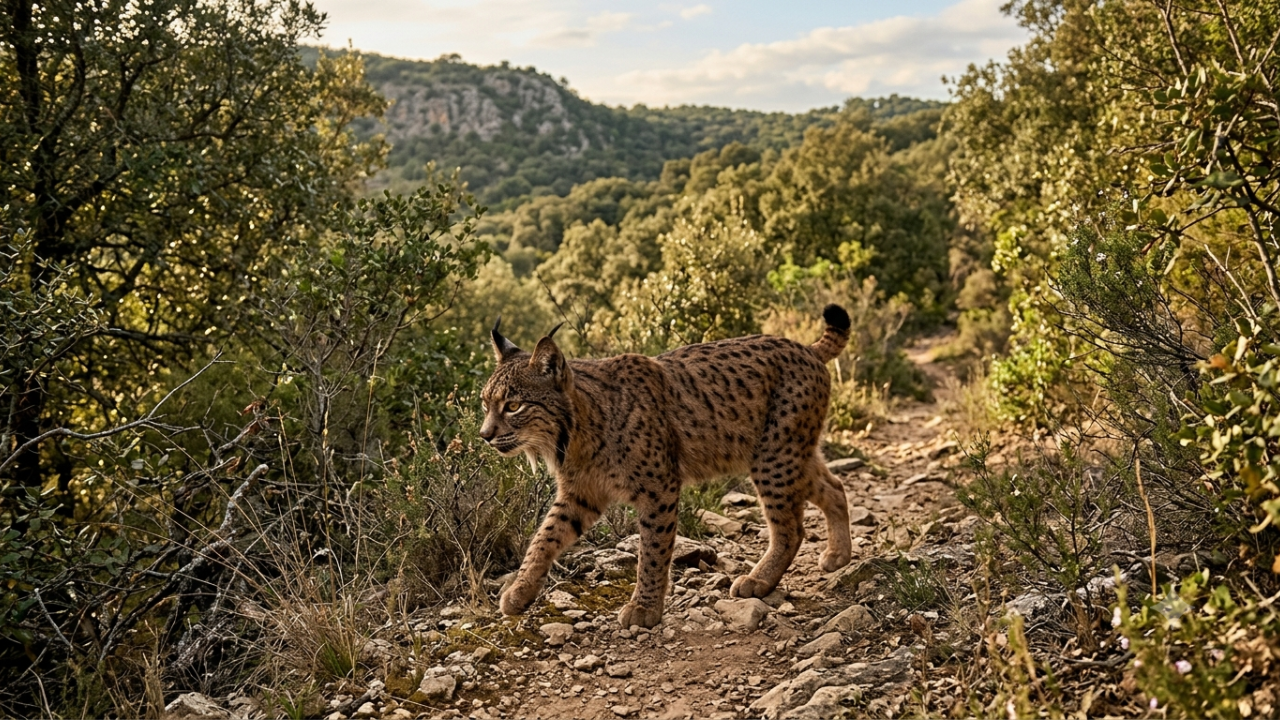
For much of the 20th century, the Iberian lynx was disappearing from the Spanish landscape.
asserted
lynx → disappear → landscape
By 2001, only 62 mature animals were recorded, leaving one of Europe’s most distinctive wild cats perilously close to extinction.
asserted
animals → record → extinction
Since then, a sustained conservation programme has altered its trajectory.
asserted
programme → alter → trajectory
Reintroductions, captive breeding, habitat restoration and efforts to protect its main prey have helped the population expand into areas where the species had vanished.
asserted
species → protect → areas
By 2022, the number of mature Iberian lynx had risen to 648, while the total population, including younger animals, was estimated to have passed 2,000.
asserted
population → rise → 2,000
The improvement has now been reflected in its status on the IUCN Red List, although the species remains far from fully recovered.
asserted
species → reflect → List
The Iberian lynx, Lynx pardinus, is native to the Iberian Peninsula and depends heavily on Mediterranean landscapes where its principal prey, the European rabbit, is available.
asserted
prey → depend → landscapes
As suitable habitat became fragmented and rabbit numbers were affected by disease and changes in land use, the lynx lost both territory and access to food.
asserted
lynx → become → food
The scale of the decline became especially clear at the beginning of this century.
asserted
scale → become → century
In 2001, just 62 mature individuals were recorded.
asserted
individuals → record → 2001
The species had already disappeared from large parts of its former range.
asserted
species → disappear → range
Concern over its future had been building for years.
asserted
Concern → build → years
A 2009 assessment from the IUCN Centre for Mediterranean Cooperation had already highlighted the need for conservation action for Mediterranean mammals, including species facing severe population losses.
asserted
assessment → highlight → losses
What followed was not one single intervention, but a collection of measures carried out over many years.
asserted
followed → follow → years
How captive breeding helped return lynx to the wild
Some populations could not recover simply by protecting the animals that remained.
uncertain
that → help → animals
The lynx also needed to return to places where it had disappeared.
asserted
it → need → places
Reintroduction programmes helped establish animals in suitable areas, while captive breeding supplied lynx for release into the wild.
asserted
breeding → help → wild
Moving individuals between populations also became part of the strategy, helping to broaden the genetic base of groups that had become isolated.
asserted
that → move → groups
Captive breeding was particularly important because the remaining wild population had been reduced to such a small number.
asserted
population → remain → number
With so few animals spread across fragmented areas, natural dispersal alone could not easily rebuild a healthy population.
uncertain
dispersal → spread → population
The approach gradually changed the distribution of the species.
asserted
approach → change → species
Areas that had once been empty of Iberian lynx could once again support them.
uncertain
that → support → them
Why rabbit populations became central to lynx conservation
Saving the lynx meant dealing with something much smaller.
asserted
Saving → become → something
European rabbits make up the main part of the Iberian lynx’s diet, so protecting lynx habitat without maintaining a reliable food supply would have left a major weakness in the recovery effort.
asserted
protecting → make → effort
Rabbit populations have been affected by disease as well as changes in land use, creating periods when food becomes scarce.
asserted
food → affect → periods
Conservation work therefore extended beyond the predator itself.
asserted
work → extend → predator
Protecting rabbit populations, restoring vegetation and maintaining suitable Mediterranean habitat all became connected parts of the same effort.
asserted
Protecting → protect → effort
The restoration of scrub and forest areas has also helped rebuild landscapes capable of supporting prey species.
asserted
restoration → help → species
That creates benefits beyond the lynx, since the same habitats provide shelter and resources for other animals and contribute to the wider functioning of Mediterranean ecosystems.
asserted
habitats → create → ecosystems
How ecological corridors helped the lynx move between territories
A growing population still needs somewhere to live.
asserted
population → help → territories
Fragmentation had left Iberian lynx populations separated by roads, developed land and altered landscapes.
asserted
Fragmentation → leave → roads
For a solitary territorial animal, those gaps can become a serious obstacle.
asserted
gaps → become → animal
They can restrict movement, make it harder for animals to establish new territories and reduce opportunities for breeding between different groups.
asserted
animals → restrict → groups
Ecological corridors have been used to make those movements easier.
asserted
movements → use → ?
Instead of treating each protected area as an isolated patch, conservation planning has increasingly focused on maintaining connections between suitable habitats.
asserted
planning → treat → habitats
This has also brought road safety into the picture.
asserted
This → bring → picture
Vehicle collisions remain one of the threats facing the species, particularly where animals have to cross transport routes while moving between territories.
asserted
animals → remain → territories
The population has changed dramatically since 2001
The figures give a clearer sense of the recovery than any single reintroduction.
asserted
figures → change → reintroduction
By 2022, that figure had reached 648.
asserted
figure → reach → 648
When young animals were included, the total population was estimated to be above 2,000.
asserted
population → include → 2,000
…and 26 more, not listed.
 The Aporia