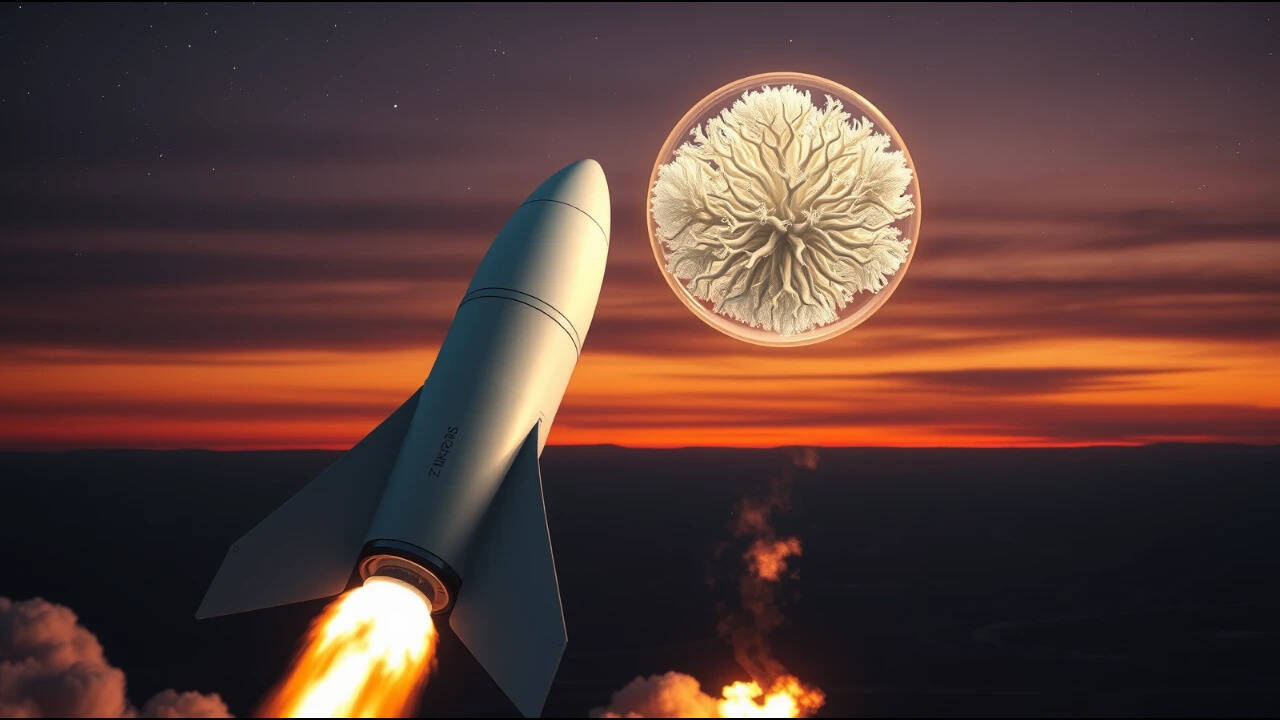
In August 2024, researchers at Swinburne University of Technology in Australia sent 36 small vials containing fungi into space aboard a SpaceX Falcon 9 rocket bound for the International Space Station.
asserted
researchers → send → Station
The vials held mycelium, the filament-like network from which mushrooms grow, belonging to three edible species: lion's mane, turkey's tail and cordyceps.
asserted
mushrooms → hold → species
The fungi remained aboard the ISS for close to a month before returning to Earth, eventually making their way back to Australia in 2025.
asserted
fungi → remain → 2025
Once the researchers had the vials back, they transferred the mycelium into nutrient-rich growing substrates and placed them in different environments to see whether the fungi could produce mushrooms after their time in space.
uncertain
fungi → transfer → space
Within days, the first mushrooms began emerging, and within a week the team had a batch of lion's mane ready to harvest.
asserted
batch → begin → mane
The researchers then cooked the mushrooms into a creamy pasta sauce and ate them, turning an experiment in space biology into an unusually literal taste test.
asserted
researchers → cook → test
Why scientists sent fungi to the ISS
The experiment was led by astrophysicists Sara Webb and Rebecca Allen at Swinburne University of Technology and formed part of the university's microgravity experimentation programme.
asserted
experiment → send → programme
The researchers selected three edible fungi, lion's mane (Hericium erinaceus), turkey's tail (Trametes versicolor) and cordyceps (Cordyceps militaris), because of their potential relevance to human health and their suitability for growing as fungi.
asserted
researchers → select → fungi
The project was also unusual because school students were involved from the beginning.
asserted
students → involve → beginning
Twelve students from Haileybury College in Melbourne helped design and prototype the experiment, while professional mushroom growers and suppliers helped provide food-grade fungal strains that were healthy enough for the experiment.
asserted
that → help → experiment
The fungi were transported as mycelium rather than fully grown mushrooms.
asserted
fungi → transport → mushrooms
The material was sealed inside specialised packaging designed to maintain suitable conditions and protect it during its journey.
asserted
material → seal → journey
Because the experiment was kept sealed aboard the station, the researchers had limited opportunities to see what was happening inside.
asserted
what → keep → opportunities
During the mission, they received only occasional photographs and videos from
NASA showing the outside of the experiment.
asserted
they → receive → experiment
What happened when the fungi came back to Earth
The mycelium spent close to a month in the ISS environment before returning with a change of crew.
asserted
mycelium → happen → crew
It eventually arrived back in Australia in 2025, where the researchers opened the experiment and transferred the fungi into a nutrient-rich growing substrate.
asserted
researchers → arrive → substrate
The team then placed the material into several grow kits and tested different environments to see where mushrooms would develop most successfully.
asserted
mushrooms → place → environments
Some were kept on kitchen benches, others on staff-room tables and others in laboratory fridges.
asserted
Some → keep → fridges
The response was faster than the researchers expected.
asserted
researchers → expect → ?
Within a few days, they saw signs that mushrooms were beginning to emerge.
asserted
mushrooms → see → signs
Within about a week, the team had lion's mane mushrooms ready to harvest.
asserted
mushrooms → have → week
The researchers then tried several recipes with the mushrooms, including the meal that became the most memorable part of the experiment: a creamy pasta sauce.
asserted
that → try → experiment
According to Webb and Allen's account, the mushrooms were dense, rich and strongly aromatic.
uncertain
mushrooms → accord → account
They melted together with cheese to form the sauce, and the researchers described the first taste as delicious, with the distinctive flavour of lion's mane coming through clearly.
asserted
flavour → melt → mane
ABC also reported that the mushrooms were ultimately cooked in a cheesy sauce in Melbourne.
asserted
mushrooms → report → Melbourne
The mushrooms survived space, but scientists are still studying them
asserted
scientists → survive → them
The researchers say the reduced-gravity environment did not appear to negatively affect the mycelium.
asserted
environment → say → mycelium
After returning to Earth, it continued producing mushrooms, with the team observing several rounds of fruiting.
asserted
team → return → fruiting
That does not mean the experiment has established that mushrooms grown after spaceflight are identical to those grown entirely on Earth.
asserted
mushrooms → mean → Earth
The researchers are still analysing the harvested mushrooms to determine how their time in space affected them.
asserted
time → analyse → them
One of the questions is whether exposure to the space environment, particularly radiation and other stresses, could alter food produced for astronauts.
uncertain
exposure → alter → astronauts
Understanding those effects will be important if fungi are eventually grown as part of food-production systems on long-duration missions.
asserted
fungi → understand → missions
The distinction is important because the experiment was not designed simply to prove that astronauts can grow and eat mushrooms in space.
asserted
astronauts → design → space
It was an early test of whether edible fungi can survive the journey, remain viable after exposure to a reduced-gravity environment and subsequently produce fruiting bodies back on Earth.
asserted
fungi → survive → Earth
Could mushrooms become space food?
uncertain
mushrooms → become → ?
Growing food during long missions could eventually reduce the amount of food astronauts need to carry from Earth.
uncertain
astronauts → grow → Earth
Missions lasting weeks or months will require reliable sources of nutrition, particularly as crews travel farther from Earth and resupply becomes more difficult.
asserted
resupply → last → Earth
Fungi are interesting for this purpose because the part sent into space can be compact and does not require the researchers to transport a fully grown crop.
asserted
part → send → crop
If the mycelium can survive the journey and subsequently produce edible mushrooms under controlled conditions, it could potentially form part of a future space-growing system.
uncertain
it → survive → system
The Swinburne experiment also comes as space agencies prepare for increasingly ambitious missions.
asserted
agencies → come → missions
…and 4 more, not listed.
 The Aporia