Photo via Semafor

Why Kai-Fu Lee thinks companies need an AI boss

Read the original at Semafor ↗
Cite

Edgecliffe-Johnson, A. (2026, September 18). Why Kai-Fu Lee thinks companies need an AI boss. Semafor. https://www.semafor.com/article/09/18/2026/why-kai-fu-lee-thinks-companies-need-an-ai-boss

Dated when The Aporia collected the article, usually within hours of publication. Check the original for its exact date and byline.

Semafor · collected 2026-09-18 · by Andrew Edgecliffe-Johnson

Quick Summary

Kai-Fu Lee, former head of Google China and author of "AI Superpowers," discusses how CEOs need to personally oversee AI integration within their companies to stay competitive in a rapidly evolving technological landscape. He emphasizes the importance of safety measures keeping pace with AI development and highlights that many companies are failing to properly implement AI strategies. Lee advocates for “radical transparency” enabled by AI to provide unprecedented insights, suggesting this approach could be more readily accepted in China than the West.
Written by AI on 2026-09-20, from this article's own text only (the story summary below draws on all the coverage).

AI analysis

Story summary

Kai-Fu Lee, former head of Google China and now chairman of Sinovation Ventures and CEO of 01.AI, predicts that artificial intelligence will cause more profound changes within companies than most CEOs anticipate. He advocates for balancing rapid technological advancement with safety measures and regulatory oversight to prevent lagging governance frameworks from hindering AI development. Lee emphasizes the need for industry collaboration due to the current pace of technology outstripping regulatory capabilities, highlighting his unique perspective as someone deeply involved in both US and Chinese tech industries through roles at companies like Microsoft and Apple. His influential 2018 book, "AI Superpowers," accurately forecasted the ongoing tech competition between the US and China.

Written for “AI in Business Leadership” on 2026-11-02, grounded in this article and the 0 other(s) covering the same event.

Story

📰 AI in Business Leadership
Technology · 1 article(s) covering the same event.

Compared with similar articles

This article reads unscored and hedges 7% of its claims. Each row says how that neighbour differs.
NPR
Hedges 6 of 26 claims Outlet record 60/100
“The articles discuss different topics related to AI but do not describe the same specific incident or time.”
Al Jazeera
⚖️ Leans right Hedges 0 of 3 claims Outlet record 60/100
“The articles discuss different topics related to AI regulation and competition between the US and China, but they are not describing the same specific incident or happening.”
Al Jazeera
Hedges 3 of 27 claims Outlet record 60/100
“The articles discuss different topics related to AI but describe distinct events or opinions from different individuals.”
Daily Mail
⚖️ Leans left Hedges 2 of 32 claims Outlet record 69/100
“Article A describes King Charles hosting a meeting with tech leaders in Scotland, while Article B is an interview with Kai-Fu Lee discussing AI's impact on companies and economies.”
South China Morning Post
Hedges 2 of 3 claims Outlet record 63/100
“Article A discusses Kai-Fu Lee's views on AI and its impact on companies and economies, while Article B reports on revenue comparisons between Chinese AI models and American firms like OpenAI and Anthropic.”
Al Jazeera
Hedges 0 of 11 claims Outlet record 60/100
“The articles discuss different aspects and perspectives on AI's impact and regulation without describing the same specific incident or occurrence.”
Washington Examiner
⚖️ Leans right Hedges 0 of 21 claims Outlet record 70/100
“The articles discuss different perspectives and opinions on AI from two separate individuals, Sam Altman and Kai-Fu Lee, not a single specific incident.”
The Sydney Morning Herald
⚖️ Leans left Hedges 5 of 17 claims Outlet record 61/100
“The articles discuss different topics related to AI but do not describe the same specific incident.”
South China Morning Post
Hedges 0 of 3 claims Outlet record 63/100
“The articles discuss different events: one about Kai-Fu Lee's views on AI in companies and another about Hong Kong recruiting an AI chief.”
The Free Press
Hedges 1 of 12 claims Outlet record 96/100
“The articles discuss different perspectives on AI regulation and development, with Article A focusing on Dario Amodei's call for slowing down AI improvement and endorsements from other companies. Article B discusses Kai-Fu Lee’s views on the need for an AI boss within companies.”
How this article was measured signals, leaning charts, publisher record, byline, topics and claims

Signals How these are calculated →

Claims extracted
60
sentences that state something as happening or true
Uncertain
7%
4 of 60 hedged ("reportedly", "may", "according to")
Leaning
not political
takes no side on a contested political question
Publisher signals
59/100
Semafor's corrections and hedging, across everything collected from it. Not a measure of accuracy.
Outlets on this story
1
Technology
Same framing elsewhere
1
articles that frame the event the way this one does
Analyzed 2026-09-20 · how these are computed

How this is being covered How these are calculated →

Article leaning vs. publisher reliability
Source leaning vs. consistency

Publisher

Semafor · 1423 article(s) · 3 correction(s) detected
Running correction rate · 3 correction(s)

Who wrote this

Andrew Edgecliffe-Johnson
14 article(s) here · 1 carrying a prediction
🔮 Chenault, who was one of the first Black CEOs to lead a Fortune 500 company and ran American Express for 17 years, says people concerned about meddling in Tuesday’s election or damaging disputes over the results have been calling him to ask: “Will business stand up?”
🔮 “We should talk to normal people we don’t pay, people who are willing to tell us to F off and tell us why they don’t like us.”
🔮 He is now weighing a possible market listing that could value his holding company at $10 billion, even as war in the Middle East sends jet fuel prices higher and economists debate how much longer the boom in global luxury spending can continue.
🔮 Beyond the walls of the company’s London headquarters, which is filled with thousands of its plushy pink octopus mascots, Jackson’s empire may look like an unwieldy one.
🔮 Brown resolved to spin off the mobility business for which his brand was best known, and says now that “there wouldn’t be a firm” if he had not done so in 2011.
🔮 I think there was maybe 20% of that role that was the same.
🔮 The technology heralds a new era of decentralization, he believes, and that will make the people CEOs have surrounded themselves with feel threatened.
🔮 Sydney’s diversified economy makes it “a great microcosm,” where Atlassian can test whether ideas hatched in California’s Bay Area will work in less tech-forward cities around the world.
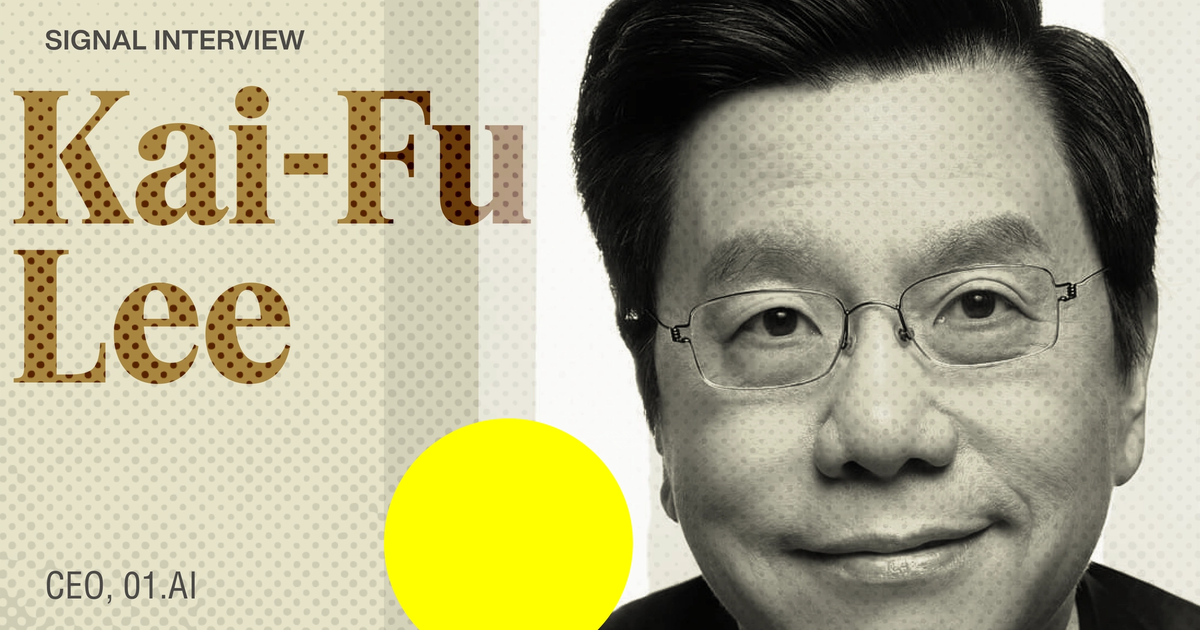
🔮 The Signal Interview Kai-Fu Lee’s AI Superpowers, an influential book published in 2018, largely predicted the current tech battle between the US and China.
2026-09-18 · assertive framing · Why Kai-Fu Lee thinks companies need an AI boss
🔮 Combining two of the three largest US carriers would transform the country’s aviation industry to such an extent that many analysts predicted regulators would never clear such a deal.
Also by Andrew Edgecliffe-Johnson
Nothing else under this byline is closely related to this article, so these are simply their most recent.
All 14 articles by Andrew Edgecliffe-Johnson →

Topics

Apple China Chinese Google China Microsoft

Subjects

Lee PERSON · 10× China GPE · 2× Chinese NORP · 2× Anthropic ORG · 1× Apple ORG · 1× Beijing GPE · 1× Dario Amodei PERSON · 1× Google China ORG · 1× Kai-Fu Lee’s PERSON · 1× Microsoft ORG · 1×

Narrative

Lee says he agrees with the principle that developments in AI capability must be matched by advances in safety and governance, adding that industry collaboration will be “particularly important at this stage,” given how governance and regulatory frameworks “inevitably lag behind technological development.” He is now deeply embedded in China’s AI industry as chairman of the Beijing-based venture capital firm Sinovation Ventures and founder-CEO of 01.AI, a Chinese “AI tiger” that has pivoted from building AI models to helping enterprises deploy the technology effectively. Lee’s transpacific perspective has given him a unique insight into the challenges that global companies face in realizing AI’s potential.
framing: assertive · carried by 1 article(s) · first seen 2026-09-20
🔮 The Signal Interview Kai-Fu Lee’s AI Superpowers, an influential book published in 2018, largely predicted the current tech battle between the US and China.
2026-09-20 · Semafor
Why Kai-Fu Lee thinks companies need an AI boss · assertive framing

Claims (60 extracted, 4 hedged)

The Signal Interview Kai-Fu Lee’s AI Superpowers, an influential book published in 2018, largely predicted the current tech battle between the US and China. asserted
Superpowers → publish → US
Now, Lee’s forecasting that AI will unleash more radical changes inside the world’s companies than most CEOs expect — and this could reshape the competition between those two economies once again. uncertain
this → forecast → economies
The former head of Google China, who has also held senior executive roles at Microsoft and Apple, understands intimately how Silicon Valley leaders think. asserted
leaders → hold → Microsoft
But now that Anthropic’s Dario Amodei has called on the industry and its regulators to “pace the frontier,” Lee says he would reframe that call: “Move fast, but make sure safety keeps pace.” asserted
safety → call → pace
Lee says he agrees with the principle that developments in AI capability must be matched by advances in safety and governance, adding that industry collaboration will be “particularly important at this stage,” given how governance and regulatory frameworks “inevitably lag behind technological development.” He is now deeply embedded in China’s AI industry as chairman of the Beijing-based venture capital firm Sinovation Ventures and founder-CEO of 01.AI, a Chinese “AI tiger” that has pivoted from building AI models to helping enterprises deploy the technology effectively. Lee’s transpacific perspective has given him a unique insight into the challenges that global companies face in realizing AI’s potential. asserted
companies → say → potential
In a video interview, he says two things are clear from his conversations with other chief executives: “One is that they all want to do AI transformation. asserted
they → say → transformation
Two is they’re mostly doing it wrong.” asserted
they → do → it
Lee is pitching his new book, AI Native, as a road map for doing it right. asserted
Lee → pitch → it
CEOs hoping to build an “AI-native” company must take personal charge of their technology strategy, he says, and use “radical transparency,” enabled by AI, to give them unprecedented insights into what is actually happening inside their organization. asserted
what → hop → organization
That conscious echo of the management mantra of Bridgewater Associates founder Ray Dalio, he adds, is an idea that Chinese employees will embrace faster than Western workforces. asserted
employees → add → workforces
Why transformation starts at the top CEOs everywhere face “a Darwinian choice,” Lee says: Embrace AI or accept the consequences. asserted
Lee → start → consequences
They have little time to do so, he adds; companies whose assets are largely digital, like entertainment, gaming, and internet businesses, will be “dead in the water” if they do not adapt, he says. asserted
he → have → water
CEOs operating businesses further from the AI frontier — like coal mines, farms, or manufacturing plants — may have a three-to-five-year “buffer” before they feel the pain of AI disruption. uncertain
they → operate → disruption
That means executives need to ask now whether they are passing “the earnings call test,” Lee says: If their company’s AI efforts have not yet boosted their profits, then they are mere “AI theater.” asserted
they → mean → profits
Where chief executives go wrong, in any industry, is when they delegate and defer to their chief information officer, Lee argues. asserted
Lee → go → officer
“Only the CEO can define the ambition, concentrate resources, redesign the operating model, remove barriers, and remain accountable for the result,” he writes in AI Native, so AI transformation “can only be done from the top asserted
transformation → define → top
That also means that each CEO needs to be using AI effectively themselves, he adds. asserted
he → mean → AI
Doing so demonstrates that the company’s leader understands AI’s importance to the bottom line. asserted
leader → do → line
Lee has taken his own advice, designing a “decision assistant” made up of 19 agents to help him run 01.AI. asserted
him → take → 01.AI
His company has since packaged this up into a product to sell to other companies, called Boss AI. asserted
company → package → companies
At its heart is what Lee calls a “truth engine” that records, organizes, and analyzes every internal meeting, sales call, and customer service request to show what is getting in the way of the company meeting its goals. asserted
company → call → goals
That gives a CEO visibility into all corners of their company — and a “promise ledger” to hold people accountable for following through on what they say they’ll do. asserted
they → give → what
“Middle managers often hope that the CEO will forget. asserted
CEO → hope → ?
And the CEO does forget, but the CEO’s AI does not,” Lee says. asserted
Lee → forget → ?
It is at this tier of most companies that the bosses’ plans meet the most resistance, he adds. asserted
he → meet → resistance
“There are a lot of antibodies in the company, people who just don’t want to do AI transformation. asserted
who → be → transformation
Middle managers feel vulnerable because they’re not technology experts, [and] they’re afraid the boss will put in someone who is,” he explains. asserted
he → feel → someone
Those managers also fear losing their power if their company lays off their direct reports, he adds. asserted
he → fear → reports
Still, even as he says that AI is dividing workforces into “irreplaceable humans” and “displaceable humans,” Lee does not think that CEOs should measure AI success by the number of jobs they eliminate. “The winners will not measure success by payroll cuts. asserted
winners → say → cuts
They will measure it by what their best people, amplified 10 times, can now do that was previously impossible,” he writes in his book. asserted
he → measure → book
Most people will not be laid off if they’re willing to learn new AI skills, he adds, “but they might be paid three or five times more” than before. uncertain
they → lay → more
But he still believes that companies should flatten the hierarchies that protect people who resist change. asserted
who → believe → change
“When the company is transparent, there’s no need to hide, nowhere to hide, and everybody talks about the real issues and tries to solve the problems.” asserted
everybody → ’ → problems
Where clashing cultures meet AI superpowers Lee presents his ideas as “exhilarating” for employees who are willing to sign up for them. asserted
who → clash → them
“The company will have a better morale, better culture, better execution, better results, better stock price, and everything will be a virtuous cycle and the company will grow,” he predicts. asserted
he → have → morale
Even so, Lee admits that radical transparency “takes [some] getting used to.” asserted
some → admit → ?
Some corporate cultures will be more reluctant than others to expose themselves to the boss’ all-seeing AI, he adds, bringing his argument around to a point which converges with his earlier predictions about AI’s impact on geopolitical competition. asserted
which → expose → competition
The idea behind Boss AI “is more acceptable and more suitable for companies where the CEO has immense respect and power, and where companies are run by consensus,” he says. asserted
he → have → consensus
“Everything else being equal, Asian companies will tend to adopt it earlier and faster. asserted
companies → tend → it
And we’re seeing that.” asserted
we → see → that
…and 20 more, not listed.

💬Give feedback
🕘History 🎫Support