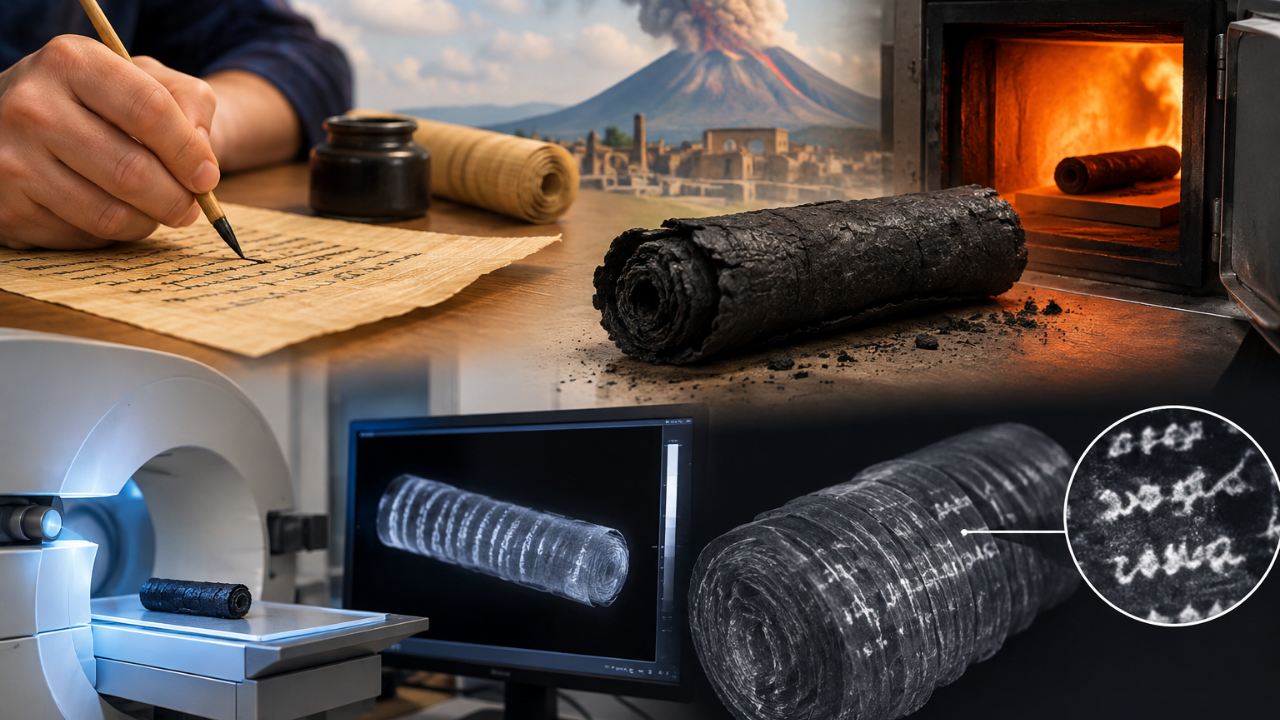
What if the best way to understand a 2,000-year-old burned scroll is to make one yourself and set it on fire?
asserted
way → understand → fire
Scientists did just that to investigate how writing might be recovered from carbonised papyrus scrolls buried by the eruption of Mount Vesuvius.
uncertain
writing → do → Vesuvius
In a
study published in PLOS ONE, researchers created modern papyrus scrolls, wrote on them with ink containing different amounts of lead and then carbonised them in a low-oxygen environment.
asserted
researchers → publish → environment
The experiments showed that leaded ink could stand out dramatically in X-ray scans, offering a possible way to identify ancient scrolls whose hidden writing may be recoverable.
uncertain
writing → show → scrolls
The experiment was designed around one of archaeology's most difficult collections: the Herculaneum scrolls.
asserted
experiment → design → collections
When Mount Vesuvius erupted in 79 CE, volcanic material overwhelmed Herculaneum, an ancient Roman town near modern Naples, Italy.
asserted
material → erupt → Naples
Among the material buried was a library containing more than a thousand papyrus scrolls.
asserted
library → bury → scrolls
The extreme heat did not simply destroy the scrolls.
asserted
heat → destroy → scrolls
Instead, it carbonised them, turning the papyrus into fragile, blackened objects.
asserted
it → carbonise → objects
The process preserved the scrolls in a severely damaged state, but it also created a major problem for researchers: opening them can cause further damage or destroy them altogether.
asserted
opening → preserve → them
The collection is especially important because it represents the only known intact library from antiquity.
asserted
it → represent → antiquity
Many of the texts inside the scrolls may contain information that has never been read in the modern era.
uncertain
that → contain → era
Researchers have therefore been developing methods to look inside the scrolls without physically unrolling them.
asserted
Researchers → develop → them
Why ordinary ink is difficult to see
One of the biggest challenges is the material itself.
asserted
One → see → challenges
Ancient carbon-based ink and carbonised papyrus can look remarkably similar when examined using X-ray techniques.
asserted
ink → base → techniques
Because both contain carbon, the contrast between writing and the surrounding papyrus can be extremely weak.
asserted
contrast → contain → writing
That makes it difficult for X-ray CT scans to distinguish individual letters, even when the scans successfully capture the complicated layers of a tightly rolled scroll.
asserted
scans → make → scroll
The Berkeley-led research explored whether a different ingredient in some inks could solve that problem: lead.
uncertain
ingredient → lead → problem
Lead is much denser than carbonised papyrus and interacts with X-rays differently.
asserted
Lead → interact → rays
If lead is present in the ink, the written letters can produce a much stronger signal in an X-ray scan.
asserted
letters → write → scan
The researchers found that the lead in their experimental ink absorbed up to 25 times more X-rays than the surrounding charred papyrus, making the writing stand out clearly.
asserted
writing → find → papyrus
Students helped create the test scrolls
To test the idea, researcher Douglas Seiler sourced papyrus and reed pens and prepared ink containing different concentrations of lead.
asserted
Seiler → help → lead
High school students were then asked to write passages on the modern papyrus.
asserted
students → ask → papyrus
The material included lines from Star Wars, passages from the Bible and a quotation from the 1960s science-fiction television series The Outer Limits.
asserted
material → include → series
The researchers then rolled the papyrus into scrolls and placed them inside a container with very little oxygen.
asserted
researchers → roll → oxygen
They heated the scrolls in a high-temperature furnace, producing carbonised replicas designed to resemble the physical condition of the ancient Herculaneum material.
asserted
They → heat → material
The point was not to recreate every detail of the ancient eruption.
asserted
point → recreate → eruption
Instead, the model gave scientists something they could safely experiment on.
uncertain
they → give → something
Unlike a priceless archaeological artefact, the modern scrolls could be burned, scanned and processed repeatedly without putting an irreplaceable historical object at risk.
uncertain
scrolls → burn → risk
X-rays revealed the hidden writing
After carbonisation, the experimental scroll was examined using X-ray techniques.
asserted
scroll → reveal → techniques
The researchers used X-ray computed tomography, or X-ray CT, to produce thousands of images that could be combined into a three-dimensional representation of the scroll.
uncertain
that → use → scroll
Because lead absorbs X-rays much more strongly than carbonised papyrus, the lead-containing letters appeared as significantly brighter features within the scan.
asserted
letters → absorb → scan
The researchers reported that lead concentrations as low as 25 micrograms per square centimetre could be detected using both X-ray CT and X-ray fluorescence.
uncertain
concentrations → report → CT
This is important because it suggests that researchers may not need to begin by trying to decipher every surviving scroll individually.
uncertain
researchers → suggest → scroll
Instead, they could first screen the collection for evidence of lead-containing ink and then prioritise the scrolls where the X-ray contrast is likely to be strongest.
uncertain
contrast → screen → scrolls
From scanning to virtually opening a scroll
Detecting the letters is only part of the problem.
asserted
Detecting → scan → problem
A scroll consists of many tightly packed layers of papyrus.
asserted
scroll → consist → papyrus
Even if an X-ray scan captures the writing, researchers still need to separate those layers computationally and reconstruct the surface on which the letters were written.
asserted
letters → capture → which
This is where virtual unrolling comes in.
asserted
unrolling → come → ?
The researchers tested software originally developed to map the internal layers of lithium-ion batteries.
asserted
researchers → test → batteries
…and 19 more, not listed.
 The Aporia