Our enduring belief that anything is possible — whether based in reality or not — has helped the nation become the world’s largest economy.
asserted
nation → endure → reality
It has also led us to fall head over heels for hucksters and charlatans, again and again.
asserted
It → lead → hucksters
If so much is possible here in America, who is to say it’s not possible that the next new supplement, device or scheme might make you young, strong, rich or all of the above, all at once?
uncertain
you → say → above
In 1897, a Baptist minister convinced us that his company could extract gold from the seawater near Lubec, Maine.
uncertain
company → convince → Lubec
A company called Bailey Radium Laboratories in East Orange, New Jersey, introduced a hit product in 1925 called Radithor that it advertised as “a cure for the living dead” that could restore vitality and cure impotence.
uncertain
that → call → impotence
And Radithor didn’t turn people into Adonis; it poisoned them with radiation.
asserted
it → turn → radiation
Americans have been suckered by fraudsters so bold that their schemes are now part of everyday speech.
asserted
schemes → suckere → speech
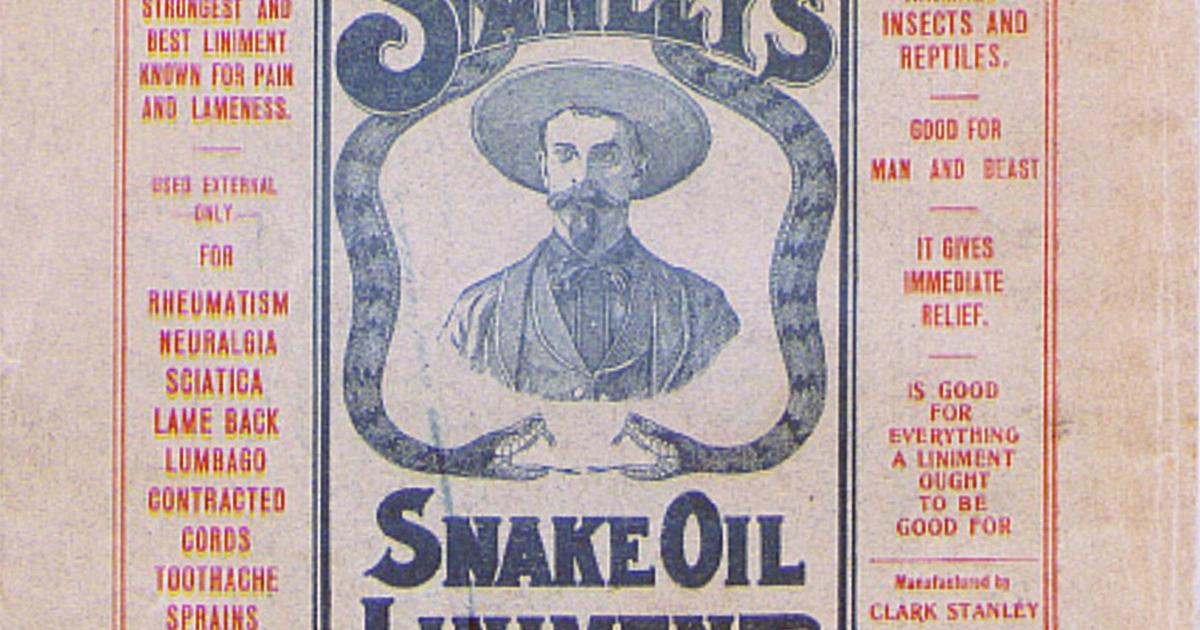
America brought us Clark Stanley, the Rattlesnake King, who sold us what he called “snake oil liniment” that promised to remedy “pain and lameness, for rheumatism, neuralgia, sciatica, sprains, bunions,” cure “partial paralysis of the arms and lower limbs” and “reduce large joints to their natural size.”
asserted
that → bring → size
America created Charles Ponzi, who could deliver you 50% profit in just 45 days by investing in stamp coupons.
uncertain
who → create → coupons
These old examples are easy to laugh at or be mortified by, but we should be careful: We are as willing as ever to believe claims that, when subjected to even a modicum of common sense, seem ludicrous.
uncertain
that → laugh → sense
Raw milk has special powers?
asserted
milk → have → powers
Peptides can make us young again?
asserted
us → make → ?
A blast of vitamins through an IV can flush out your hangover?
asserted
blast → flush → hangover
Why do we keep falling for this stuff?
asserted
we → keep → stuff
There’s a simple, poignant reason: “People really don’t want to die.
asserted
People → ’ → ?
So says Dr. Lydia Kang, author of a book on medical fads called “Quackery” and associate professor of internal medicine at University of Nebraska Medical Center.
asserted
Kang → say → Center
“Everybody has a deep wish to have a long and fruitful life,” she says, “without disability or pain and with your brain intact.”
asserted
she → have → brain
Other experts say there are sociological and evolutionary reasons to be attracted to outlandish and even disproven claims.
uncertain
experts → say → claims
But these instincts and tendencies are amplified in America, with its relentless optimism, its spirit of individualism, its lightly regulated capitalism, its desperate ambition to get richer or healthier or prettier, and a desire to get in on the action driven by suspicion: Others surely have gamed the system, so why can’t I?
asserted
I → amplify → system
“It’s sort of a wild wild West cowboy situation,” Kang said.
asserted
Kang → ’ → situation
“People are like, ‘Well, if you’re not going to do it, I’m going to do it myself.’
asserted
I → go → it
The truth often doesn’t matter
When we fall for claims or cling to beliefs after they’ve been disproved, we’re not necessarily being stupid.
We don’t have beliefs to create an accurate representation of the world, said Tali Sharot, a neuroscience professor at University College London.
uncertain
Sharot → matter → London
Instead, she said, it’s simply “to have beliefs that will get us the most rewards and help us avoid harm.
asserted
us → say → harm
And sometimes those beliefs are the accurate ones, but sometimes they’re not.”
asserted
they → ’re → ?
Overconfidence, for example, can land you a mate or a job you aren’t qualified for, she said.
asserted
she → land → mate
People can get a sense of community, support and belonging by believing what others in a group believe.
asserted
others → get → group
“If it’s a false belief, it doesn’t matter,” Sharot said.
asserted
Sharot → ’ → ?
Believing that vaccines cause autism, despite conclusive evidence that they don’t, gives families and loved ones something to blame and provides them with support from a group that shares in their anger, fear and pain.
And hope and belief can provide optimism that things could get better, which can in turn at least temporarily improve mood and mental health.
uncertain
which → believe → mood
“Believing that your future will be better than the past and the present — even if your future will not be better,” Sharot said, “Many times can be optimal.”
asserted
Sharot → believe → past
The lottery is almost guaranteed to lose you money — it’s a terrible financial decision.
asserted
it → guarantee → money
People know this.
asserted
People → know → this
But they also know that a lottery ticket is a little slip of hope, a chance to imagine a richer future.
asserted
ticket → know → future
“What you buy for sure is kind of the fun of thinking about it,” she said.
asserted
she → buy → it
“That is something that you are guaranteed to get.”
asserted
you → guarantee → that
Our thinking is similar when it comes to the supplements, balms and techniques that promise benefits that are extremely unlikely to materialize.
asserted
that → come → benefits
On one hand, they are a tragic waste of hard-earned money and sometimes have negative side effects.
asserted
they → earn → effects
On the other hand, “you gain something from trying,” Sharot said, like positive anticipation or excitement.
asserted
Sharot → gain → anticipation
Hope produces hype
asserted
Hope → produce → hype
But these tendencies leave us open to exploitation by companies that want our money.
asserted
that → leave → money
Throughout U.S. history, there is a clear pattern: A hint that something might work opens a crack in a door that companies barge through, capturing the desperation — and the paychecks — of people who are hurting, tired or scared.
uncertain
who → be → people
…and 29 more, not listed.
 The Aporia