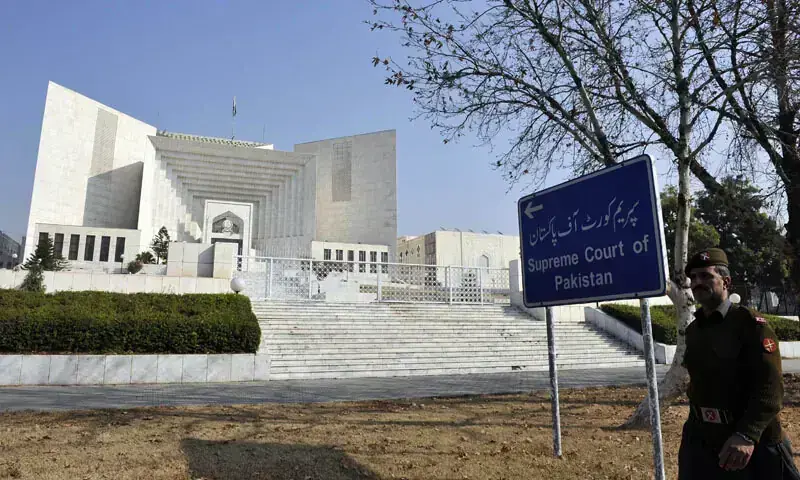
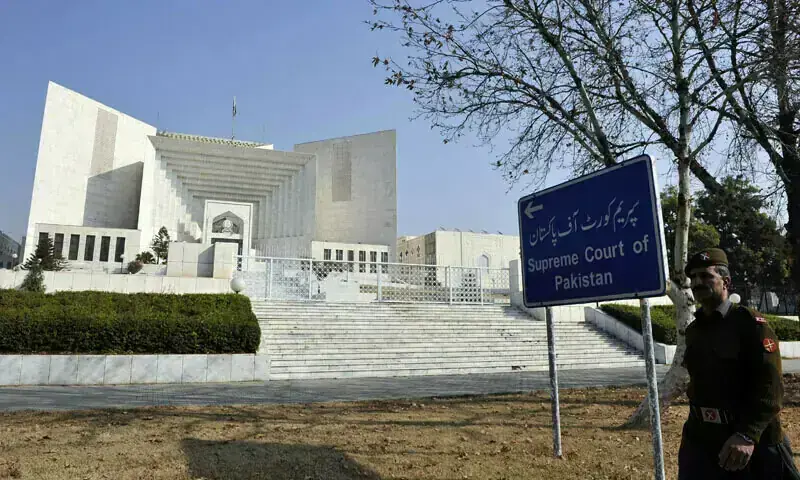
Photo via Dawn

Supreme Court admonishes Sindh police over delays in filing FIRs

Read the original at Dawn ↗
Cite

Iqbal, N. (2026, September 18). Supreme Court admonishes Sindh police over delays in filing FIRs. Dawn. https://www.dawn.com/news/2030908/supreme-court-admonishes-sindh-police-over-delays-in-filing-firs

Dated when The Aporia collected the article, usually within hours of publication. Check the original for its exact date and byline.

Dawn · collected 2026-09-18 · by Nasir Iqbal

Quick Summary

The Supreme Court of Pakistan expressed strong dissatisfaction with the delays in registering first information reports (FIRs) by the Sindh police on Friday. The two-judge bench, during a hearing related to a 2012 murder case, warned that failure to promptly register FIRs could lead to contempt proceedings against officials. Justice Salahuddin Panhwar ordered the Sindh prosecutor general to submit a report within two months detailing all murder cases from January 1, 2025, identifying those with delays exceeding 24 hours for registration. The court also directed that its earlier Muhammad Bux judgment be translated into Sindhi and made available online to educate the public on timely FIR registration requirements.
Written by AI on 2026-09-18, from this article's own text only (the story summary below draws on all the coverage).

AI analysis

Story summary

The Supreme Court in Islamabad on Friday strongly criticized the Sindh police for consistently delaying the filing of first information reports (FIRs), warning officials they could face contempt proceedings if such delays continue. A two-judge bench, comprising Justices Hashim Khan Kakar and Salahuddin Panhwar, was hearing a jail petition from Ali Raza Siyal, who had been convicted in a 2012 murder case in Dadu district. The court upheld Siyal's life sentence while expressing dismay over the repeated delays in registering FIRs. In this specific case, despite information being provided immediately after an incident, the FIR was filed more than three days later. Justice Salahuddin Panhwar emphasized that such practices violate legal standards and may lead to departmental action against police officials under Section 201 of the Penal Code (PPC).

Written for “Supreme Court Admonishes Police” on 2026-10-30, grounded in this article and the 0 other(s) covering the same event.

Story

📰 Supreme Court Admonishes Police
Politics · 1 article(s) covering the same event.

Compared with similar articles

Nothing to compare against. No article is close enough to this one for the pipeline to have linked or judged the pair.
How this article was measured signals, leaning charts, publisher record, byline, topics and claims

Signals How these are calculated →

Claims extracted
26
sentences that state something as happening or true
Uncertain
15%
4 of 26 hedged ("reportedly", "may", "according to")
Leaning
not political
takes no side on a contested political question
Publisher signals
71/100
Dawn's corrections and hedging, across everything collected from it. Not a measure of accuracy.
Outlets on this story
1
Politics
Same framing elsewhere
1
articles that frame the event the way this one does
Analyzed 2026-09-18 · how these are computed

How this is being covered How these are calculated →

Article leaning vs. publisher reliability
Source leaning vs. consistency

Publisher

Dawn · 2467 article(s) · 3 correction(s) detected
Running correction rate · 3 correction(s)

Who wrote this

Nasir Iqbal
27 article(s) here · 1 carrying a prediction
🔮 The petitioners had challenged their convictions in a 2011 double-murder case, upheld by the Lahore High Court (LHC) on May 18, 2022.
🔮 Expecting mathematical precision from eyewitnesses exposed to traumatic events is ‘unnatural and impractical’, Justice Ibrahim holds “In criminal jurisprudence, human behaviour should not be subjected to a fixed formula, nor should every witness be expected to react to, observe or retain events in an identical manner,” the judgement said.
2026-10-17 · assertive framing · SC questions ‘lofty expectations’ in criminal cases
🔮 The detailed order for dismissal will be issued by the FCC later.
🔮 Dismissing his review plea, the court ruled that a condemned prisoner could not claim, as a matter of right, that him having served 14 or 15 years of his sentence placed him in the same position as a person sentenced to life imprisonment.
🔮 If a plain reading of the plaint showed that it was palpably vexatious or meritless, the trial court could invoke Order VII, Rule 11 of the CPC to terminate sham litigation at the earliest stage.
🔮 Both Bilawal and Rana will represent Parliament as members of the treasury benches in the respective Houses – the National Assembly and the Senate.
🔮 The petitioner had challenged the March 12, 2025 decision of the Punjab Service Tribunal, which rejected his plea against the withdrawal of his promotion order dated May 24, 2023.
🔮 The Supreme Court ruled on Wednesday that a marriage could be dissolved on grounds of shiqaq (marital discord) under a residuary provision of the Dissolution of Muslim Marriages Act, 1939 even when cruelty was not proven.
🔮 But the high court dismissed their requests in May 2026, observing that their appeals against their convictions had already been fixed for hearing.
🔮 The Federal Constitutional Court (FCC) on Friday ruled that a registered medical practitioner (doctor) may prescribe and dispense medicine to his own patient within the scope of Section 31(4)(a) of the Pharmacy Act 1967, but cannot maintain a medical store or retail drug outlet without a licence under the Drugs Act 1976.
2026-10-03 · assertive framing · Doctors cannot run drug stores without licence: FCC
Also by Nasir Iqbal
Nothing else under this byline is closely related to this article, so these are simply their most recent.
All 27 articles by Nasir Iqbal →

Topics

Dadu ISLAMABAD Sindh The Supreme Court the Sindh High Court’s

Subjects

Sindh GPE · 7× Muhammad Bux PERSON · 5× The Supreme Court ORG · 3× Panhwar PERSON · 2× Salahuddin Panhwar PERSON · 2× Ali Raza Siyal PERSON · 1× Dadu GPE · 1× ISLAMABAD GPE · 1× Muhammad Hashim Khan Kakar PERSON · 1× the Sindh High Court’s ORG · 1×

Narrative

“When the record discloses that the officer in charge, knowing of a cognisable offence, delayed registration of an FIR, the trial court is competent and, in a proper case, obliged to take notice of that conduct and proceed in accordance with law, including under Section 201 of the PPC if the ingredients are made out, and to refer the matter to the inspector general of police for departmental action,” the judgment added.
framing: assertive · carried by 1 article(s) · first seen 2026-09-18
🔮 The Supreme Court on Friday expressed strong displeasure over delays in the registration of first information reports (FIRs) in Sindh, cautioning police officials that they could face contempt proceedings over any future delays.

Claims (26 extracted, 4 hedged)

The Supreme Court on Friday expressed strong displeasure over delays in the registration of first information reports (FIRs) in Sindh, cautioning police officials that they could face contempt proceedings over any future delays. uncertain
they → express → delays
A two-judge SC bench, comprising Justice Muhammad Hashim Khan Kakar and Justice Salahuddin Panhwar, upheld the life sentence of a man convicted of a 2012 murder in Sindh’s Dadu district while hearing the jail petition of Ali Raza Siyal, who had challenged the Sindh High Court’s Aug 24, 2023, Circuit Bench at Larkana judgment upholding his sentence. asserted
who → comprise → sentence
“We observe with dismay, once again, the consistent practice of delayed registration of FIRs in the province of Sindh,” Justice Salahuddin Panhwar observed in a seven-page judgment, adding that despite earlier directions — and even after the Sindh inspector general had appeared before the court — the practice showed no sign of abating. asserted
practice → observe → abating
In this case, the FIR was registered after a delay of more than three days. asserted
FIR → register → days
Although information had been furnished the same night, the judgment expressed regret and recalled that it had called these delays out in the 2026 Muhammad Bux case. asserted
it → furnish → case
The court had directed all inspectors general of police in Pakistan to ensure the prompt registration of an FIR once the officer in charge of a police station was informed about an incident, noting that the officer was duty-bound to register the FIR without delay. asserted
officer → direct → delay
The SC also cited the Muhammad Bux judgment, which held that the criminal justice system had evolved and that time was of the essence in the investigation of criminal matters. asserted
time → cite → matters
It further observed that delays could result in the loss or deterioration of forensic evidence, ultimately prejudicing the merits of a case. uncertain
delays → observe → case
Consequently, Justice Panhwar ordered the Sindh prosecutor general to furnish a report on all murder cases from Jan 1, 2025, to date, setting out the time of occurrence against the time of reporting and identifying cases in which the FIR was registered after 24 hours. asserted
FIR → order → hours
“The report will be submitted within two months for perusal in our chambers,” the judgment directed. asserted
judgment → submit → chambers
At the same time, the judgment directed the SC registrar to ensure that the Muhammad Bux judgment was translated into Sindhi for the understanding of the general public in Sindh and uploaded to the court’s website. asserted
judgment → direct → website
“Let it be assured that any further defiance of the judgment of the Supreme Court in Muhammad Bux, from this date onwards, may invite contempt proceedings against the inspectors general of police, the superintendents of police (investigation) and the concerned sub-divisional police officers,” the judgment cautioned. uncertain
judgment → let → police
Additionally, the judgment also recalled that the FIR in the present case carried the expression “faryaadi”, which the apex court in the Muhammad Bux judgment had also expressly discouraged since it depicted a colonial mindset. asserted
it → recall → mindset
In the Muhammad Bux case, the apex court observed that the term “faryaadi”, used in police proceedings in Sindh, originated from the Persian word “faryad”, meaning cry, help or lamentation, as noted in the Persian dictionary. asserted
term → observe → dictionary
“Needless to say that the citizen approaches the authorities as a matter of right and not as a matter of mercy,” the judgment emphasised. asserted
judgment → say → mercy
Similarly, the phrase ‘bakhidmat janaab SHO’ was a common salutation used in applications addressed to the station house officer (SHO) and also lacked legal backing and implied a subordinate tone. asserted
phrase → use → tone
“We concur that it’s actually the SHO, who serves the citizens, not the other way around,” the Supreme Court ruled. asserted
Court → concur → citizens
Justice Panhwar noted that, in the case at hand, the record itself demonstrated that the police had knowledge of a cognisable offence on the same night but did not register an FIR until more than three days later. asserted
police → note → FIR
“When the record discloses that the officer in charge, knowing of a cognisable offence, delayed registration of an FIR, the trial court is competent and, in a proper case, obliged to take notice of that conduct and proceed in accordance with law, including under Section 201 of the PPC if the ingredients are made out, and to refer the matter to the inspector general of police for departmental action,” the judgment added. asserted
judgment → disclose → action
It further said that every trial court would be aware of any deliberate delay in the filing of an FIR. asserted
court → say → FIR
Where such a delay was attributable to the police and apparent from the record, it would not be treated as a “mere irregularity”, the SC ruled, adding that the trial court would record a finding on the cause of the delay and take such action as the law permits. asserted
law → treat → action
In conclusion, the apex court dismissed the jail petition, finding no ground for granting leave. asserted
court → dismiss → leave
Last September, the SC ruled that no reason could justify the dereliction of the mandatory statutory duty of the police, as violations would erode public trust in the criminal justice system. uncertain
violations → rule → system
A three-judge bench of the apex court, comprising Justice Muhammad Ali Mazhar, Justice Athar Minallah and Justice Panhwar, also noted that the registration of an FIR under Section 154 of the Code of Criminal Procedure (CrPC) was exclusively an executive function and that violation of the statutory duty has profound consequences for the parties involved in a criminal case. asserted
violation → comprise → case
“A dysfunctional criminal justice system for citizens who are not privileged or powerful manifests [a] lack of constitutional governance. asserted
who → manifest → governance
The onus is on the respective governments to establish that every citizen is dealt with in accordance with the obligation enshrined under Article 4 of the Constitution,” it added. asserted
it → establish → Constitution

💬Give feedback
🕘History 🎫Support