Photo via Reason

Montana's Anti-Deepfakes Law Just Hit a First Amendment Roadblock

Read the original at Reason ↗
Cite

Ibrahim, R. (2026, September 18). Montana's Anti-Deepfakes Law Just Hit a First Amendment Roadblock. Reason. https://reason.com/2026/09/18/montanas-anti-deepfakes-law-just-hit-a-first-amendment-roadblock/

Dated when The Aporia collected the article, usually within hours of publication. Check the original for its exact date and byline.

Reason · collected 2026-09-18 · by Reem Ibrahim

Quick Summary

A U.S. District Judge issued a preliminary injunction blocking Montana from enforcing a law that restricts AI-generated political advertisements, citing potential violations of the First Amendment. The law prohibits distributing election communications containing deepfakes within 60 days of voting if they aim to damage a candidate's reputation, but exempts satire and parody. Critics argue this statute is unconstitutional because it treats similar forms of media differently based on intent; for instance, complimentary AI content would be permissible while damaging content could be considered illegal.
Written by AI on 2026-09-18, from this article's own text only (the story summary below draws on all the coverage).

AI analysis

Story summary

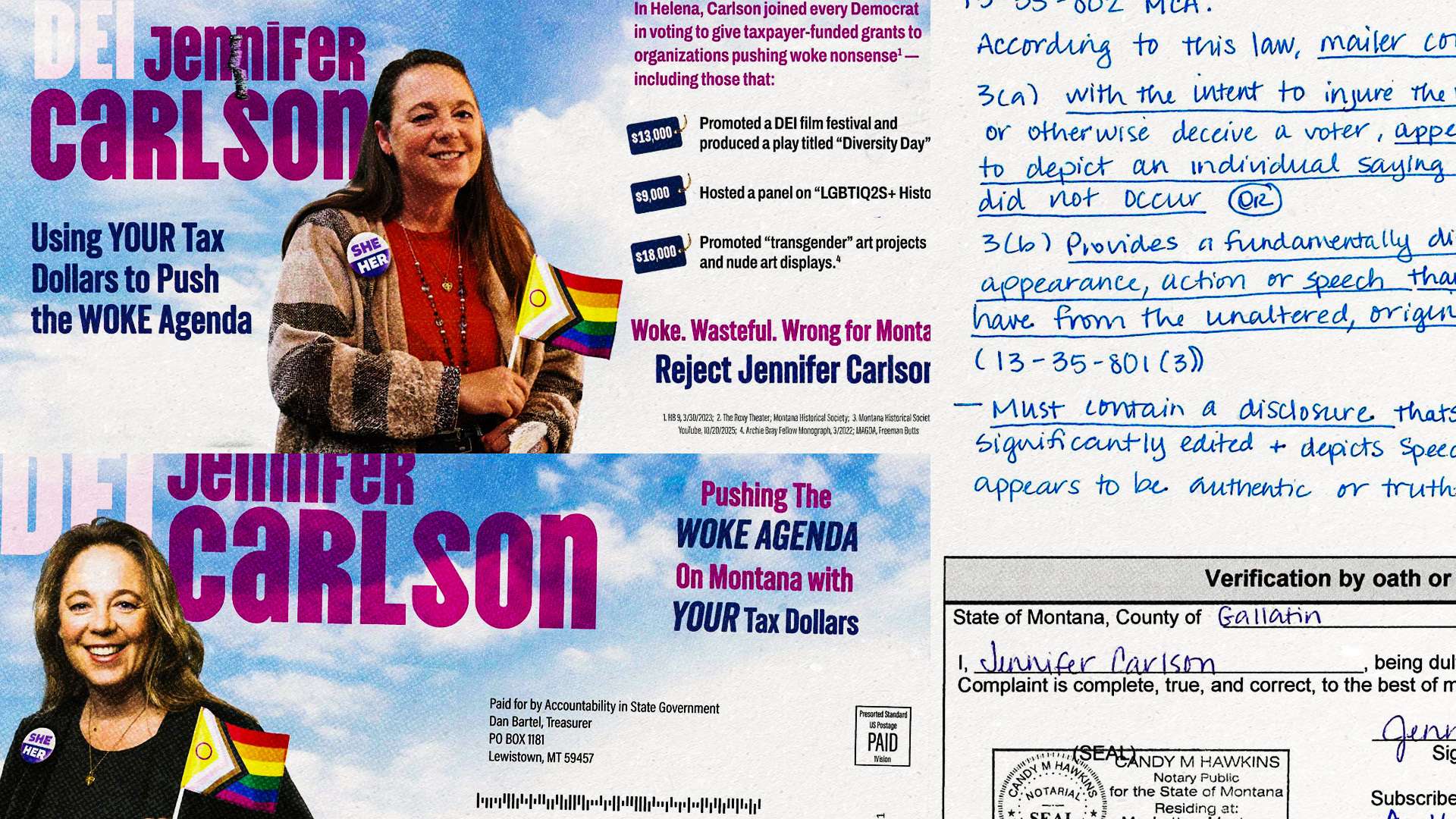
On Wednesday, U.S. District Judge Susan Watters issued a preliminary injunction against enforcing a new Montana law aimed at regulating AI-generated political advertisements. This decision came after Accountability in State Government, an organization led by former state lawmaker Dan Bartel, challenged the statute. Bartel's group sent out mailers featuring doctored images of political figures holding pride flags and wearing pronoun badges to test the legality of such synthetic media. The Montana law prohibits sponsoring or distributing election communications containing deepfakes within 60 days of voting if one "knew or should have known" it was a deepfake, unless it falls under satire or parody exemptions. When complaints were filed against Bartel's mailouts by state representatives like Jennifer Carlson (R–Manhattan), the commissioner of political practices determined that these images qualified as humor and thus were protected under the statute’s exemption for satire. This case highlights ongoing tensions between states' efforts to regulate deceptive election communications and First Amendment protections for free speech.

Written for “Deepfake Legislation” on 2026-11-04, grounded in this article and the 0 other(s) covering the same event.

Story

📰 Deepfake Legislation
Politics · 1 article(s) covering the same event.

Compared with similar articles

Nothing to compare against. No article is close enough to this one for the pipeline to have linked or judged the pair.
How this article was measured signals, leaning charts, publisher record, byline, topics and claims

Signals How these are calculated →

Claims extracted
27
sentences that state something as happening or true
Uncertain
15%
4 of 27 hedged ("reportedly", "may", "according to")
Leaning
Leans right
of the writing, not the subject · beta estimate
Publisher signals
67/100
Reason's corrections and hedging, across everything collected from it. Not a measure of accuracy.
Outlets on this story
1
Politics
Same framing elsewhere
1
articles that frame the event the way this one does
Analyzed 2026-09-18 · how these are computed

How this is being covered How these are calculated →

Article leaning vs. publisher reliability
Source leaning vs. consistency

Publisher

Reason · 1111 article(s) · 4 correction(s) detected
Running correction rate · 4 correction(s)

Who wrote this

Reem Ibrahim
15 article(s) here · 1 carrying a prediction
🔮 In European cities, I would often spend evenings hopping between bars on organized bar crawls, but this Halloween I wasn't able to because of Washington, D.C.'s prohibition on pub crawls.
🔮 Under the new plans, many departments could see staffing reductions of anywhere from 20 to 60 percent, according to the letter.
🔮 Singer says that removing barriers that prevent new companies from competing with established providers could not only increase choice but also drive down prices.
🔮 Starting next week, Pennsylvania will begin enforcing a law prohibiting the sale of e-cigarettes that have not been explicitly approved by the state.
🔮 There's no way to guarantee a risk-free environment, that there will not be major hacks, scams, or negative consequences of AI, Altman says.
🔮 On Wednesday, Sen. Rand Paul (R–Ky.) blocked efforts to pass the Senate's Kids Online Safety Act (KOSA)—a bill that would legally require platforms to "exercise reasonable care" in creating any "design feature" that could foreseeably harm minors—through unanimous consent (a fast-track procedure that would only pass if no senator objects).
🔮 And the fact that they also maybe seemed to be interacting in some way also seemed weird and not like typical bot behavior." After assuming they were bots, Blanchard deleted the comments, but then noticed new ones pop up.
🔮 Rep. William Jefferson (D–La.) was famously caught with $90,000 in cash stuffed in his freezer in 2005.
🔮 On Sunday, he said that the arch would, in fact, be a "Military Complex" with "large numbers of drones, plus Snipers.
🔮 "You could have AI deepfakes that were fine as long as they were complimentary," Schulman tells Reason.
Also by Reem Ibrahim
Nothing else under this byline is closely related to this article, so these are simply their most recent.
All 15 articles by Reem Ibrahim →

Topics

Accountability in State Government Bartel Montana U.S. the First Amendment

Subjects

Montana GPE · 6× Bartel PERSON · 4× Schulman PERSON · 4× Watters PERSON · 3× California GPE · 2× U.S. GPE · 2× Accountability in State Government ORG · 1× Dan Bartel PERSON · 1× Jennifer Carlson PERSON · 1× Susan Watters PERSON · 1×

Narrative

Montana's statute covers synthetic media created "with the intent to injure the reputation" of a candidate or political party, meaning that, as Watters put it, the law "treats identically deceptive media differently based solely on whether its message is weaponized to damage or deployed to elevate a candidate."
framing: assertive · carried by 1 article(s) · first seen 2026-09-18
🔮 "You could have AI deepfakes that were fine as long as they were complimentary," Schulman tells Reason.
2026-09-18 · Reason
Montana's Anti-Deepfakes Law Just Hit a First Amendment Roadblock · assertive framing

Claims (27 extracted, 4 hedged)

States' efforts to regulate election deepfakes keep colliding with the First Amendment. asserted
efforts → regulate → Amendment
On Wednesday, U.S. District Judge Susan Watters issued a preliminary injunction preventing Montana from enforcing a 2025 law that restricts AI-generated political advertisements. asserted
that → issue → advertisements
The law had been challenged by Accountability in State Government, a group run the former state lawmaker Dan Bartel; the organization had sent mailouts containing doctored images of political figures holding pride flags and wearing pronoun badges. asserted
organization → challenge → badges
Under Montana law, it is illegal to sponsor or distribute an election communication within 60 days of voting if you "knew or should have known [it] is a deepfake"—though "satire or parody" is exempt. asserted
satire → sponsor → voting
And so the targets of Bartel's mailouts filed complaints. asserted
targets → file → complaints
State Rep. Jennifer Carlson (R–Manhattan), for example, said a mailer showing her holding an AI-generated pride flag was created "with the intent to injure the reputation of the candidate or otherwise deceive a voter." asserted
mailer → say → voter
The complaints were dismissed on August 20, with Christopher Gallus, commissioner of political practices, concluding that the mailers were sufficiently "humorous or outlandish" to qualify as satire. asserted
mailers → dismiss → satire
The next morning, Watters heard arguments on Bartel's request to block enforcement of the law altogether on the grounds that it violates the First Amendment. asserted
it → hear → Amendment
This week, Watters found that Bartel and his group are likely to succeed on their First Amendment challenge. asserted
Bartel → find → challenge
Montana's statute covers synthetic media created "with the intent to injure the reputation" of a candidate or political party, meaning that, as Watters put it, the law "treats identically deceptive media differently based solely on whether its message is weaponized to damage or deployed to elevate a candidate." asserted
message → cover → candidate
Adam Schulman—an attorney at the Hamilton Lincoln Law Institute, which is representing Bartel in the case—says that this was the statute's fundamental flaw. asserted
this → represent → case
"You could have AI deepfakes that were fine as long as they were complimentary," Schulman tells Reason. uncertain
Schulman → have → Reason
"You could have Donald Trump dressed in a Pittsburgh Steelers uniform deepfake [and that would be] fine because it's not injuring the reputation of a candidate." uncertain
it → have → candidate
Schulman also argues that the law asks regulators to make inherently subjective judgments about political imagery. asserted
law → argue → imagery
Montana's statute relies in part on how a "reasonable person" would understand the material, but that becomes difficult when satire and parody are involved. asserted
satire → rely → material
"People have different artistic sensibilities," says Schulman. asserted
Schulman → have → sensibilities
Plenty of states have attempted to restrict AI-generated political speech and discovered the constitutional difficulty of doing so. asserted
Plenty → attempt → difficulty
After the conservative YouTuber Christopher Kohls posted an AI-produced parody of then–Vice President Kamala Harris in the 2024 election, California passed Assembly Bill 2839, prohibiting the distribution of communications "that contains certain materially deceptive content" produced "with malice." asserted
that → post → malice
In 2025, a federal court ruled the law was unconstitutional and permanently enjoined California from enforcing the law. asserted
law → rule → law
Similarly, Hawaii passed Act 191 in 2024, which restricted "materially deceptive" election media. asserted
which → pass → media
The Babylon Bee and Dawn O'Brien, a Hawaiian resident, challenged the law as a violation of free speech. asserted
Bee → challenge → speech
In January 2026, U.S. District Judge Shanlyn Park granted a summary judgment finding the law "unconstitutionally vague," in part because it "employs ambiguous and subjective standards." asserted
it → grant → standards
As new technologies develop, calls for more government regulation inevitably ensue. asserted
calls → develop → regulation
The push to regulate AI-generated political speech reminds Schulman of COVID-era efforts to police "misinformation." asserted
push → regulate → misinformation
Montana has a month to appeal the decision. asserted
Montana → have → decision
But given how things have gone for other states, it might not want to bother. uncertain
it → give → states
The constitutional limits on regulating AI-generated political speech may not be fully settled, but the early cases have been a warning against attempts to restrict protected political expression. uncertain
cases → regulate → expression

💬Give feedback
🕘History 🎫Support