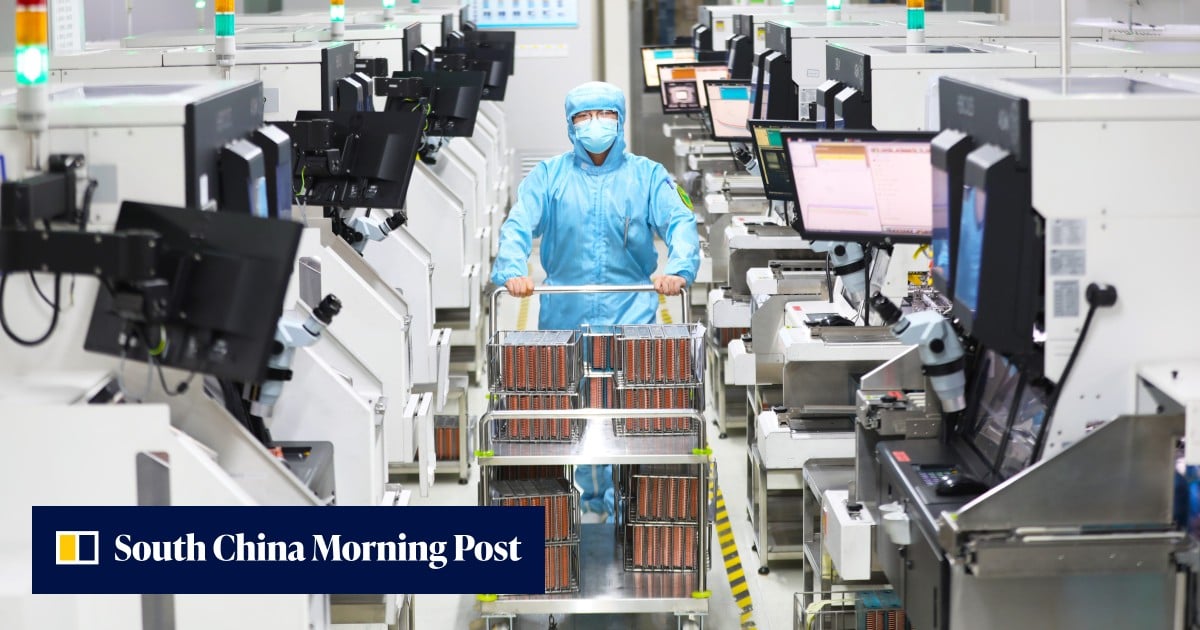
Photo via South China Morning Post

China makes progress in 3-nm chips without advanced lithography tools

Read the original at South China Morning Post ↗
Cite

Cao, A. (2026, September 19). China makes progress in 3-nm chips without advanced lithography tools. South China Morning Post. https://www.scmp.com/tech/tech-war/article/3368042/china-makes-progress-3-nm-chips-without-advanced-lithography-tools?utm_source=rss_feed

Dated when The Aporia collected the article, usually within hours of publication. Check the original for its exact date and byline.

South China Morning Post · collected 2026-09-19 · by Ann Cao

Quick Summary

Chinese researchers at the Chinese Academy of Sciences have made initial progress in developing 3-nanometer chips using less advanced deep ultraviolet (DUV) lithography technology, as reported by Taiwanese media Digitimes. This breakthrough comes despite US sanctions preventing China from accessing more sophisticated extreme ultraviolet (EUV) tools necessary for producing chips below the 7-nm node, indicating China's efforts to advance its semiconductor industry independently of Western technology.
Written by AI on 2026-09-19, from this article's own text only (the story summary below draws on all the coverage).

AI analysis

Story summary

In a significant development, Chinese researchers at the state-backed Chinese Academy of Sciences (CAS) have made progress in developing 3-nm chips using less advanced deep ultraviolet (DUV) lithography technology. This breakthrough was reported by Digitimes, a Taiwanese media outlet, on Thursday and stems from a speech given by Ye Tianchun, a veteran researcher at the CAS’s Institute of Microelectronics (IMECAS). The Chinese team has established an initial development path for gate-all-around (GAA) devices without access to advanced extreme ultraviolet lithography (EUV) tools. US sanctions prevent ASML, a Dutch equipment manufacturer, from selling its EUV machines essential for producing chips below the 7-nm node to Chinese clients. Although this progress is not yet ready for mass production, it demonstrates China's ability to advance chip manufacturing despite technological and trade barriers.

Written for “Chinese Chip Advancement” on 2026-11-01, grounded in this article and the 0 other(s) covering the same event.

Story

📰 Chinese Chip Advancement
Technology · 1 article(s) covering the same event.

Compared with similar articles

This article reads leans left and hedges 17% of its claims. Each row says how that neighbour differs.
South China Morning Post
Hedges 0 of 2 claims Outlet record 63/100
“The articles discuss different aspects of China's technology development and do not describe the same specific incident or occurrence.”
South China Morning Post
Hedges 1 of 2 claims Outlet record 63/100
“Article B is a collection of weekend reads and does not specifically focus on the same detailed event as Article A.”
How this article was measured signals, leaning charts, publisher record, byline, topics and claims

Signals How these are calculated →

Claims extracted
6
sentences that state something as happening or true
Uncertain
17%
1 of 6 hedged ("reportedly", "may", "according to")
Leaning
Leans left
of the writing, not the subject · beta estimate
Publisher signals
63/100
South China Morning Post's corrections and hedging, across everything collected from it. Not a measure of accuracy.
Outlets on this story
1
Technology
Same framing elsewhere
1
articles that frame the event the way this one does
Analyzed 2026-09-19 · how these are computed

How this is being covered How these are calculated →

Article leaning vs. publisher reliability
Source leaning vs. consistency

Publisher

South China Morning Post · 3535 article(s) · 7 correction(s) detected
Running correction rate · 7 correction(s)

Who wrote this

Ann Cao
16 article(s) here · 0 carrying a prediction
🔮 Apple Intelligence to roll out on iPhones in China in December with Alibaba backing Alibaba’s flagship AI model Qwen will be integrated into Apple Intelligence, after years of speculation and regulatory uncertainty
🔮 Alibaba Cloud founder says open-source, closed-source AI philosophies not at odds, calls for more Chinese cloud competition to strengthen industry Long before artificial intelligence became the next big thing in the tech industry, Wang Jian was crafting the foundational infrastructure that would eventually power it.
🔮 The deal will enable Tesla drivers to pay for parking from their in-car touchscreens, with more features to follow, Alipay says Tesla has agreed a deal to integrate Chinese fintech giant Ant Group’s Alipay digital payment software into its vehicles in China, as Elon Musk’s firm steps up efforts to offer localised smart features amid intense competition in the Chinese market. The agreement, signed on Tuesday, will see Tesla roll out an Alipay-powered smart parking service across its Chinese fleet, according to the fintech firm.
🔮 Following the transaction, Guosheng’s direct stake in Hua Hong Group would jump to 41.7 per cent from 15.3 per cent, while its indirect holding would rise to 10.2 per cent from 3.8 per cent.
🔮 When trading begins, CanSemi is expected to set a milestone for the Shenzhen exchange as the first pure-play wafer fabrication company to list on its Shenzhen’s tech-heavy ChiNext board.
🔮 Chinese AI chipmaker Hygon plots expansion from data centres to robotics New chip targets range of physical AI applications, where machines interact directly with their environments Chinese chipmaker Hygon Information Technology is set to release a new chip targeting physical-world applications including robotics, expanding from its current focus on data centres, according to Chinese media reports and company information. The new chip, an iteration of the company’s CPU1000 series, is designed to meet “low-power, embedded and edge computing requirements”, targeting a range of physical AI applications in sectors including robotics, machine vision and intelligent manufacturing, according to reports by business news outlet Jiemian News and state-backed newspaper China Securities Journal on Sunday.
🔮 The research team said the training method could eventually be extended to other types of medical imaging, calling the model “the world’s first expert-level generalist medical imaging model”.
🔮 Cloudy with a chance of Big Macs: McDonald’s and Meituan launch drone route in Shanghai Fast-food orders will soar through the Shanghai sky, quickly reaching designated kiosks along the West Bund, offering a new way to collect meals Shanghai’s bustling riverfront has become the latest testing ground for urban logistics technology, with McDonald’s and Chinese food-delivery giant Meituan joining forces to launch the country’s first catering brand-exclusive drone-delivery route.
🔮 These digital workers could then be put to work within any of China’s three major workplace communication platforms: Alibaba’s DingTalk, ByteDance’s Feishu and Tencent’s WeCom.
Also by Ann Cao
Nothing else under this byline is closely related to this article, so these are simply their most recent.
All 16 articles by Ann Cao →

Topics

ASML China Chinese Digitimes the Chinese Academy of Sciences

Subjects

China GPE · 4× ASML ORG · 2× Chinese NORP · 2× Digitimes ORG · 2× CAS ORG · 1× Chinese Academy of Sciences ORG · 1× Dutch NORP · 1× Taiwanese NORP · 1× Ye Tianchun PERSON · 1× the Chinese Academy of Sciences ORG · 1×

Narrative

In the latest development, state-backed Chinese Academy of Sciences (CAS) has established a preliminary gate-all-around (GAA) device development path using the less advanced deep ultraviolet (DUV) lithography, Taiwanese media Digitimes reported on Thursday, citing a speech by Ye Tianchun, a veteran from the academy’s Institute of Microelectronics (IMECAS). Ye said the institute had finished early integration for stacked nanosheet-channel GAA CMOS transistors using DUV tools.
framing: assertive · carried by 1 article(s) · first seen 2026-09-19
2026-09-19 · South China Morning Post
China makes progress in 3-nm chips without advanced lithography tools · assertive framing

Claims (6 extracted, 1 hedged)

China makes progress in 3-nm chips without advanced lithography tools asserted
China → make → tools
The breakthrough by the Chinese Academy of Sciences is far from mass production but shows China is tracking the road map of global leaders Chinese researchers have made early strides in pushing semiconductor processing nodes below 3-nm using older lithography technology, as more advanced extreme ultraviolet lithography (EUV) tools from ASML remain blocked under US sanctions. asserted
tools → show → sanctions
The breakthrough marks the latest progress in China’s drive to chart an alternative path to advanced chipmaking amid US export restrictions. asserted
breakthrough → mark → restrictions
Under current export control rules, Dutch equipment giant ASML is barred from selling its state-of-the-art EUV machines – essential for producing chips below the 7-nm node – to Chinese clients. asserted
ASML → bar → clients
In the latest development, state-backed Chinese Academy of Sciences (CAS) has established a preliminary gate-all-around (GAA) device development path using the less advanced deep ultraviolet (DUV) lithography, Taiwanese media Digitimes reported on Thursday, citing a speech by Ye Tianchun, a veteran from the academy’s Institute of Microelectronics (IMECAS). Ye said the institute had finished early integration for stacked nanosheet-channel GAA CMOS transistors using DUV tools. asserted
institute → back → tools
He described the result as a “new early-stage MOS transistor process path for China’s sub-3-nm advanced manufacturing”, according to the Digitimes article. uncertain
He → describe → article
💬Give feedback
🕘History 🎫Support