Ancient teeth pose a mystery: What made those strange grooves?
asserted
What → pose → grooves
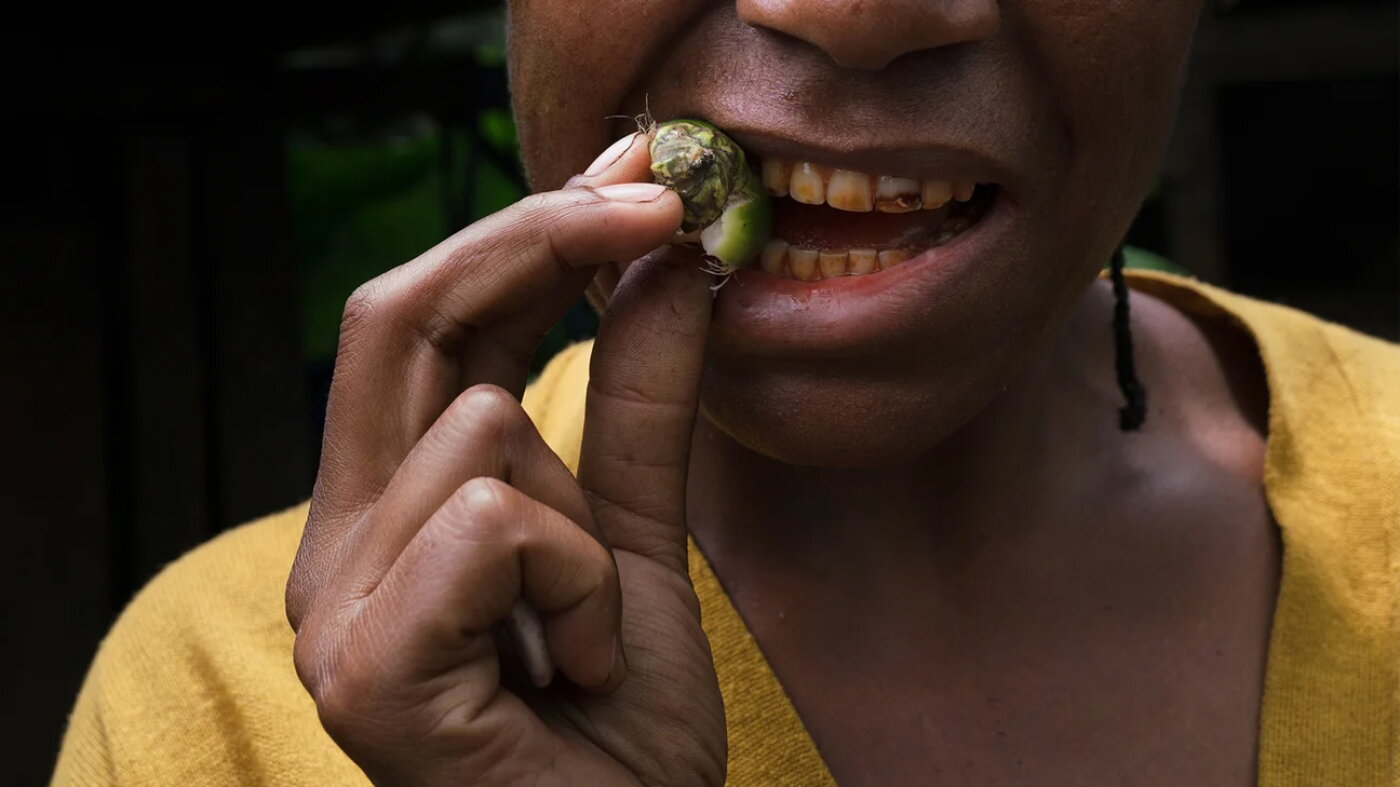
About 600 million people today chew on betel nuts —- the brownish green seeds of certain palm trees that are about the size of a walnut.
asserted
that → chew → walnut
Betel nut users say they get all kinds of benefits — relief from indigestion, fresh breath, an energy boost.
asserted
they → say → indigestion
The medical community notes that long-term betel nut use can damage teeth, increase the risk of heart disease, and lead to oral cancer due to the chemicals within.
asserted
use → note → chemicals
Still, many people in Asia and the Asian Pacific are addicted to chewing them.
asserted
people → chew → them
Betel nuts are considered the world's fourth most commonly used mind-affecting substances, after tobacco, alcohol and caffeine.
asserted
nuts → consider → tobacco
A new study, published in Science Advances, finds this love affair with betel nuts is nothing new.
asserted
affair → publish → nuts
By looking at ancient teeth, researchers uncovered what they think is an early stage in the practice, when hunter-gatherers had a habit of sucking on betel nuts, possibly for their painkilling effects.
uncertain
gatherers → look → effects
"It's a chance archaeological discovery that reveals an initial stage in the development of this common drug used today," says Adam Brumm, a professor of archaeology at Griffith University in Australia who led the research, "We think it might have started with hunter-gatherers just sucking on the nuts, almost as though they were gobstoppers."
uncertain
they → reveal → nuts
Outside researchers find the evidence compelling though not conclusive — and further note that drug use has longstanding and deep roots among humanity: The instinct to experiment and expand our horizons with substances is part of human nature, says José Capriles, associate professor of anthropology at Penn State University, who has found drugs used by humans a thousand years ago in South America.
asserted
who → find → America
Puzzled by "strange grooves"
How did scientists uncover this ancient betel nut usage?
asserted
scientists → puzzle → usage
The answer involves two puzzling sets of teeth, fake saliva — and some personal experimentation.
asserted
answer → involve → teeth
On an archaeological dig in Sulawesi, an island in modern-day Indonesia, Brumm and his colleagues excavated some very old human remains.
asserted
Brumm → excavate → remains
They belonged to a hunter-gatherer who lived as far back as 25,000 years.
asserted
who → belong → gatherer
The remains posed a mystery.
asserted
remains → pose → mystery
"There were really strange grooves in the teeth that we couldn't explain," Brumm says.
asserted
Brumm → be → that
He emailed other archaeologists — "all of the world's leading experts in ancient dental wear" — soliciting their advice.
asserted
He → email → advice
"None of them could explain how these grooves could have formed," says Brumm.
uncertain
Brumm → explain → them
About 20 miles to the east, they found a second set of teeth from a human who lived up to 8,000 years ago, with similar marks.
asserted
who → find → marks
"The grooves were so deep that they had actually exposed the pulp cavity, the nerve center, of several teeth," Brumm says, describing it as a pattern that likely took decades of repeated wear to form.
asserted
that → expose → wear
While hunter-gatherers from that time are known to have used their teeth as tools — holding, breaking, stretching things — none of those uses matched the grooves on these teeth.
asserted
none → know → teeth
"We ruled out any type of food they might have been eating, we ruled out the possibility that they were processing plant fibers to make string in their mouth," says Brumm.
uncertain
Brumm → rule → mouth
Brumm was stumped.
asserted
Brumm → stump → ?
Then he remembered another example of distinctive teeth wear, from the colonial period in Europe, America and Australia, when laborers habitually smoked tobacco from clay pipes.
asserted
laborers → remember → pipes
"They would have the pipe sticking out of their mouth, Popeye-style,"
asserted
pipe → have → mouth
Brumm explains, "Over a lifetime of this habit, they've got a perfectly round notch in their teeth that you can slot the clay pipe stem straight into."
asserted
you → explain → stem
Brumm and his colleagues thought the teeth grooves from Indonesia might originate in a similar habit, one grounded in cultural practices.
uncertain
grooves → think → practices
The case for the betel nut
In the Asia and Pacific region today, betel nuts are commonly chewed with other chemicals for their combined stimulant effects.
asserted
nuts → chew → effects
However, the wear patterns on the teeth were consistent with sucking — not chewing — hard, round abrasive objects over many years, Brumm says.
asserted
Brumm → suck → years
He and his colleagues think they've uncovered an early developmental stage in the practice.
asserted
they → think → practice
"We think they were hooked on nut-sucking," Brumm says.
asserted
Brumm → think → sucking
Since sucking betel nuts is not common today, Brumm partnered with Professor Roger Papke, a neuropharmacological researcher at the University of Florida, to test whether the action could cause a drug effect ancient humans may have desired.
uncertain
humans → suck → effect
"We soaked whole betel nuts in artificial saliva, and then introduced the resultant extracts into frog egg cells engineered to produce human brain receptors," Brumm says.
asserted
Brumm → soak → receptors
They found that the artificial saliva successfully extracted arecoline, an active chemical in the betel nut, and that the brain receptors turned on when they touched the saliva.
asserted
they → find → saliva
"We've shown that if you just suck on the nut, there's a physiological reaction that can be released into your bloodstream and then into your brain, and that can alter human brain function," he says.
asserted
he → show → function
Then they sought to establish that these ancient people actually did it.
asserted
people → seek → it
In addition to matching the shape of betel nuts to the grooves in the teeth, they tested the dental tissues and found traces of arecoline — for which betel nuts are the only known natural source, Papke says.
asserted
Papke → match → which
Brumm also put himself in the mindset of ancient humans and tried sucking on betel nuts himself.
asserted
Brumm → put → nuts
"I had to give it a go," he says, "If you gently gnaw on the outside of it, it releases the betel juice.
asserted
it → have → juice
It has this extremely bitter and astringent taste that makes your whole mouth go numb."
asserted
mouth → have → taste
…and 19 more, not listed.
 The Aporia