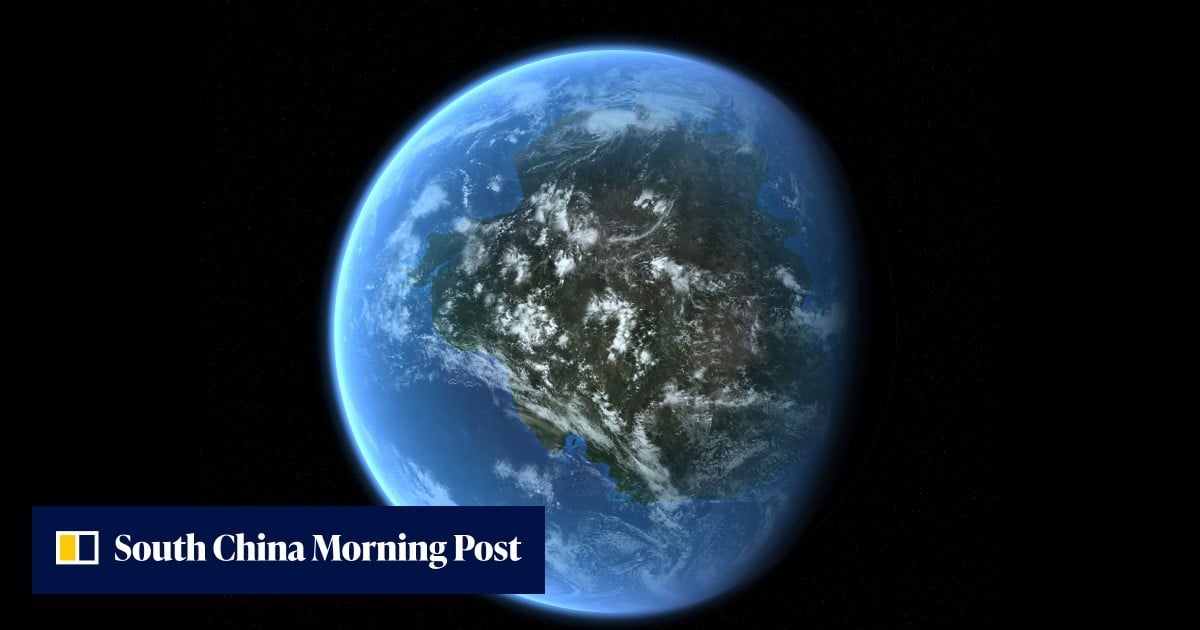
Photo via South China Morning Post

China-led study reveals ‘Greater Gondwana’ was 80% of Earth’s crust 500m years ago

Read the original at South China Morning Post ↗
Cite

Peng, D. (2026, September 19). China-led study reveals ‘Greater Gondwana’ was 80% of Earth’s crust 500m years ago. South China Morning Post. https://www.scmp.com/news/china/science/article/3368102/china-led-study-reveals-greater-gondwana-was-80-earths-crust-500m-years-ago?utm_source=rss_feed

Dated when The Aporia collected the article, usually within hours of publication. Check the original for its exact date and byline.

South China Morning Post · collected 2026-09-19 · by Dannie Peng

Quick Summary

An international team led by Chinese scientists has found that 'Greater Gondwana', a supercontinent that existed 500 million years ago, covered approximately 80% of the Earth's crust. The study, published in Science Advances, indicates that geological activities associated with this massive landmass created conditions favorable for the Cambrian explosion, a period marked by rapid diversification of life forms. Researchers from China, Australia, and eastern China contributed to this discovery, which expands our understanding of Gondwana’s extent and its impact on early Earth's biodiversity.
Written by AI on 2026-09-19, from this article's own text only (the story summary below draws on all the coverage).

AI analysis

Story summary

A China-led international team of scientists has discovered that Gondwana, a land mass which dominated Earth about 500 million years ago, was approximately 80% of the planet's crust at its peak, significantly larger than previously thought. The findings were published in the peer-reviewed journal Science Advances and indicate that geological activity linked to Gondwana created favorable conditions for the Cambrian explosion. Researchers from the Chinese Academy of Geological Sciences, Australia’s Curtin University, and Zhejiang Lab collaborated on this study, revealing fragments of ancient Gondwana buried deep beneath parts of modern continents.

Written for “Ancient Supercontinent Discovery” on 2026-11-02, grounded in this article and the 0 other(s) covering the same event.

Story

📰 Ancient Supercontinent Discovery
Science · 1 article(s) covering the same event.

Compared with similar articles

Nothing to compare against. No article is close enough to this one for the pipeline to have linked or judged the pair.
How this article was measured signals, leaning charts, publisher record, byline, topics and claims

Signals How these are calculated →

Claims extracted
5
sentences that state something as happening or true
Uncertain
40%
2 of 5 hedged ("reportedly", "may", "according to")
Leaning
not political
takes no side on a contested political question
Publisher signals
63/100
South China Morning Post's corrections and hedging, across everything collected from it. Not a measure of accuracy.
Outlets on this story
1
Science
Same framing elsewhere
1
articles that frame the event the way this one does
Analyzed 2026-09-19 · how these are computed

How this is being covered How these are calculated →

Article leaning vs. publisher reliability
Source leaning vs. consistency

Publisher

South China Morning Post · 3547 article(s) · 7 correction(s) detected
Running correction rate · 7 correction(s)

Who wrote this

Dannie Peng
16 article(s) here · 0 carrying a prediction
🔮 AI could turn China’s social credit system into surveillance tool: government-funded study
🔮 The semi-submersible twin-hull platform is the world’s first mobile, self-sustaining artificial island and is expected to be fully completed and delivered by June 2030, news outlet Shanghai Observer reported on October 21.
🔮 The device was jointly developed by scientists from Tsinghua University and the Chinese PLA Medical School, and detailed in a paper published in the peer-reviewed journal Nature on Monday. “This microscope will push optical brain-computer interfaces towards more precise neural detection,” said Dai Qionghai, the paper’s corresponding author from Tsinghua’s automation department.
🔮 Chinese desalination plant cuts 60% energy use by turning waste brine into industrial salt Technology may help to solve the global problem of discharging concentrated by-products of drinking water production into the sea Situated in the Caofeidian industrial zone of Tangshan, Hebei province, the facility recently entered its trial production stage, the state-run Science and Technology Daily reported last month.
🔮 Once this group of exceptionally brilliant young people was identified, their sole performance metric over a 15-year period would be “whether they are in the laboratory”, Dou said on September 19.
🔮 The coating may also have potential for broader use in public infrastructure and homes.
🔮 US-China decoupling could benefit other countries, China trade war game suggests The study suggests a complete severing of trade ties would hurt both superpowers while bringing temporary gains elsewhere
Also by Dannie Peng
Nothing else under this byline is closely related to this article, so these are simply their most recent.
All 16 articles by Dannie Peng →

Topics

Australia China Chinese Science Advances the Chinese Academy of Geological Sciences

Subjects

China GPE · 2× Australia GPE · 1× Chinese NORP · 1× Curtin University ORG · 1× Science Advances ORG · 1× Zhejiang Lab ORG · 1× the Chinese Academy of Geological Sciences ORG · 1×

Narrative

Published this month in the peer-reviewed journal Science Advances, the discovery reveals that Gondwana – a land mass that dominated Earth some 500 million years ago – was much larger than previously believed.
framing: mixed · carried by 1 article(s) · first seen 2026-09-19

Claims (5 extracted, 2 hedged)

China-led study reveals ‘Greater Gondwana’ was 80% of Earth’s crust 500m years ago Research suggests that the land mass that once dominated Earth was larger than previously thought uncertain
that → lead → Earth
Fragments of a long-disappeared ancient giant land mass have been discovered buried deep beneath parts of the modern continents that once formed it, according to an international team led by Chinese scientists. uncertain
that → disappear → scientists
Published this month in the peer-reviewed journal Science Advances, the discovery reveals that Gondwana – a land mass that dominated Earth some 500 million years ago – was much larger than previously believed. asserted
that → publish → Earth
Crucially, the findings show how geological activity related to Gondwana created favourable conditions for the Cambrian explosion. asserted
activity → show → explosion
The study was jointly conducted by researchers from the Chinese Academy of Geological Sciences, Australia’s Curtin University, and Zhejiang Lab, a non-profit research institution in eastern China. asserted
study → conduct → China
💬Give feedback
🕘History 🎫Support