Photo via Fox News

Strange rock catches scientist's eye during creek search, leading to rare discovery

Read the original at Fox News ↗
Cite

Margolis, A. (2026, September 19). Strange rock catches scientist's eye during creek search, leading to rare discovery. Fox News. https://www.foxnews.com/travel/strange-rock-catches-scientist-eye-creek-search-leading-rare-discovery

Dated when The Aporia collected the article, usually within hours of publication. Check the original for its exact date and byline.

Fox News · collected 2026-09-19 · by Andrea Margolis

Quick Summary

A geomorphologist named Brigid Lynch discovered an ancient Pacific mastodon tooth while surveying a California creek for habitat improvement of the threatened California red-legged frog. Wayne Thompson, CEO of Pacific Paleontology, assessed the fossil and estimated its age to be between 50,000 and 100,000 years old based on its pristine condition and location. The rare find is expected to provide valuable insights into Ice Age ecosystems when mastodons roamed areas lined with alder trees, their preferred food source.
Written by AI on 2026-09-19, from this article's own text only (the story summary below draws on all the coverage).

AI analysis

Story summary

A Brigid Lynch, a geomorphologist from Balance Hydrologics, found an unusual rock in a creek within a Midpen preserve in San Mateo County, California while surveying the area to improve habitat for threatened species like the California red-legged frog. The "rock" turned out to be a tooth from a Pacific mastodon, a massive elephant-like herbivore that went extinct around 11,700 years ago at the end of the last Ice Age.

Wayne Thompson, CEO of Pacific Paleontology, confirmed that the tooth is in immaculate condition and estimated its age to be between 50,000 and 100,000 years old, based on the site's location. The discovery was announced by the Midpeninsula Regional Open Space District (Midpen). Thompson noted that the preservation of most of the tooth's fragile roots suggests it had not moved much since the mastodon died, providing clues about what happened after its death.

Written for “Creek Rare Discovery” on 2026-11-01, grounded in this article and the 0 other(s) covering the same event.

Story

📰 Creek Rare Discovery
Science · 1 article(s) covering the same event.

Compared with similar articles

Nothing to compare against. No article is close enough to this one for the pipeline to have linked or judged the pair.
How this article was measured signals, leaning charts, publisher record, byline, topics and claims

Signals How these are calculated →

Claims extracted
23
sentences that state something as happening or true
Uncertain
4%
1 of 23 hedged ("reportedly", "may", "according to")
Leaning
not political
takes no side on a contested political question
Publisher signals
69/100
Fox News's corrections and hedging, across everything collected from it. Not a measure of accuracy.
Outlets on this story
1
Science
Same framing elsewhere
1
articles that frame the event the way this one does
Analyzed 2026-09-19 · how these are computed

How this is being covered How these are calculated →

Article leaning vs. publisher reliability
Source leaning vs. consistency

Publisher

Fox News · 6204 article(s) · 11 correction(s) detected
Running correction rate · 11 correction(s)

Who wrote this

Andrea Margolis
56 article(s) here · 1 carrying a prediction
🔮 Villa Vie Residences had offered lifetime access to the ship through its "Endless Horizons" program for a one-time payment of $299,999 for a single-occupancy cabin or $499,999 for double occupancy, Fox Business reported in May 2024.
🔮 The "rusty treasure," as researchers called it in a press release, would have been extremely valuable during the Iron Age, when iron production and trade were expanding across Europe.
🔮 A scholar believes a nearly 2,000-year-old account of Jesus may be more historically reliable than previously thought, challenging longstanding doubts about one of the earliest non-Christian accounts of his life.
🔮 Workers fear the findings could lead to pay cuts of up to 8%, according to local news outlet betevé.
🔮 Fox Business reported in May 2024 that Villa Vie Residences was offering lifetime access to its Odyssey cruise ship through its "Endless Horizons" program for a one-time payment of $299,999 for a single-occupancy cabin or $499,999 for double occupancy.
🔮 They found the remains of two colossal statues believed to depict Ramses II, the pharaoh some scholars believe may have confronted Moses in the biblical Book of Exodus.
🔮 They determined it would need repairs at a shipyard, a TUI Cruises official told Fox News Digital.
🔮 Yet the history of these imposing structures is much closer to home than many might realize.
🔮 "Prepare a will," the advisory added.
🔮 An American Airlines flight departed from St. Louis Lambert International Airport on Oct. 17, bound for Philadelphia, before turning back to the airport. Gary Leff, a Texas-based aviation expert who founded the blog "View from the Wing," told Fox News Digital that engine oil entering an aircraft's air supply could potentially explain the odor, although the cause of the incident has not yet been confirmed. "When that happens, you can get smoke, you can get vibration, you can get loud noises.
Also by Andrea Margolis
Nothing else under this byline is closely related to this article, so these are simply their most recent.
All 56 articles by Andrea Margolis →

Topics

California Fox News Digital Midpen Pacific Paleontology San Mateo County

Subjects

Thompson PERSON · 5× California GPE · 3× Lynch PERSON · 2× Brigid Lynch PERSON · 1× Fox News Digital ORG · 1× Midpen PERSON · 1× Pacific Paleontology ORG · 1× San Mateo County GPE · 1× Stanford University's ORG · 1× Wayne Thompson PERSON · 1×

Narrative

Thompson said the condition of the tooth also offers clues about what happened to it after the mastodon died, noting that it "hadn't moved very much in the stream where the creature died." "Mastodon teeth are — the roots are extremely fragile — and this one had the majority of the roots of the molar still preserved with it intact, and so, it wasn't tumbled around in the stream," he said.
framing: assertive · carried by 1 article(s) · first seen 2026-09-19
🔮 The paleontologist believes the rest of the animal may still be at the site.

Claims (23 extracted, 1 hedged)

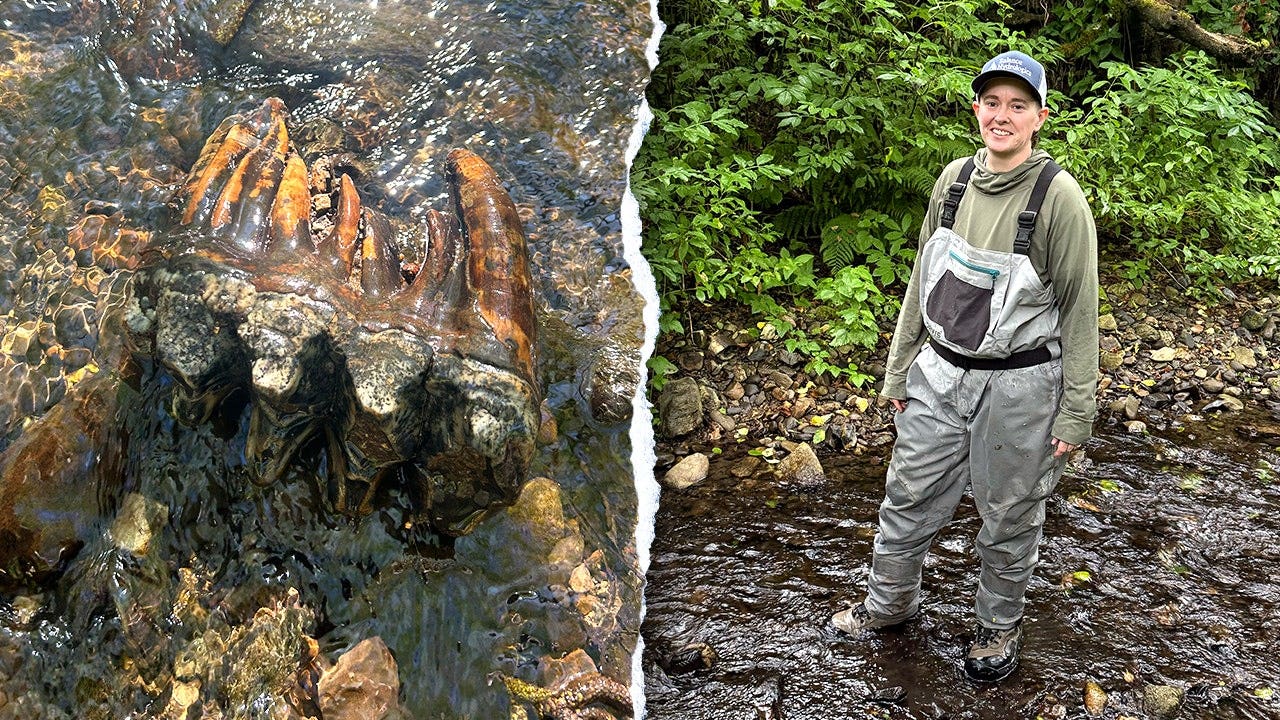
A scientist surveying a California creek recently stumbled across something unexpected: a tooth from the mouth of an Ice Age giant. asserted
scientist → survey → giant
The discovery of the tooth, which belonged to an ancient Pacific mastodon, was announced by the Midpeninsula Regional Open Space District (Midpen) in San Mateo County, California. asserted
which → belong → County
Mastodons were massive, elephant-like herbivores that went extinct roughly 11,700 years ago, near the end of the last Ice Age. asserted
that → go → Age
The tooth was found in a Midpen preserve creek by Brigid Lynch, a Balance Hydrologics geomorphologist who was surveying the area as part of an effort to improve the habitat of the threatened California red-legged frog. asserted
who → find → frog
"As a geologist, I've gone out and seen stuff in the field, but definitely nothing as exciting as this," Lynch said in a release. asserted
Lynch → go → release
Pictures of the molar show its strange shape, which Lynch initially thought was an oddly shaped rock. asserted
Lynch → show → shape
The tooth is in "immaculate condition," Wayne Thompson, CEO of Pacific Paleontology, told Fox News Digital in an interview. asserted
Thompson → tell → interview
Thompson, whose job it was to examine the fossil and assess the site where it was discovered, said the tooth likely dates back between 50,000 and 100,000 years, based on where it was found. asserted
it → examine → site
"It doesn't happen often. … asserted
It → happen → ?
"There is a lot of misinformation going around about the age of the tooth," he said. asserted
he → be → tooth
"Most of the reports out [there] are saying it's 10,000 years old, but it's not 10,000 years. asserted
it → say → reports
"From the location where the specimen was found, we can pretty confidently say that it’s much, much older than 11,700 years — probably on the order between 50 and 100,000 years," he added. asserted
he → find → order
Thompson said the condition of the tooth also offers clues about what happened to it after the mastodon died, noting that it "hadn't moved very much in the stream where the creature died." "Mastodon teeth are — the roots are extremely fragile — and this one had the majority of the roots of the molar still preserved with it intact, and so, it wasn't tumbled around in the stream," he said. asserted
he → say → stream
The paleontologist believes the rest of the animal may still be at the site. uncertain
rest → believe → site
"It probably recently came out of the skull and the skull, along with the rest of the bones, are still buried out there," he said. asserted
he → come → bones
It is "extremely rare" to find a mastodon molar in such well-preserved condition, Thompson said. " asserted
Thompson → find → condition
It doesn't happen often. ... asserted
It → happen → ?
[It's] quite uncommon," he said. asserted
he → say → ?
Looking ahead, researchers from Stanford University's Doerr School of Sustainability plan to carbon date the molar to determine its exact age. asserted
researchers → look → age
Researchers will also create a 3-D scan of the tooth, which will be used to produce a replica. asserted
which → create → replica
Thompson said mastodons favored creek and river valleys, browsing on leaves rather than grazing on grasses as mammoths did. asserted
mammoths → say → grasses
Alder trees, he said, were among their preferred food sources — and they still line the creek where the tooth was found. asserted
tooth → say → creek
"Even today, when we went out to the site to inspect where the biological monitor was surveying, there were still hundreds of alders along the stream," Thompson said. asserted
Thompson → go → stream

💬Give feedback
🕘History 🎫Support