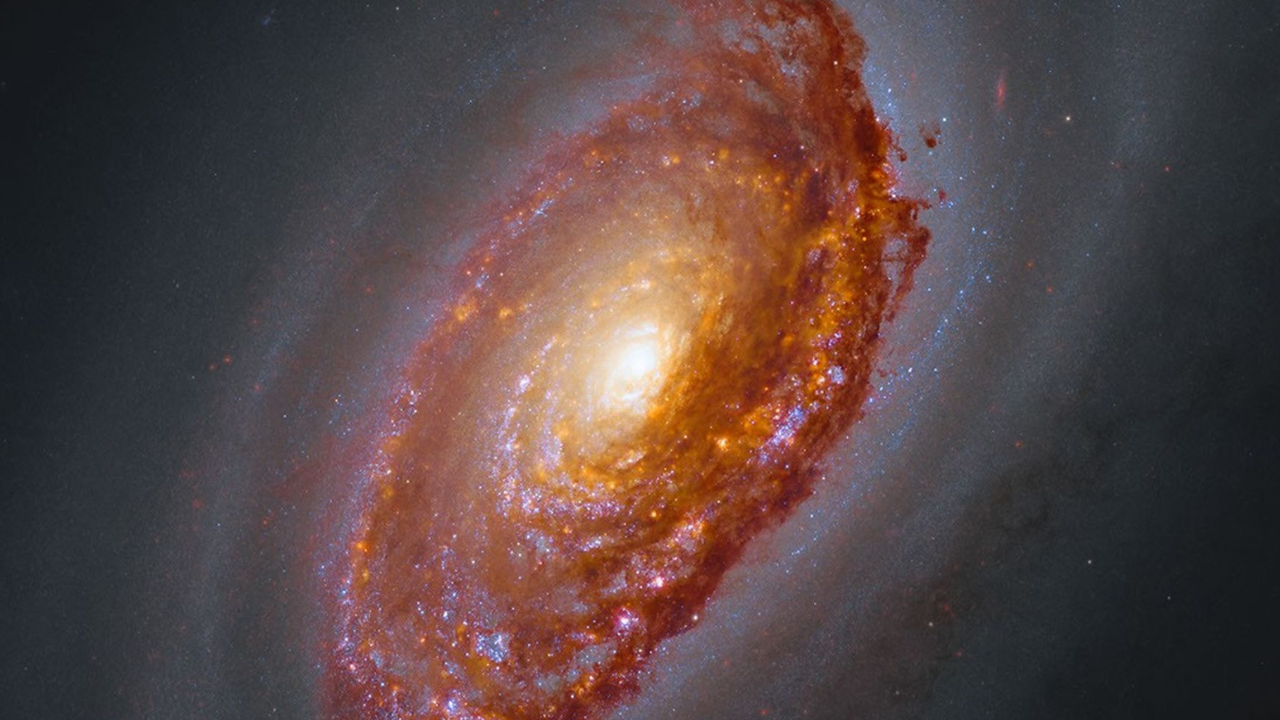
Photo via Times of India

Black Eye Galaxy Image: Webb and Hubble reveal dusty star-forming band; traces ancient merger

Read the original at Times of India ↗
Cite

TOI Science Desk. (2026, September 19). Black Eye Galaxy Image: Webb and Hubble reveal dusty star-forming band; traces ancient merger. Times of India. https://timesofindia.indiatimes.com/science/space/nasas-webb-telescope-captured-the-black-eye-galaxy-in-unprecedented-detail-its-opposing-gas-streams-reveal-a-violent-cosmic-past/articleshow/134330971.cms

Dated when The Aporia collected the article, usually within hours of publication. Check the original for its exact date and byline.

Times of India · collected 2026-09-19 · by TOI Science Desk analysis

Quick Summary

NASA's James Webb and Hubble telescopes have combined to create a new image of Messier 64, also known as the Black Eye Galaxy due to its distinctive dark dust band. Located about 17 million light-years away in the constellation Coma Berenices, M64 is unusual because it has gas rotating in opposite directions within different parts of the galaxy, suggesting an ancient merger with a smaller satellite galaxy over a billion years ago. The composite image reveals active star formation where these two gas systems interact, providing insights into the galaxy's complex history and evolution.
Written by AI on 2026-09-19, from this article's own text only (the story summary below draws on all the coverage).

AI analysis

Story summary

The Black Eye Galaxy, officially named Messier 64 (M64), located roughly 17 million light-years from Earth in the constellation Coma Berenices, displays an unusual internal motion: gas in its outer regions rotates opposite to that of gas and stars near its center. NASA suggests this counter-rotation is a remnant from a merger with a smaller satellite galaxy more than a billion years ago. A new composite image combining observations from both the James Webb Space Telescope and the Hubble Space Telescope reveals details about M64's dusty regions that Hubble alone could not capture, thanks to Webb’s Mid-Infrared Instrument (MIRI), which allows for better detection of radiation associated with dust and young stars.

Written for “Black Eye Galaxy Revealed” on 2026-11-04, grounded in this article and the 0 other(s) covering the same event.

Story

📰 Black Eye Galaxy Revealed
Science · 1 article(s) covering the same event.

Compared with similar articles

Nothing to compare against. No article is close enough to this one for the pipeline to have linked or judged the pair.
How this article was measured signals, leaning charts, publisher record, byline, topics and claims

Signals How these are calculated →

Claims extracted
30
sentences that state something as happening or true
Uncertain
13%
4 of 30 hedged ("reportedly", "may", "according to")
Leaning
not political
takes no side on a contested political question
Publisher signals
59/100
Times of India's corrections and hedging, across everything collected from it. Not a measure of accuracy.
Outlets on this story
1
Science
Same framing elsewhere
1
articles that frame the event the way this one does
Analyzed 2026-09-19 · how these are computed

How this is being covered How these are calculated →

Article leaning vs. publisher reliability
Source leaning vs. consistency

Publisher

Times of India · 4052 article(s) · 4 correction(s) detected
Running correction rate · 4 correction(s)

Who wrote this

TOI Science Desk
308 article(s) here · 1 carrying a prediction
🔮 Researchers are continuing to examine daily measurements to determine whether temperatures will climb further.
🔮 According to Reuters reporting by Will Dunham, a new study published in the journal Spixiana documents more than 90 Bangka slow lorises identified between 2015 and 2025.
🔮 “Normally, my job is quite monotonous, so I wanted to create something that would entertain people, turning my ‘serious’ job into something fun,” he said in a Guinness World Records news release.
🔮 The subsequent collision between the two galaxy clusters may then have compressed the cloud or re-energised its particles, causing it to shine more brightly in radio wavelengths once again.
🔮 The mathematicians at the University of California, Davis, argue that the answer may already lie within Einstein’s own equations and that an invisible form of energy may not be needed at all.
🔮 The work will be carried out by the West Tennessee River Basin Authority, which is preparing a plan to restore the river and the land around it.
🔮 Cornell University scientists have developed genetically engineered tomato plants that turn red-purple when nitrogen becomes scarce, giving farmers a visible warning that crops may need fertiliser.
🔮 By studying these crystals and other mineral grains, scientists could establish the meteorite's age and identify later changes caused by water.
🔮 Centuries later, bronze objects found in Scandinavia would preserve chemical signatures consistent with the metals produced at this Spanish site, offering evidence of connections that may have crossed much of Europe.
🔮 Deposited impurities and staining may also have contributed, while low temperatures and humidity could cause the fabric to crack.
Wire or desk byline, not an individual reporter.
Also by TOI Science Desk
Nothing else under this byline is closely related to this article, so these are simply their most recent.
All 308 articles by TOI Science Desk →

Topics

NASA Webb

Subjects

NASA ORG · 5× Webb PERSON · 2×

Narrative

Located roughly 17 million light-years from Earth in the constellation Coma Berenices, M64 is known for an unusual internal motion: gas in its outer regions rotates in the opposite direction to the gas and stars closer to the centre.
framing: assertive · carried by 1 article(s) · first seen 2026-09-19
🔮 NASA says this counter-rotation may be a remnant of a merger involving M64 and a smaller satellite galaxy more than a billion years ago.

Claims (30 extracted, 4 hedged)

At first glance, Messier 64 looks like a classic spiral galaxy. asserted
Messier → look → galaxy
Its bright centre is wrapped in sweeping arms, while a broad, dark band of dust cuts across one side of its nucleus, giving it the distinctive appearance that earned it the nickname Black Eye Galaxy. asserted
that → wrap → nickname
But beneath that familiar spiral shape lies something much stranger. asserted
something → lie → shape
Located roughly 17 million light-years from Earth in the constellation Coma Berenices, M64 is known for an unusual internal motion: gas in its outer regions rotates in the opposite direction to the gas and stars closer to the centre. asserted
gas → locate → centre
NASA says this counter-rotation may be a remnant of a merger involving M64 and a smaller satellite galaxy more than a billion years ago. uncertain
rotation → say → M64
Webb sees what Hubble could not The new composite image combines observations from the James Webb Space Telescope and Hubble Space Telescope, allowing astronomers to examine M64 across different wavelengths. Webb’s Mid-Infrared Instrument, or MIRI, is particularly useful for studying the galaxy’s dusty regions. uncertain
Instrument → see → regions
While the dust can appear dark in visible-light observations, infrared wavelengths allow Webb to detect radiation associated with the dust and the young stars embedded within it. asserted
Webb → appear → it
NASA’s APOD description notes that MIRI reveals the dust in red, while Hubble’s observations show pink regions associated with active star formation. asserted
observations → note → formation
That difference is important because the dark band that gives M64 its name is not simply an empty, shadowy region. asserted
that → give → name
It contains material involved in the ongoing process of forming new stars. asserted
It → contain → stars
Two gas streams moving against each other The galaxy’s most intriguing feature is its opposing gas motion. asserted
feature → move → other
The gas closer to M64’s centre rotates in one direction, while gas farther out rotates in the opposite direction. asserted
gas → rotate → direction
Where these two systems interact, the gas can collide and become compressed. asserted
gas → interact → ?
That compression helps trigger the collapse of gas clouds, creating conditions favourable for new stars to form. asserted
stars → help → conditions
This makes M64 something of a cosmic record of its own past. asserted
M64 → make → past
The opposing motion is thought to have originated when a smaller galaxy interacted with and was eventually absorbed by M64. asserted
galaxy → oppose → M64
Astronomers have studied this unusual behaviour for decades. asserted
Astronomers → study → decades
NASA’s earlier Hubble observations found that the outer gas extends much farther from the centre and rotates in the opposite direction, while regions where the gas systems meet show evidence of active star formation. asserted
systems → find → formation
A merger hidden inside a beautiful spiral The idea that a spiral galaxy could have undergone such a dramatic merger was significant in the study of M64. uncertain
galaxy → hide → M64
Rather than being a completely settled system, the galaxy preserves traces of an ancient encounter in the movement of its gas. asserted
galaxy → settle → gas
NASA notes that M64 became important evidence that spiral galaxies can experience mergers, challenging the older assumption that their histories were comparatively peaceful. asserted
histories → note → assumption
The smaller galaxy involved in the event is no longer an obvious separate object. asserted
galaxy → involve → event
Instead, evidence of the encounter remains embedded in M64’s unusual gas dynamics. asserted
evidence → embed → dynamics
Why Webb’s view matters The new Webb observations are not simply about producing a more detailed-looking photograph. asserted
observations → matter → photograph
Infrared observations allow astronomers to study the structure, composition and behaviour of dust that is difficult to see in visible wavelengths. asserted
that → allow → wavelengths
Combined with Hubble’s view, the observations provide a broader picture of how dust and star-forming regions are distributed throughout M64. asserted
dust → combine → M64
NASA says the Webb data will help researchers better understand the galaxy’s dust and provide additional context for reconstructing its merger history and evolution. asserted
researchers → say → history
For a galaxy some 17 million light-years away, its appearance may seem frozen in time. uncertain
appearance → seem → time
Yet the Black Eye Galaxy is effectively carrying the evidence of an ancient cosmic collision within it. asserted
Galaxy → carry → it
What looks like a dark streak across a beautiful spiral is part of a much larger story involving two streams of gas, newly forming stars and a merger that happened more than a billion years ago. asserted
that → look → gas

💬Give feedback
🕘History 🎫Support