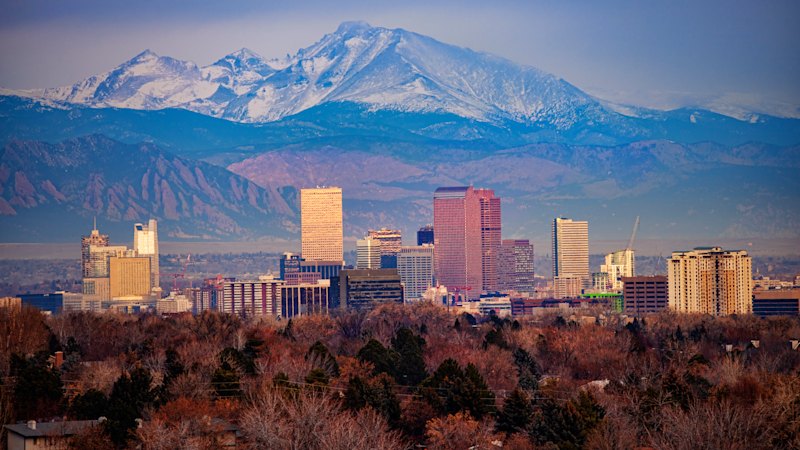
From the rooftop terrace of tapas bar El Five, Denver appears to be showing off.
asserted
Denver → appear → Five
The city stretches below us in the late afternoon light, the hazy outline of the Rocky Mountains behind it, while plates of Spanish and other Mediterranean food arrive at the table and the bar fills with people.
asserted
bar → stretch → people
It is not quite the Denver I had pictured.
asserted
I → picture → ?
Nor, apparently, do my family and I look like visitors.
asserted
family → look → visitors
For reasons I can’t quite understand, people keep assuming we’re residents.
asserted
we → understand → reasons
This seems unlikely given we are travelling with two children and hardly moving through the city with the confidence of locals.
asserted
we → seem → locals
Yet, the questions keep coming: which neighbourhood are you in?
asserted
you → come → neighbourhood
How long have you lived here?
asserted
you → live → ?
Perhaps it is because Denver doesn’t seem particularly interested in defining what belongs here.
asserted
what → seem → ?
From El Five’s perch in the neighbourhood known as LoHi (its full name is Lower Highlands), the city feels young, energetic and decidedly urban, yet the mountains remain on the horizon.
asserted
mountains → know → horizon
At street level, the layers become easier to see.
asserted
layers → become → level
I’d already noticed Denver’s fondness for spacious communal spaces.
asserted
I → notice → spaces
In the public areas of The Maven Hotel, and in the Dairy Block and Union Station precincts, there are sofas and armchairs occupied by people who may be hotel guests or train passengers, but are just as likely neither.
uncertain
who → be → people
Like oversized public living rooms these are spaces where the people of Denver work, meet friends, drink coffee or just sit.
asserted
people → work → coffee
We’re staying at the 172-room Maven, where the lobby flows into the surrounding restaurants, bars, shops and laneways while showing off more than 700 works by Colorado artists.
asserted
lobby → stay → artists
Our room feels part loft, part gallery; downstairs, for instance, coffee is served from an Airstream.
asserted
coffee → feel → Airstream
The hotel is playful and fun, but what I like most is that it feels like part of the neighbourhood.
asserted
it → like → neighbourhood
Buildings that double as public gathering places feel almost like the norm here.
asserted
that → double → norm
A few blocks away, the beaux-arts Union Station has been greeting people since 1914 (and there’s been a station on this site since 1881).
asserted
Station → greet → 1881
But Denver’s relationship with the railways has long been complicated.
asserted
relationship → complicate → railways
The city began in 1858 as a gold-rush settlement, but when gold exploration moved into the mountains, it reinvented itself as a supply town.
asserted
it → begin → town
Then, in a major blow, the transcontinental railway bypassed Denver, causing Union Pacific railway vice president Thomas Durant to declare Denver “too dead to bury” in 1867.
asserted
Denver → bypass → 1867
The settlement’s businessmen responded by raising the money to build a railway spur to Cheyenne, connecting Denver to the national rail network.
asserted
businessmen → respond → network
Union Station followed, helping to turn Denver into the commercial hub of the region.
asserted
Station → follow → region
You can still read that history in the streets of LoDo (Lower Downtown), the neighbourhood surrounding the station.
asserted
You → read → station
Walking through it, I notice unusually high restaurant terraces built into old brick warehouses.
asserted
I → walk → warehouses
These look like a design flourish, but they’re not; the platforms once sat at streetcar height, allowing goods arriving by rail to be unloaded directly into the warehouses.
asserted
goods → look → warehouses
More recent Denver businesses have simply put tables and chairs on them.
asserted
businesses → put → them
This is, in a sense, the story of Denver, where many old mercantile buildings now host boutiques, bars and restaurants.
asserted
buildings → host → boutiques
Larimer Square, Denver’s oldest commercial block, is strung with lights and filled with diners, yet might not exist at all if preservationist Dana Crawford hadn’t begun buying its threatened buildings in the 1960s, when there were few mechanisms to protect them.
uncertain
Crawford → string → them
These days, the mood shifts surprisingly quickly from one neighbourhood to the next.
asserted
mood → shift → next
LoDo has its handsome warehouses and slightly rougher edges; LoHi, where we’d eaten the night before, feels younger and more polished.
asserted
we → have → warehouses
Hiking shoes turn up in good restaurants.
asserted
shoes → hike → restaurants
Kids do, too.
asserted
Kids → do → ?
Nobody appears especially bothered by either.
asserted
Nobody → appear → either
Lunchtime finds us in RiNo, as the River North Art District is known, eating at Safta inside The Source, an 1880s iron foundry turned food hall and hotel.
asserted
District → find → Source
Here the industrial backdrop continues, only louder: murals cover the facades of old factories and warehouses, while breweries, studios and restaurants have moved into the spaces behind them.
asserted
breweries → continue → them
The angular Denver Art Museum, for instance, looks almost as interesting from the outside as anything hanging within it, while there are galleries and museums scattered through the surrounding streets.
asserted
Museum → look → streets
What surprises me is how little fuss the people of Denver make about any of this.
asserted
people → surprise → this
Hiking shoes turn up in good restaurants.
asserted
shoes → hike → restaurants
…and 11 more, not listed.
 The Aporia