Photo via Times of India

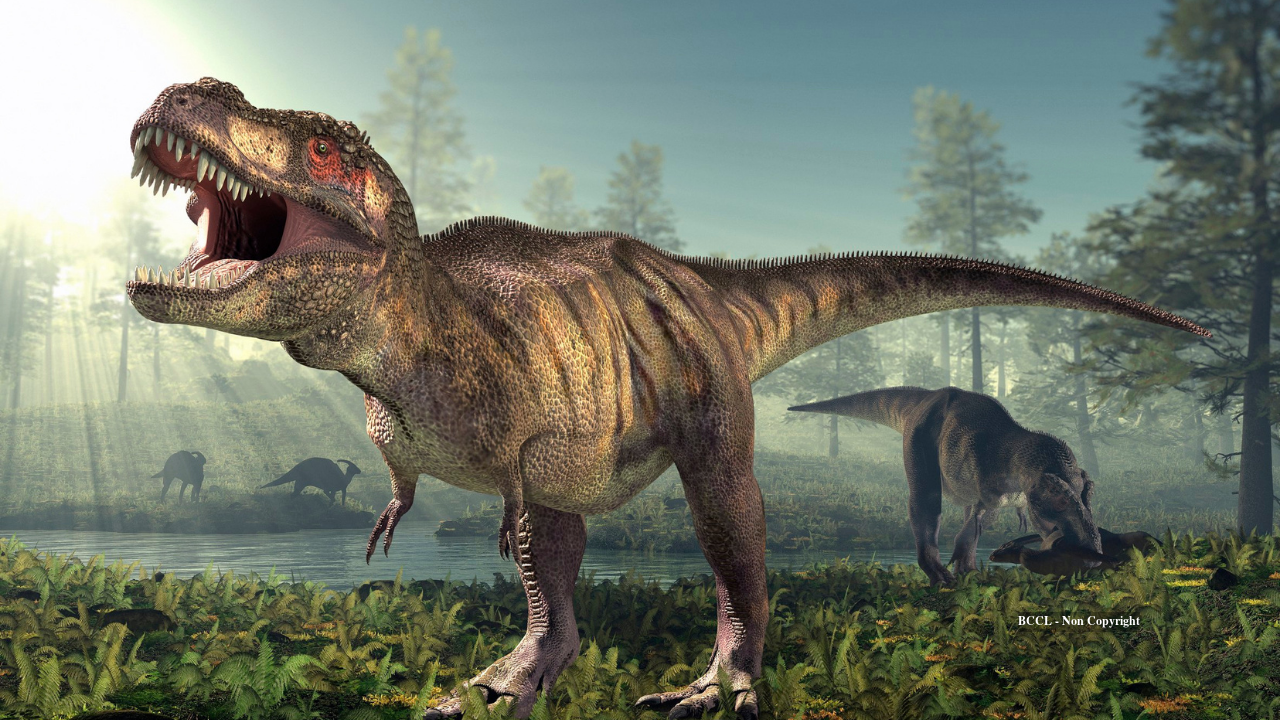
T. rex had human-like body temperature, fossil teeth reveal warm-blooded predator

Read the original at Times of India ↗
Cite

TOI Science Desk. (2026, September 19). T. rex had human-like body temperature, fossil teeth reveal warm-blooded predator. Times of India. https://timesofindia.indiatimes.com/science/archaeology/t-rex-had-a-body-temperature-of-36-3c-almost-the-same-as-humans-fossil-tooth-chemistry-reveals-the-66-million-year-old-predator-was-warm-blooded-and-could-survive-in-cold-climates/articleshow/134337176.cms

Dated when The Aporia collected the article, usually within hours of publication. Check the original for its exact date and byline.

Times of India · collected 2026-09-19 · by TOI Science Desk

Quick Summary

Scientists have determined that Tyrannosaurus rex had an average body temperature of about 36.3°C (97.3°F) using clumped isotope analysis on fossilized teeth, indicating it was warm-blooded like humans and elephants. This study, published in Science Advances, suggests T. rex could maintain a high metabolism across various climates, supporting theories that it was an active predator capable of thriving in diverse environments from ancient floodplains to cooler regions. The research challenges previous views by providing direct evidence of the dinosaur’s core temperature through chemical signals preserved in tooth enamel.
Written by AI on 2026-09-19, from this article's own text only (the story summary below draws on all the coverage).

AI analysis

Story summary

Scientists have successfully measured the body temperature of Tyrannosaurus rex using fossilized teeth, revealing it to be around 36.3°C (97.3°F), similar to humans and modern warm-blooded animals like elephants. Researchers at UCLA used a technique called clumped isotope analysis, which examines how heavy isotopes of carbon and oxygen bond within the tooth enamel based on body temperature. This method provides direct evidence that T. rex was likely warm-blooded, capable of high-energy predatory behavior across various climates, from ancient floodplains to cooler regions. The study, published in Science Advances, confirms previous theories suggesting that dinosaurs like T. rex were not cold-blooded and sluggish but instead had the ability to control their body temperature.

Written for “T Rex Body Temperature Revealed” on 2026-11-03, grounded in this article and the 2 other(s) covering the same event.

Story

📰 T Rex Body Temperature Revealed
Science · 3 article(s) covering the same event. Compare every outlet's account →

Compared with similar articles

This article reads unscored and hedges 11% of its claims. Each row says how that neighbour differs.
CBC News
Hedges 7 of 26 claims Outlet record 60/100
New York Post
Hedges 7 of 21 claims Outlet record 66/100
How this article was measured signals, leaning charts, publisher record, byline, topics and claims

Signals How these are calculated →

Claims extracted
27
sentences that state something as happening or true
Uncertain
11%
3 of 27 hedged ("reportedly", "may", "according to")
Leaning
not political
takes no side on a contested political question
Publisher signals
59/100
Times of India's corrections and hedging, across everything collected from it. Not a measure of accuracy.
Outlets on this story
3
Science
Same framing elsewhere
1
articles that frame the event the way this one does
Analyzed 2026-09-19 · how these are computed

How this is being covered How these are calculated →

Article leaning vs. publisher reliability
Source leaning vs. consistency

Publisher

Times of India · 4006 article(s) · 4 correction(s) detected
Running correction rate · 4 correction(s)

Who wrote this

TOI Science Desk
308 article(s) here · 1 carrying a prediction
🔮 Researchers are continuing to examine daily measurements to determine whether temperatures will climb further.
🔮 According to Reuters reporting by Will Dunham, a new study published in the journal Spixiana documents more than 90 Bangka slow lorises identified between 2015 and 2025.
🔮 “Normally, my job is quite monotonous, so I wanted to create something that would entertain people, turning my ‘serious’ job into something fun,” he said in a Guinness World Records news release.
🔮 The subsequent collision between the two galaxy clusters may then have compressed the cloud or re-energised its particles, causing it to shine more brightly in radio wavelengths once again.
🔮 The mathematicians at the University of California, Davis, argue that the answer may already lie within Einstein’s own equations and that an invisible form of energy may not be needed at all.
🔮 The work will be carried out by the West Tennessee River Basin Authority, which is preparing a plan to restore the river and the land around it.
🔮 Cornell University scientists have developed genetically engineered tomato plants that turn red-purple when nitrogen becomes scarce, giving farmers a visible warning that crops may need fertiliser.
🔮 By studying these crystals and other mineral grains, scientists could establish the meteorite's age and identify later changes caused by water.
🔮 Centuries later, bronze objects found in Scandinavia would preserve chemical signatures consistent with the metals produced at this Spanish site, offering evidence of connections that may have crossed much of Europe.
🔮 Deposited impurities and staining may also have contributed, while low temperatures and humidity could cause the fabric to crack.
Wire or desk byline, not an individual reporter.
Also by TOI Science Desk
Nothing else under this byline is closely related to this article, so these are simply their most recent.
All 308 articles by TOI Science Desk →

Topics

Alaska Los Angeles County Montana Science Advances the Natural History Museum

Subjects

Alaska GPE · 1× Jasmina Wiemann PERSON · 1× Johns Hopkins University ORG · 1× Los Angeles County GPE · 1× Montana ORG · 1× Science Advances ORG · 1× Thomas PERSON · 1× the Natural History Museum ORG · 1×

Narrative

The research, published in Science Advances, offers one of the first direct measurements of an extinct animal’s core temperature and strengthens the case that T. rex was a warm-blooded, high-energy predator capable of thriving across diverse climates, from ancient floodplains to cooler high-latitude regions.
framing: assertive · carried by 1 article(s) · first seen 2026-09-19
🔮 By drilling out a few milligrams of enamel from three T. rex teeth and measuring the abundance of these isotope pairs, researchers could calculate the temperature at which the enamel formed, effectively using the tooth as a fossil thermometer.

Claims (27 extracted, 3 hedged)

For 66 million years, the body temperature of Tyrannosaurus rex (T.rex) lived only in speculation. asserted
temperature → live → speculation
Now, a new study has taken the dinosaur’s temperature using chemistry locked inside its fossilised teeth, finding an average of about 36.3°C (97.3°F), strikingly close to the human norm. asserted
study → take → norm
The research, published in Science Advances, offers one of the first direct measurements of an extinct animal’s core temperature and strengthens the case that T. rex was a warm-blooded, high-energy predator capable of thriving across diverse climates, from ancient floodplains to cooler high-latitude regions. asserted
rex → publish → regions
A thermometer hidden in tooth enamelThe breakthrough rests on a technique called clumped isotope analysis, which reads temperature signals preserved in the enamel of growing teeth. asserted
which → hide → teeth
Inside enamel, rare heavy isotopes of carbon and oxygen form chemical bonds with one another at rates that depend on body heat. asserted
that → form → heat
Cooler temperatures produce more of these bonds, while warmer temperatures produce fewer. asserted
temperatures → produce → fewer
By drilling out a few milligrams of enamel from three T. rex teeth and measuring the abundance of these isotope pairs, researchers could calculate the temperature at which the enamel formed, effectively using the tooth as a fossil thermometer. uncertain
enamel → drill → thermometer
The teeth came from a well-known T. rex specimen nicknamed Thomas, housed at the Natural History Museum of Los Angeles County, and were originally unearthed in Montana. asserted
teeth → come → Montana
Analysis indicated a body temperature of 97.3°F (36.3°C), with a margin of error of about 2.5°C. asserted
Analysis → indicate → C
That places the king of dinosaurs in the same thermal neighbourhood as modern humans and elephants, and firmly within the range of warm-blooded, or endothermic, animals. asserted
That → place → animals
What this says about how T. rex livedA stable, human-like body temperature reshapes how we imagine T. rex moving through its world. asserted
rex → say → world
Rather than a sluggish, sun-basking reptile, the animal likely maintained a high, steady metabolism that supported fast growth, sustained activity and powerful bursts of hunting or scavenging. asserted
that → bask → hunting
Warm-blooded physiology would have allowed T. rex to remain active across a wide span of environmental conditions, including cooler regions such as parts of ancient Alaska, where other dinosaur fossils suggest some species endured long, dark winters. asserted
species → allow → winters
The temperature reading also helps explain the predator’s ecological dominance. asserted
reading → help → dominance
Maintaining an internal thermostat near 36°C means T. rex could have ranged across much of prehistoric North America without being constrained by external heat sources, expanding its hunting grounds and prey options. uncertain
rex → maintain → grounds
At the same time, such a metabolism would have demanded substantial food intake, fitting with estimates that adult T. rex needed large quantities of meat to fuel its massive body. asserted
rex → demand → body
Why the number surprised some scientistsWhile many researchers already suspected T. rex was warm-blooded, the precise figure was not a given. asserted
figure → surprise → scientistsWhile
Some paleobiologists expected a higher temperature, closer to that of modern birds, which are living descendants of dinosaurs and often run several degrees hotter than mammals. asserted
which → expect → mammals
The new result suggests T. rex occupied a middle ground, warmer than cold-blooded reptiles like crocodiles but cooler than many birds, aligning more closely with large mammals such as elephants. uncertain
rex → suggest → elephants
This does not settle every debate about dinosaur metabolism, but it provides a concrete data point where there was once only inference from bone structure, growth rates and ecological modelling. asserted
it → settle → structure
Jasmina Wiemann, a paleobiologist at Johns Hopkins University who was not involved in the study, noted that the method opens the door to measuring temperatures in other charismatic species, potentially rewriting chapters of dinosaur biology one tooth at a time. asserted
method → involve → time
finding also nudges long-standing ideas about why some animals survived the asteroid impact that ended the Cretaceous period. asserted
that → nudge → period
If T. rex and other large dinosaurs were already warm-blooded, their extinction cannot be simply blamed on an inability to cope with cold or darkness after the impact. asserted
extinction → blame → impact
Instead, factors such as ecosystem collapse, food-web disruption and the sheer scale of the catastrophe likely played larger roles in their demise, while smaller, more flexible endotherms such as early mammals found niches to persist. asserted
endotherms → play → niches
study showcases how advances in geochemistry are turning fossils into archives of physiology, not just shape. asserted
advances → showcase → physiology
Clumped isotope analysis has been refined over the past decade to improve accuracy and reduce the amount of material needed, making it feasible to sample precious specimens like T. rex teeth without causing major damage. asserted
it → refine → damage
As the technique is applied to more dinosaurs, from giant sauropods to small feathered theropods, scientists expect to build a thermal map of the Mesozoic, revealing which lineages ran hot, which ran cool, and how metabolism influenced evolution. asserted
metabolism → apply → evolution

💬Give feedback
🕘History 🎫Support